
What Is a Training Content Strategy?

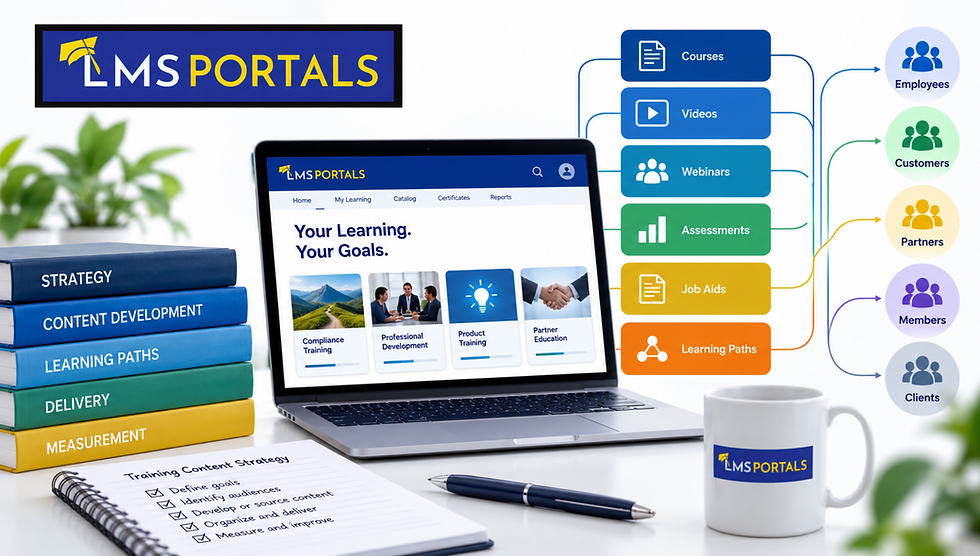
Organizations often invest heavily in training without having a clear strategy for the content behind it. Courses are purchased as needs arise, subject-matter experts create materials independently, compliance programs operate on separate schedules, and new learning resources accumulate over time.
The result may be a large amount of training content without a cohesive training program.
A training content strategy provides the framework for deciding what learning content an organization needs, who needs it, how it should be created or sourced, how it will be delivered, and how its effectiveness will be measured over time.
For organizations managing employees, customers, partners, members, or other audiences, a content strategy can also help prevent duplication, improve consistency, control costs, and make training easier to scale.
The learning management system (LMS) plays an important role in putting that strategy into practice. A flexible LMS can provide the infrastructure needed to organize content, deliver it to different audiences, maintain training records, and understand how learning resources are actually being used.
What Is a Training Content Strategy?
A training content strategy is a structured plan for creating, acquiring, organizing, delivering, maintaining, and evaluating learning content.
It connects training content to organizational objectives rather than treating individual courses as isolated resources.
Training Content Is More Than Courses
When organizations think about training content, they often think primarily about eLearning courses.
Courses are important, but a modern training content strategy can include many different learning resources, such as:
Videos
Documents and reference materials
Assessments and quizzes
Webinars
Instructor-led training
Interactive coaching
Recorded presentations
Certifications
Learning paths
Job aids and performance-support resources
The goal is not simply to accumulate more content. It is to determine which combination of resources best supports each training requirement.
Content Strategy Connects Learning to Business Needs
Every training resource should ideally exist for a reason.
An organization might need training to improve employee performance, meet regulatory requirements, onboard customers, educate partners, reduce operational risk, develop managers, or support a new product.
A content strategy starts with those objectives and works backward to determine what training should be provided.
That is a very different approach from simply asking, "What courses should we buy?"
Why Is a Training Content Strategy Important?
As organizations grow, their training requirements tend to become more complex.
Different departments may develop their own programs. Compliance teams may purchase specialized courses. Human resources may create onboarding materials.
Sales teams may need product training. Customers and partners may require entirely different learning experiences.
Without a strategy, training content can quickly become fragmented.
It Reduces Content Duplication
Multiple departments may unknowingly create or purchase training covering similar subjects.
For example, HR might purchase a workplace communication course while a leadership team independently develops similar material for managers.
A centralized content strategy provides visibility into existing resources before additional content is commissioned.
It Improves Training Consistency
Training content communicates more than information. It can also communicate policies, processes, expectations, brand standards, and organizational values.
When content is developed independently without common standards, learners may receive inconsistent information.
A content strategy establishes guidelines for how training should be developed and maintained.
It Helps Control Training Costs
Training budgets can be wasted when organizations purchase courses that are rarely used or develop custom programs where existing content would have been sufficient.
A strategy helps organizations decide where investment is most valuable.
What Should a Training Content Strategy Include?
There is no single content strategy that works for every organization, but several components should generally be considered.
Training Audiences
The first step is identifying who needs training.
This could include employees, managers, contractors, customers, partners, distributors, franchisees, members, volunteers, or clients.
Different audiences often have different learning objectives.
An employee might need mandatory cybersecurity training, while a customer needs instruction on how to use a product. A reseller may need sales certification, while a manager needs leadership development.
Clearly defining audiences makes it easier to build appropriate training programs.
Learning Objectives
Each training initiative should have an identifiable objective.
For example:
Employee onboarding: Help new hires understand policies, systems, responsibilities, and organizational expectations.
Compliance training: Demonstrate that required training has been delivered and completed.
Customer education: Help customers use products successfully and achieve value more quickly.
Partner training: Ensure distributors, resellers, or other partners understand products, processes, and brand expectations.
Professional development: Build skills that support employee growth and organizational capabilities.
Learning objectives help determine what content is actually required.
Should You Build or Buy Training Content?
One of the most important content strategy decisions is determining which courses should be created internally and which should be purchased.
The answer is usually a combination of both.
When Off-the-Shelf Training Makes Sense
Many training subjects are relatively standardized.
Examples can include workplace safety, cybersecurity awareness, harassment prevention, communication skills, time management, and general leadership development.
Organizations may be able to purchase high-quality course libraries covering these topics more efficiently than developing them internally.
When Custom eLearning Makes Sense
Custom training becomes more valuable when the subject matter is unique to the organization.
Examples might include:
Proprietary products
Internal processes
Company policies
Specialized compliance requirements
Customer onboarding
Technical procedures
Brand standards
Organization-specific sales processes
Custom eLearning allows the organization to build training around its actual workflows, terminology, scenarios, and objectives.
When Existing Materials Can Be Repurposed
Organizations frequently already possess valuable training material.
Presentations, manuals, recorded webinars, policies, documentation, and instructor-led programs may be transformed into digital learning experiences.
A content strategy should therefore begin with an inventory of existing resources before new content is purchased or developed.
How Should Training Content Be Organized?
Content organization becomes increasingly important as the training library grows.
Uploading hundreds of courses into an LMS without a structure can make training difficult for both administrators and learners.
Create Logical Categories
Courses can be organized around subjects such as:
Leadership
Sales
Product Training
Customer Education
Professional Development
Safety
Onboarding
Technical Skills
Organizations with specialized requirements may create additional categories based on departments, roles, industries, products, or certifications.
Build Learning Paths
Individual courses are often more valuable when they form part of a structured learning journey.
A new manager, for example, might complete a learning path consisting of:
Introduction to Management
Communication and Feedback
Performance Management
Conflict Resolution
Coaching Employees
Leadership Assessment
This provides learners with direction instead of presenting them with an unstructured catalog.
Consider the Learner Experience
Content organization should reflect how learners actually search for and consume training.
The best taxonomy from an administrator's perspective is not always the most intuitive structure for learners.
Content should be easy to locate, understand, and begin.
How Do You Manage Training Content for Multiple Audiences?
This becomes particularly important for organizations delivering training beyond their internal workforce.
A company may need to provide different training programs to employees, customers, partners, clients, or members.
A training provider might have dozens or even hundreds of separate customer organizations.
Separate Audiences Without Duplicating Everything
Creating a completely separate LMS for every audience can produce unnecessary administrative work.
Instead, a multi-portal LMS architecture can provide distinct learning environments while allowing training operations to be centrally managed.
Each portal can have its own users, administrators, courses, branding, and learning programs.
Reuse Content Where Appropriate
The same course may be useful across several audiences.
For example, a software company might use the same product fundamentals course for employees, customers, and channel partners while providing different advanced content to each group.
A content strategy should identify opportunities to reuse learning assets rather than repeatedly recreating them.
Personalize Where It Matters
Reuse does not mean every learner should receive an identical experience.
Different audiences can receive unique combinations of shared and specialized content.
This allows organizations to balance efficiency with personalization.
How Does an LMS Support a Training Content Strategy?
A content strategy describes what the organization wants to accomplish. The LMS provides the operational infrastructure needed to execute that strategy.
Centralized Content Management
An LMS provides a centralized location for managing courses and other learning resources.
Administrators can organize content, assign training, manage users, and monitor activity without relying on disconnected systems and spreadsheets.
SCORM-Compliant Course Delivery
SCORM remains an important standard for packaged eLearning content.
Using a SCORM-compliant LMS allows organizations to deliver courses created with compatible authoring tools or acquired from third-party content providers while tracking learner activity and completion.
This also helps organizations avoid unnecessarily tying their content strategy to a single course-development vendor.
Training Records and Reporting
A content strategy should include a plan for measuring participation and results.
An LMS can create centralized training records that show which learners were assigned training, what they completed, and when activity occurred.
This becomes particularly important for compliance, certification, customer education, and other programs where evidence of completion matters.
How Should Training Content Be Maintained?
Training content should not be treated as a permanent asset that never changes.
Information becomes outdated. Regulations change. Products evolve. Branding changes. Business processes are revised.
Establish Content Owners
Important training resources should have designated owners.
A content owner might be responsible for confirming that a course remains accurate and determining when updates are necessary.
For example, HR may own employee policy training while the product team owns customer product education.
Establish Review Cycles
Organizations can establish periodic review schedules based on the importance and volatility of the subject.
Some content may require annual review. Other courses may only need to be revisited when a policy, regulation, product, or process changes.
Retire Outdated Content
More content is not always better.
Old, redundant, or inaccurate training can create confusion and make it harder for learners to find relevant resources.
A mature training content strategy includes a process for retiring material as well as creating it.
How Do You Measure Whether a Training Content Strategy Is Working?
Course completion is useful, but it should not always be the only measure of success.
The appropriate metrics depend on the objective of the training.
Measure Learning Activity
Organizations can monitor metrics such as enrollments, course starts, completions, assessment results, certificates, and participation in live training.
These measures provide visibility into whether learners are actually engaging with the program.
Connect Training to Outcomes
Where possible, organizations should also consider business outcomes.
Customer education might be evaluated against product adoption or support requirements.
Partner training might be connected with certifications or sales readiness.
Employee development might be evaluated through competency development, performance improvement, or internal advancement.
The goal is to move from simply measuring training activity toward understanding training impact.
How LMS Portals Supports a Training Content Strategy
LMS Portals provides organizations with a flexible platform for turning a training content strategy into an operational learning environment.
Rather than managing courses, audiences, and training records through disconnected tools, organizations can centralize these activities while still providing distinct experiences for different learning audiences.
Create Dedicated Learning Portals
LMS Portals allows organizations to create branded learning portals for different audiences.
A business might create separate portals for employees, customers, partners, business units, or clients while maintaining centralized oversight.
Training companies can use the same approach to create dedicated environments for individual B2B customers.
This makes it possible to execute a broad content strategy without forcing every learner into the same learning environment.
Deliver Different Types of Training
A content strategy should not be limited to one delivery method.
LMS Portals can support self-paced online courses along with webinars and interactive coaching sessions, allowing organizations to build blended learning experiences around different training objectives.
Support SCORM and xAPI Strategies
Organizations can use standards-based learning technologies such as SCORM and xAPI as part of a broader content and learning-data strategy.
This provides greater flexibility in how learning experiences are created, delivered, and tracked.
Centralize Training Administration and Reporting
As training expands across audiences, centralized administration becomes increasingly valuable.
LMS Portals provides tools for managing users, courses, portals, training programs, and reporting from a common platform.
This can help organizations scale their training strategy without creating a separate administrative infrastructure for every audience.
Integrate Training With Other Systems
Learning rarely operates completely independently from other business processes.
LMS integrations, APIs, SSO, and automation capabilities can help connect training activity with other systems and workflows.
This becomes especially important for organizations seeking to make the LMS part of a broader technology ecosystem.
How Training Companies Can Use Content Strategy to Grow
For training companies, content strategy has a commercial dimension as well.
Courses are not simply learning resources. They can become reusable intellectual property that supports recurring revenue.
Create Repeatable Training Programs
Instead of developing every customer engagement from scratch, training providers can create structured programs that can be deployed repeatedly.
Core content can remain consistent while specific elements are customized for individual clients.
This improves delivery efficiency and makes the training business easier to scale.
Combine Content, Technology, and Services
A training provider can package multiple elements into a single customer solution:
Branded learning portal
Custom eLearning
Live training
Coaching
Administration
Reporting
Support
This creates a more comprehensive offering than simply selling courses.
With LMS Portals providing the underlying learning technology, training companies can focus on developing content, serving customers, and expanding their training services rather than building and maintaining an LMS themselves.
Build a Training Content Strategy That Can Scale
A strong training content strategy answers several fundamental questions:
Who are we training?
What do they need to learn?
Which content do we already have?
What should we purchase?
What should we develop?
How will we deliver it?
How will we maintain it?
And how will we know whether it is working?
Answering these questions creates a foundation for a more deliberate training program.
Technology then makes that strategy operational.
For organizations managing multiple audiences—and for training companies serving multiple customers—LMS Portals provides a centralized, multi-portal environment for delivering courses, managing users, supporting live learning, maintaining training records, and measuring activity.
The objective of a training content strategy is ultimately not to create the largest possible course library.
It is to ensure that the right content reaches the right learners, in the right environment, at the right time—and contributes to a measurable training or business objective.
About LMS Portals
At LMS Portals, we provide our clients and partners with a mobile-responsive, SaaS-based, multi-tenant learning management system that allows you to launch a dedicated training environment (a portal) for each of your unique audiences.
The system includes built-in, SCORM-compliant rapid course development software that provides a drag and drop engine to enable most anyone to build engaging courses quickly and easily.
We also offer a complete library of ready-made courses, covering most every aspect of corporate training and employee development.
If you choose to, you can create Learning Paths to deliver courses in a logical progression and add structure to your training program. The system also supports Virtual Instructor-Led Training (VILT) and provides tools for social learning.
Together, these features make LMS Portals the ideal SaaS-based eLearning platform for our clients and our Reseller partners.
Contact us today to get started or visit our Partner Program pages


Comments