
Why Modular Design Works Better for Regulatory Training


Regulatory training sits in a category of its own. It is mandatory, measurable, and often high stakes. Most organizations treat it as a necessary process they must manage rather than something they want to manage. That makes efficiency, clarity, and repeatability the core pillars of a strong compliance program.
Over the last decade, the shift toward modular training design has accelerated because it meets these goals far better than long, linear courses ever could.
Modular design breaks training into focused, self contained units. These units can then be arranged, updated, or combined to meet different regulatory requirements without rebuilding an entire curriculum. When rules change, the organization can swap one module for another instead of rewriting everything from scratch. When different audiences require different versions of the same content, modular design solves that problem too.
This article explains why modular design is a better approach for regulatory learning, how it strengthens compliance culture, and where LMS Portals fits into the picture through custom SCORM course development and a purpose built multi tenant LMS with embedded compliance management.
1. The Pressure of Regulatory Training Today
Any organization that works in a regulated industry faces constant pressure to keep employees up to date. Healthcare, financial services, manufacturing, energy, and many other sectors operate under rules that evolve with new risks and new technologies.
There are also broad regulatory categories that apply to almost every modern employer, such as data privacy, workplace safety, and anti harassment expectations.
The complexity is not slowing down. In fact, the pace of regulatory change has increased. Laws are updated more often. Guidance from oversight bodies is refined more frequently. Risks identified in audits trigger new obligations. The average compliance officer is now managing more training cycles than ever before.
Traditional approaches struggle under these conditions. When training is built as one long, monolithic course, even small changes force substantial rework. Organizations also end up repeating the same content across different courses because each course must stand on its own. This wastes time and increases the chance of outdated information making its way into employee workflows.
Modular design offers a sustainable path out of this cycle.
2. What Modular Design Means in Practice
Modular training design splits knowledge into independent, reusable elements. Each module focuses on a single topic or requirement. For example, a data privacy course might contain separate modules for consent handling, data retention, breach reporting, and regional differences in compliance laws. A workplace safety program might divide content into hazard identification, incident reporting, equipment usage, and emergency procedures.
A module is short, targeted, and easy to consume. It includes only what learners need to understand that topic, not a series of loosely connected themes. Courses are then built by assembling these modules in the required order.
This simple shift creates major advantages.
3. Why Modular Design Works Better for Regulatory Training
A. Faster Response to Regulatory Change
The most important reason modular design thrives in compliance work is speed. When a rule changes, you only update the module tied to that specific rule. There is no need to rebuild or redistribute an entire course.
This minimizes downtime and ensures that staff always receive accurate guidance. Compliance teams can maintain a living training ecosystem that adapts quickly without overwhelming their schedules or budgets.
B. Cleaner Version Control
Regulatory audits increasingly ask for proof that training was accurate at the time learners completed it. That includes timestamped versions of content.
With modular design, version control becomes easier to track. Each module can have its own version history. Each course can link to a specific version of a module. Compliance teams know exactly what employees saw and when.
This clarity makes audits smoother and reduces risk.
C. Better Learning Outcomes
Learners digest information more effectively when it is delivered in short, focused pieces. Regulatory content can be dense and sometimes intimidating. Modular design helps reduce cognitive load by isolating key ideas. It also allows learners to revisit the exact module they struggled with rather than searching through an entire long course.
The result is higher retention, fewer mistakes in the field, and stronger companywide compliance performance.
D. Easier Personalization Across Roles and Regions
Compliance is rarely one size fits all. Different employees face different rules. A manager may require additional training not needed by a frontline team. Regional laws may require extra modules in one country but not another.
Modular design supports this variation naturally. You simply create paths that include the modules relevant to each audience. No duplication. No confusion.
E. Lower Maintenance Costs Over Time
Once a library of modules exists, maintenance becomes predictable. Instead of budgeting for periodic full scale course rework, organizations focus only on the pieces that change. This stabilizes costs and eliminates the need to rush large builds at the last minute.
Compliance teams also gain more time back. That means more proactive work, less fire fighting, and a stronger ability to monitor the true risk landscape.
4. Where SCORM Fits into Modular Design
SCORM remains a trusted standard in online learning because it ensures interoperability between authoring tools and learning platforms. For modular training, SCORM provides structure, tracking, and reliable communication with an LMS. Each module can be packaged as a SCORM object, then inserted into course pathways as needed.
However, building SCORM modules that are both compliant and instructionally strong requires specialized skill. That is where LMS Portals plays a key role.
5. What LMS Portals Offers: Custom SCORM Course Development
LMS Portals supports organizations that want to adopt or upgrade to a modular design framework by offering end to end custom SCORM course development. Our team creates modules that are:
Accurate and compliant
Built with direct reference to the regulations and standards your organization must meet.
Instructionally sound
Designed to be clear, focused, and easy for employees to understand, even when topics are technical or sensitive.
Reusable and scalable
Each SCORM module is built to stand alone, slot into learning paths, or be repurposed into different courses without rework.
Brand aligned
Visual design, tone, and structure reflect your organization’s identity and culture.
Optimized for tracking and audit readiness
SCORM packaging ensures that completion, scoring, and timestamps sync perfectly with the LMS Portals platform.
Because LMS Portals builds these modules directly into your training environment, organizations can grow their module library continuously and maintain a strong foundation for long term compliance.
6. LMS Portals Multi Tenant LMS with Embedded Compliance Management
Modular design is most effective when combined with a system that can support dynamic course assembly, strict tracking, and flexible user grouping. The LMS Portals platform was engineered for exactly this purpose.
A. True Multi-Tenant Architecture
A multi-tenant LMS allows organizations to create separate learning environments, each with its own branding, content rules, user groups, and reporting. This structure is valuable for:
Companies with multiple locations
Franchises
Managed service providers
Organizations that serve external partners
Enterprises with complex internal hierarchies
Each tenant can maintain its own compliance requirements without interfering with others. Modular courses can be shared across tenants or restricted as needed.
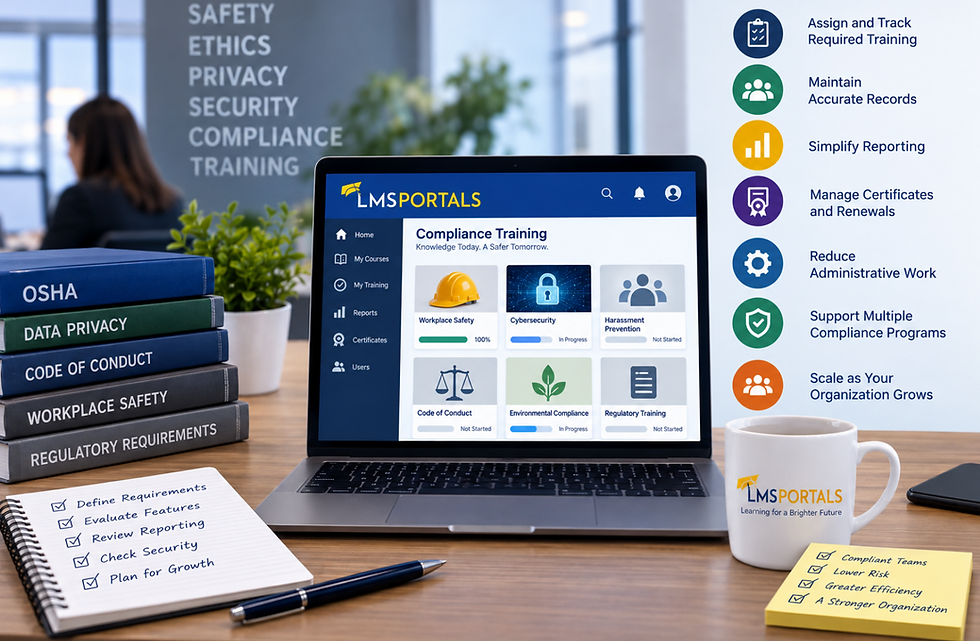
B. Built in Compliance Management Tools
LMS Portals includes a full suite of compliance features that work seamlessly with modular design:
Automated certifications
Recertification cycles
Expiration alerts
Proof of completion records
Audit ready reporting
Role based learning paths
Detailed SCORM data capture
This architecture ensures that once modules are built, the platform handles the operational tasks that keep compliance on track.
C. Flexible Course Assembly
Using LMS Portals, administrators can mix and match modules to create tailored programs for different teams. This supports global compliance strategies and eliminates the need to maintain dozens of redundant courses.
Because the system is designed with modular workflows in mind, updates cascade efficiently. When a module is revised, any course using it reflects the change instantly unless administrators choose to freeze a specific version for audit purposes.
D. Scalable for Growing Compliance Programs
As regulations evolve and organizations expand, LMS Portals grows with them. The platform makes it easy to add tenants, build new modules, and roll out updated requirements without disrupting existing learning programs.
7. How Modular Design Strengthens Compliance Culture
Although modular design makes training easier for administrators, its real value lies in how it improves employee engagement. Compliance is stronger when employees feel equipped and confident rather than overwhelmed. Modular programs support this by bringing several cultural benefits:
Clarity
Short modules reduce confusion and help employees focus on what matters.
Consistency
Everyone sees the same content for the same requirement, no matter their location.
Accountability
Clear audit trails show who has completed what, which encourages timely participation.
Transparency
Employees understand the purpose behind each training unit instead of seeing a long, unfocused course.
Continuous improvement
Updated modules show that the organization is committed to staying current and protecting staff, customers, and stakeholders.
A strong compliance culture lowers risk, improves operational performance, and builds trust throughout the organization.
8. A Practical Example: Modular Design in a Regulated Organization
Imagine a financial services firm with offices in three countries. Some regulations overlap, but others differ by region. New rules related to fraud reporting are introduced in one country, while data privacy updates affect all employees globally.
With a modular system:
A new fraud reporting module is created as a SCORM object.
Only staff in that region receive the updated learning path.
Privacy modules are updated once and then applied to all locations.
Managers receive an extra supervisory module.
Audit reports track completion by module, version, region, and team.
The entire transition takes days, not months. No one receives training that does not apply to them. No one has to sit through hours of unrelated content.
This is the power of modular design supported by the right LMS.
9. How LMS Portals Helps Organizations Transition to Modular Design
Adopting modular design often requires a shift in mindset and tools. LMS Portals supports this transition with:
Expert instructional designers who convert existing content into modular SCORM units
A platform built for flexible assembly and version control
Compliance tools that run quietly in the background
A multi tenant system that brings order to complex organizational structures
A partnership model that supports ongoing updates and long term content strategy
Many organizations begin by converting one or two programs. They quickly see the time savings and clarity modular design brings and expand their approach across the company.
10. Final Thoughts: Why Modular Design is the Future of Regulatory Training
Regulatory expectations will keep rising. Training must be accurate, accessible, and easy to maintain. Long, rigid courses cannot keep up. Modular design is the method that meets the pace of modern compliance work.
It lowers cost. It increases engagement. It improves audit readiness. It supports global teams with different rules. Most important, it gives compliance professionals the control they need to respond to change without losing momentum.
LMS Portals provides the content development expertise, SCORM functionality, and multi tenant compliance engine required to make modular design work at scale. For organizations ready to upgrade their compliance training strategy, it offers a clear path to a more flexible, predictable, and high performing future.
About LMS Portals
At LMS Portals, we provide our clients and partners with a mobile-responsive, SaaS-based, multi-tenant learning management system that allows you to launch a dedicated training environment (a portal) for each of your unique audiences.
The system includes built-in, SCORM-compliant rapid course development software that provides a drag and drop engine to enable most anyone to build engaging courses quickly and easily.
We also offer a complete library of ready-made courses, covering most every aspect of corporate training and employee development.
If you choose to, you can create Learning Paths to deliver courses in a logical progression and add structure to your training program. The system also supports Virtual Instructor-Led Training (VILT) and provides tools for social learning.
Together, these features make LMS Portals the ideal SaaS-based eLearning platform for our clients and our Reseller partners.
Contact us today to get started or visit our Partner Program pages


Comments