
Why I-9 Training Is Essential for Today’s Workforce


I-9 compliance is one of the most overlooked responsibilities in HR and workforce management. Many organizations treat it as a routine paperwork task. Others assume that as long as the form is filled out on time, the company is safe. In reality, the Form I-9 process is far more consequential. Mistakes can lead to severe penalties, costly audits, damaged reputations, and operational disruption. Employers across all industries face increasing scrutiny from regulators.
This makes accurate I-9 completion and documentation an essential part of every hiring workflow.
As the workforce becomes more distributed, with remote onboarding and multi-state hiring, the margin for error has grown. Teams that have not updated their processes or trained their staff often find themselves at risk. This is why structured I-9 training is no longer optional. It is a critical safeguard for organizations that want to avoid errors, protect their workforce, and maintain a clean compliance record.
LMS Portals supports employers and HR teams by delivering an out-of-the-box I-9 Compliance course, custom training development services, and a multi-tenant learning platform with built-in compliance management. Together, these tools give employers a full set of resources to stay ahead of federal requirements, prepare for possible audits, and train their teams consistently across all locations.
This article explores why I-9 training matters, what skills HR and hiring personnel must master, and how LMS Portals simplifies the entire process.
Why I-9 Compliance Matters More Than Ever
The Form I-9 process is not just a matter of collecting documents. It is a federal requirement overseen by the Department of Homeland Security and the U.S. Citizenship and Immigration Services. Every employer in the United States must use
Form I-9 to verify the identity and work authorization of each new employee. When the form is handled incorrectly, the company is exposed to a range of risks.
Errors are common
Even experienced HR professionals make mistakes with I-9s. The form is strict. All sections must be completed accurately and within specific timeframes. Employees must complete Section 1 on or before their first day of employment. Employers have three business days to complete Section 2. There are no shortcuts, and small errors can count as violations.
Some of the most common mistakes include:
Missing signatures
Incorrect date entries
Accepting the wrong document types
Misreading document expiration dates
Failure to reverify when required
Over-documentation, which can lead to discrimination claims
Training helps staff avoid these issues. It also creates consistency across the organization.
Penalties are substantial
I-9 penalties vary based on the number of violations and whether the employer has made errors in the past. Fines can run into thousands of dollars per form. In serious cases, investigations can lead to criminal charges. Even minor paperwork mistakes can become expensive. The government expects employers to demonstrate a good-faith effort to comply. Lack of training sends the opposite message.
Remote onboarding creates new challenges
The shift to remote work forced employers to rethink how they verify identity and authorize employment for new hires. Rules around remote document review have evolved, adding complexity to processes that used to happen in person. Authorized representatives, virtual reviews, and changing federal guidance have made it easy for employers to fall out of compliance.
Training ensures that staff understand when remote verification is allowed, what documentation must be reviewed, and how to document the process correctly.
Audits are increasing
Federal agencies continue to increase audits, investigations, and enforcement actions. Any employer can be selected for review. Companies that do not have proper documentation or that cannot produce I-9 forms quickly face immediate risk.
Proper training prepares HR teams for audit procedures, documentation expectations, and correction protocols.
What Employees Handling I-9 Forms Must Know
A proper I-9 training program should give staff a deep understanding of the entire compliance process from start to finish. Training should focus on accuracy, timing, documentation requirements, reverification rules, and anti-discrimination obligations.
Here are the topics staff must master to maintain compliance:
Understanding employer obligations
Training should begin with a full overview of the employer’s responsibilities under federal law. Staff need to understand the legal purpose of the I-9 process and how the form supports verification of identity and work authorization. Clear understanding of these responsibilities reduces risk and ensures consistency.
Completing Section 1 correctly
Employees must complete Section 1 on their first day. HR teams should know what information is required, what errors to look for, and how to guide new hires without violating anti-discrimination rules.
Reviewing documents with accuracy
Employers need to understand which documents satisfy the requirements for identity and employment eligibility. Staff must verify that documents are original, unexpired, and appear genuine. They must also understand how to spot common mistakes and when reverification is required.
Completing Section 2
Section 2 requires the employer to record detailed information about the documents reviewed. Accuracy is critical. HR staff should know how to capture the correct numbers, expiration dates, and document titles. They must also date the verification properly within the allowed window.
Reverification and rehiring procedures
Some employees have temporary work authorization. Employers must reverify these employees before their authorization expires. Training ensures that staff know when to reverify and when not to. Reverification rules are strict, and unnecessary reverification can violate anti-discrimination laws.
When rehiring employees within three years of the original I-9, employers may reuse the existing form and update Section 3. Training helps teams apply these rules correctly.
Document retention and secure storage
I-9s must be stored for a specific length of time. Employers must keep them for the duration of employment plus either one year after separation or three years after the hire date, whichever is longer. After the retention period, employers must securely destroy the form.
Training ensures teams understand these rules and have clear procedures for storing and managing sensitive information.
Avoiding discrimination and document abuse
Employers cannot request additional documents or prefer one type of document over another. They also cannot discriminate based on national origin, citizenship status, or other protected categories. Proper training helps HR avoid practices that violate anti-discrimination laws.
Preparing for government inspections
Audits happen without warning. HR staff must know what to expect during an inspection. Training should include guidance on producing documents, correcting errors, and responding to government requests.
Why Ready-Made I-9 Training Matters
Many employers do not have the time or expertise to build a complete I-9 training program. Regulations are complex, and content must be accurate, current, and legally sound. A ready-made course saves time and ensures consistency across the organization.
A well-designed ready-made course allows companies to:
Train new HR employees quickly
Provide consistent instruction across multiple locations
Update training easily as regulations change
Reduce the risk of errors
Demonstrate good-faith compliance
Ready-made I-9 training is an efficient way to strengthen hiring workflows and maintain compliance with federal rules.
How LMS Portals Supports I-9 Compliance Training
LMS Portals offers a complete solution for organizations that want to improve I-9 compliance and strengthen workforce readiness. Our platform delivers a ready-made
I-9 Compliance course along with tools that help companies manage training across departments, branches, or clients.
We provide three key resources that help employers meet I-9 obligations.
1. A Ready-Made I-9 Compliance Training Course
Our team has created a complete I-9 Compliance course that covers every part of the employer’s responsibilities. The course explains each section of the form, reviews documentation procedures, and walks through reverification, storage, audit preparation, and anti-discrimination guidelines.
The course is designed for HR teams, hiring managers, and anyone involved in onboarding. It is available immediately inside LMS Portals and can be deployed across your organization in minutes. It includes assessments, knowledge checks, and downloadable reference materials.
Companies get a fast and easy way to train staff without building content from scratch.
2. Custom Course Development for I-9 and Other Compliance Needs
In addition to our ready-made course, LMS Portals offers a full custom development service. Some organizations need training that aligns with internal policies or specific workflows. Others want a complete compliance library that includes I-9 training along with topics such as harassment prevention, workplace safety, HIPAA, and cybersecurity.
Our content development team can create custom modules, branded courses, video-based training, or full curriculum paths tailored to your organization. This ensures that your workforce receives instruction that reflects your processes, policies, and compliance expectations.
3. A Multi-Tenant LMS with Compliance Tracking
The LMS Portals platform is built for organizations that manage training across multiple clients, departments, or locations. Our multi-tenant architecture allows you to create separate learning portals for each group while managing everything from a central administrative dashboard.
This is especially valuable for companies with:
Multiple branches
Franchise models
Staffing or PEO operations
Industry groups and associations
Clients who require their own portal and tracking
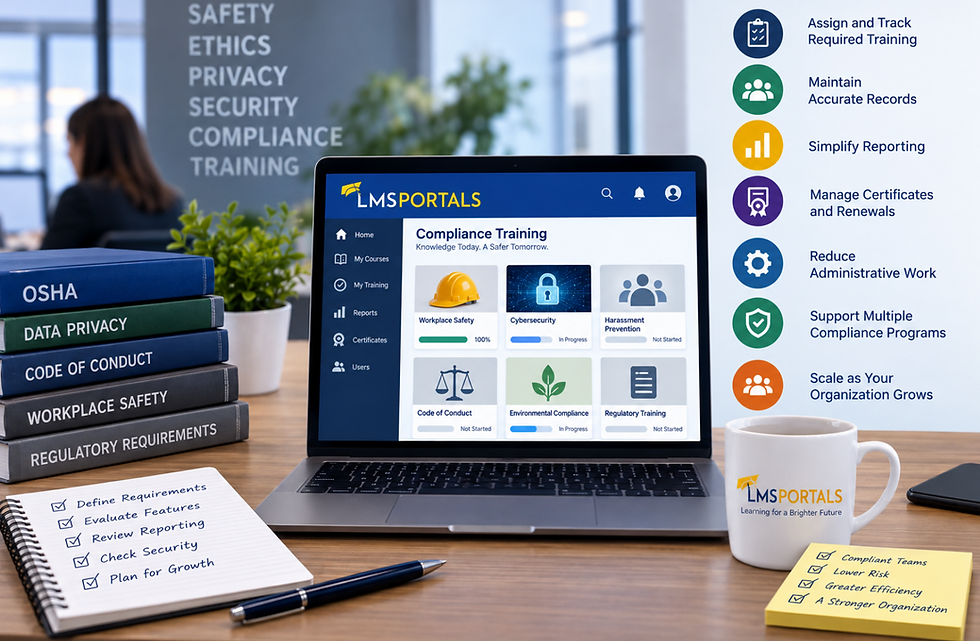
Each portal can include its own branding, course catalog, users, and reporting. HR teams can track I-9 training completion, monitor compliance, and produce records instantly when audits occur. Compliance dashboards allow administrators to see who has completed the training, who is overdue, and where gaps exist.
This level of visibility helps organizations stay ahead of compliance problems and avoid the risk of missed deadlines or inconsistent training practices.
The Value of a Complete Compliance Training Ecosystem
I-9 compliance is only one part of a broader workforce management strategy. Companies that invest in structured training reduce risk, improve consistency, and create better onboarding experiences. LMS Portals delivers a comprehensive system that supports these goals.
Our ready-made I-9 course gives organizations an immediate way to follow federal rules. Our custom development services allow companies to build additional training to support their policies. Our multi-tenant LMS provides the infrastructure to deliver and track training across the entire organization.
Together, these resources help employers manage compliance with confidence.
Final Thoughts
I-9 compliance is too important to leave to chance. Errors can be costly, and regulations are unforgiving. Training is the best way to prepare HR teams, prevent mistakes, and show auditors that your organization takes compliance seriously.
LMS Portals offers a ready-made I-9 Compliance course, custom course development services, and a multi-tenant LMS with full compliance tracking. These tools give employers a complete solution for onboarding and workforce readiness.
If your organization wants to strengthen compliance, reduce risk, and modernize training delivery, LMS Portals is ready to help.
About LMS Portals
At LMS Portals, we provide our clients and partners with a mobile-responsive, SaaS-based, multi-tenant learning management system that allows you to launch a dedicated training environment (a portal) for each of your unique audiences.
The system includes built-in, SCORM-compliant rapid course development software that provides a drag and drop engine to enable most anyone to build engaging courses quickly and easily.
We also offer a complete library of ready-made courses, covering most every aspect of corporate training and employee development.
If you choose to, you can create Learning Paths to deliver courses in a logical progression and add structure to your training program. The system also supports Virtual Instructor-Led Training (VILT) and provides tools for social learning.
Together, these features make LMS Portals the ideal SaaS-based eLearning platform for our clients and our Reseller partners.
Contact us today to get started or visit our Partner Program pages


Comments