
What LMS Features Do Training Companies Need?


Training companies have different learning management system requirements than organizations that primarily train their own employees. Instead of supporting a single internal workforce, a training provider may need to deliver courses to dozens or even hundreds of client organizations, each with its own learners, administrators, branding, training requirements, and reporting needs.
That difference can have a major impact on the type of LMS technology a training company needs.
A basic learning management system may provide course delivery, learner enrollment, assessments, and reporting. Those capabilities are important, but they may not be enough for a training business that wants to grow its client base, create recurring revenue, manage multiple training audiences, and operate efficiently at scale.
For training companies, the LMS can become much more than a place to host courses. It can serve as the technology infrastructure behind the entire training operation.
So, what LMS features should training companies look for?
1. Multi-Tenant LMS Architecture
Why Training Companies Need Separate Client Environments
One of the most important capabilities for a training company is the ability to serve multiple clients without having to operate a completely separate LMS for each organization.
This is where multi-tenant LMS architecture becomes valuable.
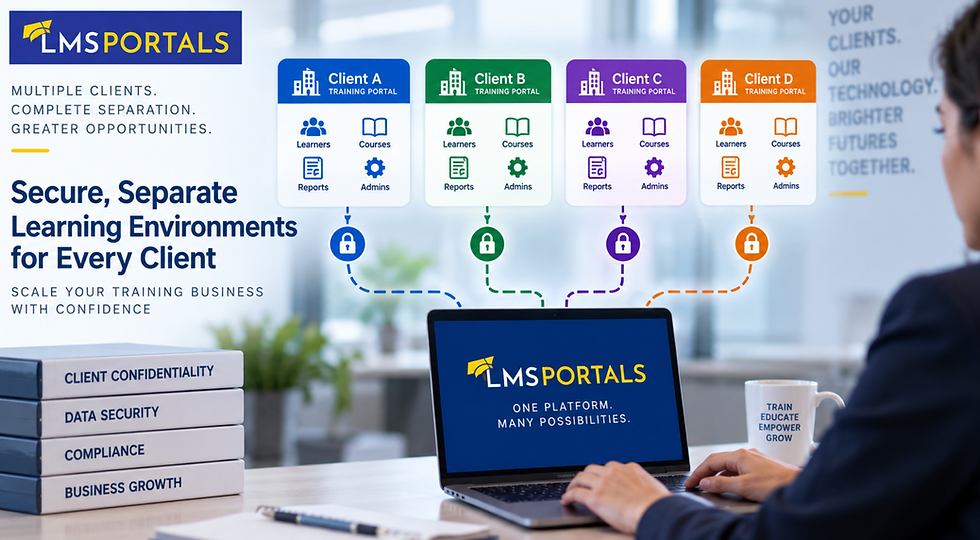
A multi-tenant LMS allows a training provider to create separate learning environments for different customers while managing those environments from a centralized platform.
For example, a safety training company might provide training to manufacturers, construction companies, logistics organizations, and healthcare businesses. Each customer can have its own portal while the training provider maintains centralized control over the overall system.
This model can make it significantly easier to add new clients without adding a corresponding amount of administrative work.
2. Branded Client Training Portals
Give Each Customer Its Own Learning Experience
Training companies frequently sell more than courses. They sell a complete training service.
Providing each customer with a branded training portal can make that service more valuable.
A client portal may include the customer's logo, colors, course catalog, learners, administrators, training records, and other settings.
Instead of sending every customer into the same generic LMS environment, the training provider can deliver an experience that feels dedicated to that organization.
Branded portals can also create new packaging opportunities. A training company might offer basic course access at one service level and a fully branded training portal as part of a premium package.
3. Centralized Administration
Manage Many Clients Without Managing Many Systems
Separate client portals are valuable, but they should not create separate administrative silos.
Training companies need centralized administration that allows their team to oversee clients, courses, learners, reporting, and other LMS activity from a central location.
Administrators should be able to move between client environments without maintaining completely independent systems.
This becomes increasingly important as the business grows. Managing five clients manually may be possible. Managing 50, 100, or 500 clients using the same approach may not be.
Centralized management helps the training company scale the number of customers it supports while keeping administrative complexity under control.
4. Course Management and Content Reuse
Build Once and Deliver Across Multiple Clients
Course content is often one of a training company's most valuable assets.
An LMS should make it easy to create or upload training once and then distribute that content to multiple client portals.
This prevents administrators from repeatedly uploading, configuring, and updating identical courses.
Centralized content management can also simplify course maintenance. If regulations change or training material needs to be updated, the provider should have an efficient way to manage those changes.
The easier it is to reuse training content across clients, the easier it becomes to build a scalable training catalog.
5. Support for SCORM and Other eLearning Content
Protect Existing Course Investments
Many professional training companies already have substantial investments in eLearning content.
An LMS should therefore support commonly used eLearning standards and formats, particularly SCORM.
SCORM support allows organizations to upload courses created with popular authoring tools and track learner activity such as course completion and assessment results.
This can be especially important for training providers that create courses for multiple customers or work with third-party instructional designers.
Rather than locking the company into one course-authoring environment, standards-based course delivery provides greater flexibility over how content is created and managed.
6. Learning Paths and Structured Training Programs
Go Beyond Individual Courses
Training companies increasingly deliver programs rather than isolated courses.
A learning path allows multiple courses and learning activities to be organized into a defined sequence.
For example, a training provider might create a supervisor development program containing courses on workplace safety, communication, leadership, harassment prevention, and compliance.
Learning paths make it easier to package these courses as a complete training solution.
They can also support onboarding programs, certification tracks, professional development programs, and other structured learning experiences.
7. Assessments, Quizzes, and Knowledge Checks
Measure Whether Learners Understand the Material
Course completion alone does not necessarily demonstrate learning.
Training companies often need tools for assessing learner knowledge and documenting results.
An LMS should support quizzes, tests, assessments, passing scores, and other mechanisms for measuring learner performance.
Assessment capabilities become particularly important when training is connected to certification, regulatory requirements, professional qualifications, or client-specific competency standards.
The resulting data can provide both the training provider and its customers with evidence that learners successfully completed required activities.
8. Certificates and Expiration Management
Support Certification and Recertification Programs
Certificates are particularly important for companies providing compliance, safety, professional development, and certification training.
The LMS should be able to automatically issue certificates when learners meet defined completion requirements.
Training companies may also need to track expiration dates.
If a certification is valid for one year, for example, the system should make it easier to identify learners who need to complete refresher or recertification training.
This transforms the LMS from a simple course-delivery system into an ongoing training management platform.
It can also help training providers create recurring business because clients need training continuously rather than only once.
9. Training Records and Compliance Tracking
Create a Reliable Record of Training Activity
Clients frequently need evidence that training occurred.
That may include completion dates, assessment scores, certificates, attendance records, course history, or other learner activity.
Training companies should look for an LMS that maintains organized training records and makes those records easy to retrieve.
This is especially important for clients operating in regulated industries.
When an audit, customer request, internal review, or regulatory inspection occurs, organizations may need to demonstrate who received training, what training they completed, and when it occurred.
Reliable LMS training records can make that process considerably easier.
10. Reporting and Analytics
Give Clients Visibility Into Their Training Programs
Training companies need reporting for their own operations, but their customers often need reporting as well.
The LMS should allow appropriate client administrators to see information about their learners without giving them access to other customers' information.
Useful reports might include enrollments, course progress, completion rates, assessment scores, certificate status, and overdue training.
Training providers can also use centralized reporting to understand activity across their entire customer base.
This information can help identify highly active clients, underused programs, upcoming certification requirements, and opportunities to improve training engagement.
11. Client Administrator Roles and Permissions
Let Customers Manage Their Own Learners
Training companies should not necessarily have to perform every administrative task for every customer.
An effective LMS can allow designated client administrators to manage appropriate parts of their own portal.
For example, a client administrator might add learners, enroll employees in courses, review training records, or run reports.
Role-based permissions allow the training provider to determine exactly what those administrators can access.
This delegated administration model can reduce support requirements while giving clients more control over their training programs.
12. Data Isolation and Security
Keep Client Training Data Separate
Data isolation is particularly important in a multi-tenant LMS.
When multiple organizations use the same underlying platform, each client should only be able to access the learners, training records, reports, and other information associated with its environment.
Strong data isolation helps training providers maintain clear boundaries between customer accounts.
This is important for privacy and security, but it can also be an important part of building client confidence in the training service.
As a training company adds more customers, a well-designed multi-tenant architecture provides a much more scalable approach than manually managing separate systems and databases.
13. Automated Notifications and Communications
Reduce Manual Follow-Up
Training administration can involve a surprising amount of communication.
Learners may need enrollment notifications, reminders about incomplete courses, certificate notifications, or messages about upcoming training requirements.
Automation can reduce the amount of manual follow-up required from the training provider.
For example, instead of manually contacting hundreds of learners about an approaching deadline, the LMS can support automated communications based on learner activity or training status.
This can improve the learner experience while helping the training company operate more efficiently.
14. Integrations and API Access
Connect the LMS With the Rest of the Technology Stack
Training rarely operates in isolation.
Training companies may need their LMS to exchange information with CRM platforms, webinar tools, authentication services, HR systems, eCommerce applications, or other business software.
Integration capabilities and APIs provide flexibility for connecting these systems.
For example, a training provider might connect its LMS with a CRM to streamline customer onboarding or use a virtual meeting integration to support instructor-led online training.
As the training business grows, integration flexibility can become increasingly important.
15. eCommerce and Course Monetization
Sell Training Directly Through the LMS
For training companies that sell courses online, eCommerce capabilities can create another important distribution channel.
The LMS may allow learners or organizations to purchase access to courses, programs, subscriptions, or other training products.
This can support both business-to-consumer and business-to-business training models.
Training companies may also combine eCommerce with branded portals, allowing them to serve larger corporate clients while continuing to sell individual courses online.
16. Scalability
Choose an LMS That Can Grow With the Training Business
A training company's LMS requirements can change dramatically as the business expands.
A company may begin with a handful of customers and a few hundred learners but eventually support hundreds of client organizations and thousands of learners.
The LMS architecture should be capable of supporting that growth without requiring the training company to rebuild its technology infrastructure.
Scalability includes more than server capacity. It also means making sure that portal creation, learner administration, course distribution, reporting, and customer management remain practical as volume increases.
Benefits of LMS Portals for Training Companies
A Platform Designed for Multi-Audience Training
LMS Portals is designed around a multi-portal approach that can be particularly well suited to training companies, eLearning providers, consultants, associations, and other organizations that deliver training to multiple audiences.
Rather than forcing every customer into a single shared learning environment, LMS Portals enables training providers to create dedicated portals for individual clients, business units, partners, or other training audiences.
Each portal can provide its own learning experience while remaining part of a centrally managed LMS environment.
Create Branded Training Portals for Clients
Training providers can use LMS Portals to create branded learning environments for their customers.
This helps the training company provide more than course access. It can offer clients a complete learning environment that becomes part of the provider's overall service offering.
This approach can help training companies differentiate their services and create higher-value client packages.
Centralize Course and Client Management
The multi-portal model also helps training providers maintain centralized oversight.
Courses and training resources can be managed efficiently and made available across the appropriate portals, reducing the need to maintain independent LMS installations for every customer.
As the number of clients grows, this centralized model can make training operations substantially easier to manage.
Support Multiple Training Business Models
LMS Portals can support a range of training delivery strategies.
A provider might use portals for corporate client training, compliance programs, customer education, partner training, certification programs, or other external learning initiatives.
This flexibility allows the LMS infrastructure to adapt as the training company's services evolve.
Create Opportunities for Recurring Revenue
Client portals can also become part of the training company's revenue model.
Instead of selling only individual courses, providers can package technology, content, administration, reporting, and ongoing training services into recurring offerings.
For example, a training company could offer a client a branded LMS portal, access to a course library, reporting, administrative support, and ongoing course updates as part of an annual or monthly service agreement.
This creates an opportunity to move from transactional course sales toward longer-term client relationships and recurring service revenue.
Choosing an LMS for a Training Company
The best LMS for a training company should support more than online course delivery.
It should help the organization manage customers, distribute content efficiently, maintain training records, provide client reporting, automate administrative tasks, protect client data, and scale as the business grows.
Features such as multi-tenant architecture, branded portals, centralized administration, SCORM support, learning paths, assessments, certificates, reporting, integrations, automation, and data isolation can become especially important when training is delivered across multiple client organizations.
For training providers, the right LMS can become part of the foundation of the business itself.
With a multi-portal platform such as LMS Portals, training companies can create dedicated learning environments for their customers while maintaining centralized control over courses, users, reporting, and administration.
That combination can help providers deliver a more professional client experience, reduce administrative complexity, expand their service offerings, and build a training operation designed to scale.
About LMS Portals
LMS Portals provides a flexible, SaaS-based multi-tenant learning management system for delivering training to employees, customers, partners, clients, and other learning audiences.
Our multi-portal architecture enables organizations to launch dedicated, branded learning environments while centrally managing users, courses, compliance, reporting, and administration.
The platform includes tools for creating and delivering SCORM-compliant courses, a library of ready-made training courses, and Learning Paths for building structured training programs. LMS Portals also supports virtual instructor-led training, certification programs, automation, reporting, and social learning.
Together, these capabilities make LMS Portals a scalable solution for organizations managing training across multiple audiences.
Contact us today to get started or visit our Partner Program pages

Comments