
How Can an LMS Track OSHA Safety Training?

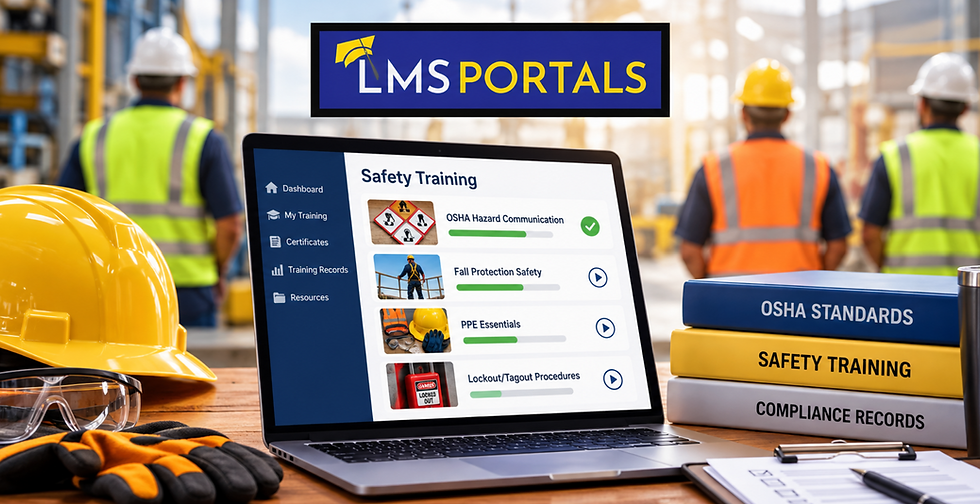
Workplace safety training is an essential responsibility for organizations in industries such as construction, manufacturing, warehousing, transportation, utilities, healthcare, and field services. Employers need more than a way to deliver safety courses—they also need a reliable method for tracking who has completed required training, when training occurred, and whether workers have demonstrated the necessary knowledge.
A Learning Management System (LMS) can help organizations centralize these activities by delivering online safety training, recording completions, tracking assessments and certifications, and generating reports that support internal compliance and audit readiness.
For organizations managing training related to Occupational Safety and Health Administration (OSHA) requirements, an LMS can provide a structured system for maintaining training records across employees, locations, job roles, and safety programs.
However, an LMS does not make an organization OSHA compliant by itself. Employers remain responsible for determining which OSHA standards apply, providing any required hands-on or site-specific instruction, ensuring workers are competent where required, and maintaining appropriate records.
When properly configured, an LMS can make those responsibilities significantly easier to manage.
What Is OSHA Safety Training?
OSHA establishes and enforces workplace safety and health requirements in the United States. Depending on the industry and workplace hazards involved, employers may be required to provide workers with training on specific safety topics.
Examples can include:
Hazard communication
Personal protective equipment (PPE)
Lockout/tagout
Fall protection
Electrical safety
Bloodborne pathogens
Respiratory protection
Powered industrial trucks
Emergency action procedures
Confined spaces
Machine guarding
Workplace ergonomics and injury prevention
The exact training requirements vary according to the applicable OSHA standard, job responsibilities, hazards, and workplace.
Some training may be delivered effectively through online courses. Other requirements may involve demonstrations, practical evaluations, supervised exercises, or workplace-specific instruction.
This is why an effective OSHA training management strategy often combines LMS-based learning with instructor-led and hands-on activities.
How Does an LMS Track OSHA Safety Training?
An LMS creates a centralized digital record of employee training activity.
Instead of relying on spreadsheets, paper certificates, email records, and separate departmental systems, organizations can use an LMS to assign training and maintain a consistent record of learner activity.
Assigning Safety Training to Employees
Administrators can assign courses to employees based on criteria such as department, location, job title, worksite, or job function.
For example, employees working in a warehouse might receive training related to hazard communication and emergency procedures, while forklift operators could be assigned additional training associated with powered industrial trucks.
This makes it easier to align training programs with workplace responsibilities.
Recording Course Completions
When an employee completes an online course, the LMS can automatically record the activity.
Depending on the course and LMS configuration, the training record may include information such as:
Employee name
Course title
Enrollment date
Completion date
Course status
Assessment score
Certificate information
Training expiration date
These records provide administrators with a centralized view of employee training history.
Tracking Assessment Results
Many safety programs require more than simply confirming that an employee opened a course.
Quizzes and assessments can be used to evaluate whether learners understand important safety concepts.
An LMS can record assessment scores, attempts, pass/fail status, and completion results. Organizations can establish passing thresholds and require employees who do not achieve the required score to repeat training or take additional instruction.
Assessment records can also help demonstrate that an organization took steps to evaluate learner understanding rather than simply distributing safety materials.
How Can an LMS Help Maintain OSHA Training Records?
One of the greatest advantages of an LMS for safety training is centralized recordkeeping.
Without an LMS, training information may be distributed across HR systems, spreadsheets, paper sign-in sheets, supervisor records, and individual employee files.
That fragmentation can create problems when organizations need to determine whether required training has been completed.
Creating a Training History for Each Employee
An LMS can maintain an individual training record for each learner.
Administrators can review courses assigned, courses completed, assessment results, certificates earned, and other training activities.
This can be especially useful when an employee changes jobs or departments and requires additional safety instruction.
Documenting Instructor-Led Training
Not every OSHA-related training activity should or can be completed online.
Organizations may need to document toolbox talks, classroom instruction, equipment demonstrations, practical evaluations, or other in-person activities.
An LMS that supports instructor-led training records can help organizations maintain those activities alongside online course completions.
The result is a more complete picture of an employee's safety training history.
Maintaining Historical Records
Safety training records may remain important long after a course has been completed.
Centralized training histories can help organizations respond to internal audits, customer requirements, regulatory inquiries, insurance reviews, and workplace investigations.
Instead of searching through multiple systems, administrators can retrieve training information from a centralized platform.
How Can an LMS Track Recurring OSHA Training?
Safety training is rarely a one-time activity.
Employees may require refresher training because of regulatory requirements, organizational policy, changes in workplace conditions, new equipment, changes in job responsibilities, or demonstrated knowledge gaps.
Training Expiration Dates
Organizations can associate expiration dates with courses or certifications when appropriate.
This allows administrators to identify employees whose training is approaching expiration.
For example, a company may establish an internal annual refresher schedule for a particular safety program even when the underlying regulatory requirements depend on specific circumstances rather than a universal annual deadline.
The LMS provides the tracking mechanism while the employer determines the appropriate training schedule.
Automated Training Reminders
Automated notifications can reduce the administrative burden associated with recurring safety training.
Instead of manually checking spreadsheets, administrators can use LMS notifications and training reports to identify employees who need to complete or renew training.
Employees can receive reminders before deadlines, while managers can monitor outstanding requirements.
Recertification Programs
Some training programs involve formal certifications or qualifications.
An LMS can help track certification dates, renewal requirements, and employee status.
This is particularly valuable for organizations with large workforces or multiple locations where manually tracking hundreds or thousands of training deadlines can become difficult.
How Can an LMS Support OSHA Audit Readiness?
Safety training records can become especially important when an organization needs to demonstrate its training practices.
An LMS helps create a structured system for retrieving and reviewing those records.
Generate Training Reports
Administrators can generate reports showing information such as:
Employees assigned to a course
Employees who completed training
Employees with incomplete training
Completion dates
Assessment results
Certificate status
Training history
Managers can use these reports proactively rather than waiting until an audit or investigation occurs.
Identify Training Gaps
Reporting can also help organizations identify potential compliance risks.
For example, an administrator may discover that employees at one facility have significantly lower completion rates than workers at other locations.
The organization can then investigate and address the issue before it becomes a larger problem.
This transforms LMS reporting from simple recordkeeping into a tool for managing training risk.
Produce Records More Efficiently
When safety records are requested, speed and organization matter.
A centralized LMS can make it easier to retrieve training information by employee, course, department, location, or other criteria.
That can reduce the administrative disruption associated with gathering documentation from multiple sources.
Can an LMS Track Safety Training Across Multiple Locations?
Multi-location organizations face additional challenges.
A company may have different factories, warehouses, construction sites, offices, franchises, contractors, or regional operations. Each location may have its own employees, managers, hazards, and training requirements.
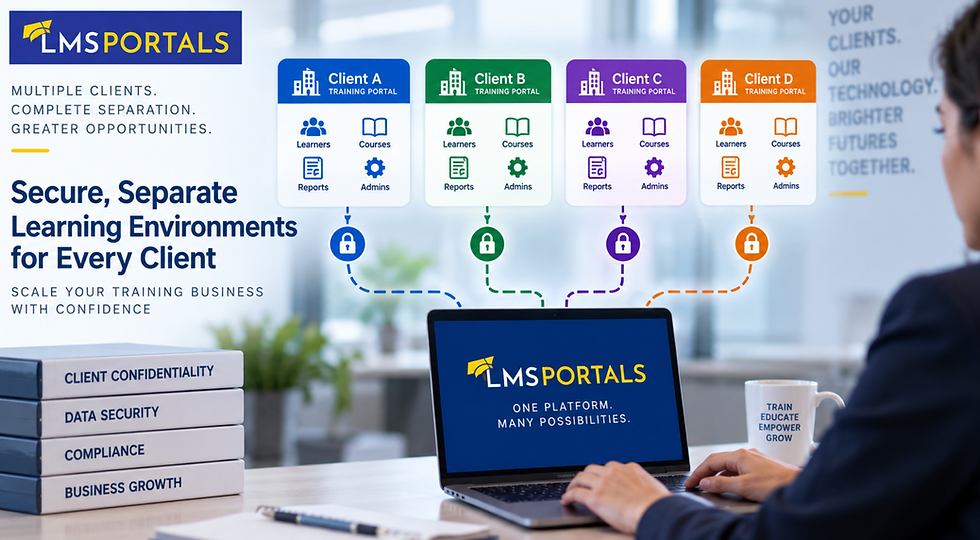
A multi-portal LMS can help organizations separate these audiences while maintaining centralized oversight.
Create Training Portals for Different Locations
Individual learning portals can be created for specific facilities, business units, departments, customers, or workforce groups.
Each portal can contain the courses and resources relevant to that audience.
For example, a manufacturing organization might operate separate training portals for facilities in Massachusetts, Texas, and California while corporate administrators maintain visibility across the organization.
Delegate Training Administration
Local managers can be given responsibility for their own employees without necessarily receiving administrative access to unrelated locations.
This distributed approach can be particularly useful for organizations with large or geographically dispersed workforces.
Maintain Centralized Oversight
Corporate safety and compliance teams still need visibility.
A multi-portal approach can combine local administration with centralized reporting, course management, and governance.
This allows organizations to scale safety training without creating an entirely separate training infrastructure for every location.
How Can an LMS Track Training for Contractors and External Workers?
Employee training is only part of the challenge for many organizations.
Manufacturers, construction companies, utilities, healthcare organizations, and other businesses may also need to train contractors, temporary workers, vendors, partners, or other external audiences.
Traditional HR systems are not always designed to manage these learners.
An LMS can provide external workers with controlled access to required safety training without requiring them to become full internal system users.
Organizations can create dedicated training environments for contractors and assign courses based on the work they will perform.
Administrators can then track whether required training has been completed before individuals begin certain activities, subject to the organization's own safety procedures and applicable regulatory requirements.
What Types of OSHA Safety Courses Can Be Delivered Through an LMS?
Many knowledge-based components of workplace safety training can be delivered through an LMS.
Common examples include courses covering hazard awareness, PPE concepts, emergency procedures, workplace violence prevention, ergonomics, electrical safety awareness, bloodborne pathogens, and general workplace safety principles.
Courses can include video, presentations, documents, interactive modules, assessments, and downloadable resources.
Using SCORM for Safety Training
SCORM-based courses can provide a more interactive training experience.
A SCORM-compatible LMS can track information such as course completion, learner progress, and assessment results transmitted by the course package.
This can be particularly useful for organizations purchasing OSHA-related or workplace safety courses from third-party training providers.
Rather than being restricted to courses created directly inside the LMS, organizations can import compatible content from external sources.
Combining Online and Hands-On Training
Organizations should not assume that completing an online course satisfies every applicable OSHA training requirement.
Some standards require practical instruction, demonstrations, workplace-specific information, competency evaluations, or other activities that cannot be replaced by an online module alone.
The LMS can still play an important role by documenting the online and administrative components of the broader training program.
How Does LMS Portals Support OSHA Safety Training?
LMS Portals provides organizations and training companies with a flexible platform for delivering, managing, and tracking workplace training.
Its multi-portal architecture is particularly useful for organizations that need to manage different locations, departments, clients, or workforce populations from a centralized platform.
Create Dedicated Safety Training Portals
Organizations can launch branded learning portals for different facilities, departments, clients, or workforce groups.
Each portal can be configured with the courses and learning resources appropriate for that audience.
This helps companies organize safety training without forcing every learner into one undifferentiated training environment.
Centralize Training Management
LMS Portals enables organizations to manage multiple learning environments through a centralized platform.
This can simplify administration for companies that need to deliver consistent safety programs across numerous locations while maintaining separation between individual training audiences.
Deliver SCORM and Online Courses
Organizations can deliver online courses and SCORM-based learning content through LMS Portals.
This provides flexibility for companies that develop their own safety courses as well as organizations that license training content from external providers.
Track Learner Activity
Administrators can monitor enrollment, course progress, completions, and other learner activity.
Centralized training records give managers greater visibility into who has completed assigned training and where follow-up may be required.
Support Assessments and Certificates
Courses can incorporate assessments to evaluate learner understanding.
Certificates can also be used to document successful completion of designated training programs, helping organizations provide learners and administrators with accessible records of achievement.
Manage Multiple Training Audiences
One of the biggest advantages of LMS Portals is the ability to support multiple training audiences.
An organization might create separate portals for employees, contractors, distributors, customers, or individual client organizations.
For safety training providers, this model can be especially valuable because each customer can receive a dedicated branded training portal while the provider manages its business through one centralized LMS environment.
How Can Safety Training Companies Use an LMS?
The same technology that helps employers manage workplace training can help safety consultants and training companies build scalable services.
Instead of delivering every training engagement manually, a provider can use an LMS to offer customers ongoing access to online safety courses, training records, assessments, certificates, and recurring programs.
Offer Branded Client Training Portals
A safety training company can create a dedicated portal for each customer.
The customer receives its own training environment while the provider manages courses and administration centrally.
This can make an LMS part of the provider's service offering rather than simply an internal technology tool.
Create Recurring Training Revenue
Safety training often creates an ongoing need for new-hire training, refresher programs, certification management, and workforce development.
By combining professional services with an LMS, training providers can potentially move from one-time engagements toward longer-term customer relationships and recurring service models.
Scale Without Duplicating Infrastructure
A multi-tenant or multi-portal architecture allows training providers to add new customers without deploying an entirely separate LMS for every client.
That can reduce administrative complexity as the training business grows.
What Should Organizations Look for in an LMS for OSHA Safety Training?
Organizations evaluating an LMS for workplace safety should consider more than basic course delivery.
The platform should support the way safety training actually operates across the organization.
Important capabilities may include training records, SCORM support, assessments, certificates, reporting, recurring training management, user groups, multiple portals, administrative permissions, and support for both internal and external learners.
Organizations should also consider whether the LMS can scale as their safety program grows.
A system that works for one facility and 100 employees may become difficult to manage when the organization expands to dozens of locations and thousands of workers.
An LMS Creates a Stronger Foundation for Safety Training Management
OSHA-related safety training involves more than assigning employees a few online courses.
Organizations need a repeatable process for delivering training, documenting participation, evaluating knowledge, maintaining records, identifying gaps, and managing recurring requirements.
An LMS provides the technology foundation for bringing those activities together.
By centralizing training records, automating administrative processes, supporting assessments and certifications, and providing visibility across locations and workforce groups, an LMS can make workplace safety training significantly easier to manage.
For organizations with multiple locations or training audiences—and for safety training companies serving multiple customers—the multi-portal approach offered by
LMS Portals provides an additional advantage.
Organizations can create dedicated training environments for different audiences while maintaining centralized control over content, users, reporting, and administration.
The result is a more scalable approach to workplace safety training: one that helps organizations maintain better records, improve visibility into training status, and build a stronger foundation for ongoing OSHA training and compliance management.
About LMS Portals
LMS Portals provides a flexible, SaaS-based multi-tenant learning management system for delivering training to employees, customers, partners, clients, and other learning audiences.
Our multi-portal architecture enables organizations to launch dedicated, branded learning environments while centrally managing users, courses, compliance, reporting, and administration.
The platform includes tools for creating and delivering SCORM-compliant courses, a library of ready-made training courses, and Learning Paths for building structured training programs. LMS Portals also supports virtual instructor-led training, certification programs, automation, reporting, and social learning.
Together, these capabilities make LMS Portals a scalable solution for organizations managing training across multiple audiences.
Contact us today to get started or visit our Partner Program pages


Comments