
How Can an LMS Improve Lockout/Tagout Training in Manufacturing?


Manufacturing environments depend on powerful machinery, automated production systems, and complex equipment to maintain productivity. While these technologies improve efficiency, they also introduce serious workplace hazards, particularly when employees perform maintenance, repairs, cleaning, or equipment servicing.
One of the most important safety procedures in manufacturing is lockout/tagout (LOTO), which protects workers from unexpected equipment startup or the release of hazardous energy. Effective lockout/tagout training helps employees understand how to isolate energy sources, apply appropriate controls, and verify that equipment is safe before beginning work.
However, managing lockout/tagout training across multiple facilities, departments, shifts, and employee roles can be challenging. Traditional classroom instruction and paper-based records often make it difficult to deliver consistent training, monitor employee qualifications, and maintain accurate compliance documentation.
A Learning Management System (LMS) offers manufacturers a more organized, scalable approach to lockout/tagout training. By combining online learning, assessments, training records, and compliance management, an LMS helps organizations strengthen safety programs while reducing administrative complexity.
Why Is Lockout/Tagout Training Essential in Manufacturing?
Understanding Hazardous Energy Risks
Manufacturing equipment can contain multiple sources of hazardous energy, including electrical, mechanical, hydraulic, pneumatic, chemical, and thermal energy. Even when machinery appears to be powered down, stored or residual energy can create dangerous conditions.
For example, a maintenance technician working on a conveyor system could be seriously injured if another employee unexpectedly restarts the equipment. Similarly, stored pressure in hydraulic systems or compressed air lines can cause unexpected movement even after a machine has been switched off.
Lockout/tagout procedures establish a systematic process for controlling these hazards.
Under the Occupational Safety and Health Administration's (OSHA) Control of Hazardous Energy standard, 29 CFR 1910.147, covered employers must establish appropriate energy control procedures and provide employee training.
Training is essential because written procedures alone cannot ensure that employees recognize hazardous energy sources or understand their responsibilities.
Different Employees Require Different Training
Not every manufacturing employee has the same responsibilities under a lockout/tagout program.
OSHA distinguishes between several employee categories:
Authorized employees: Workers who perform servicing or maintenance and apply lockout or tagout controls.
Affected employees: Workers whose jobs involve operating or using equipment being serviced or maintained.
Other employees: Individuals whose work activities may bring them into areas where energy control procedures are used.
Each group requires training appropriate to its responsibilities.
Authorized employees need detailed instruction on hazardous energy recognition, energy isolation methods, and control procedures. Affected employees must understand the purpose and use of energy control procedures, while other employees need instruction about the procedures and restrictions relevant to their work.
An LMS helps manufacturers deliver the appropriate training to each audience without requiring everyone to complete identical courses.
How Can an LMS Standardize Lockout/Tagout Training?
Delivering Consistent Safety Instruction
One of the biggest challenges in manufacturing safety training is maintaining consistency across different locations and departments.
A company operating several production facilities may rely on different supervisors, safety managers, or outside instructors to conduct lockout/tagout training.
Although these individuals may be knowledgeable, differences in instructional methods can create gaps in employee understanding.
An LMS establishes a centralized training environment where employees can access standardized educational content.
Manufacturers can develop courses covering essential topics such as:
Recognizing hazardous energy sources
Understanding lockout/tagout requirements
Identifying energy isolation devices
Following equipment shutdown procedures
Applying locks and tags correctly
Releasing or restraining stored energy
Verifying energy isolation
Understanding procedures for restoring equipment to service
Standardized online courses help ensure employees receive consistent foundational information regardless of where they work.
Importantly, online training should complement—not replace—equipment-specific instruction, practical demonstrations, and verification of employee proficiency where required.
Supporting Facility-Specific Procedures
While lockout/tagout principles are broadly applicable, individual manufacturing facilities often use different machinery, equipment configurations, and energy isolation procedures.
A food processing facility may have different energy control requirements than an automotive assembly plant or metal fabrication operation.
An LMS allows manufacturers to combine standardized safety content with facility-specific instruction.
For example, a company could provide a core lockout/tagout awareness course to all applicable employees while assigning additional courses covering specific production lines, equipment types, or maintenance responsibilities.
This approach creates consistency without overlooking important operational differences.
How Can an LMS Make Lockout/Tagout Training More Engaging?
Using Interactive Learning Activities
Traditional safety training often relies on presentations, printed manuals, or lengthy instructional videos. While these methods can communicate important information, they may not adequately reinforce decision-making skills.
Modern LMS platforms support interactive eLearning courses that encourage employees to participate actively.
For example, a lockout/tagout course might present an image of a manufacturing machine and ask learners to identify potential hazardous energy sources.
Another activity could require employees to arrange the steps of an energy control procedure in the correct sequence.
Scenario-based exercises might ask learners how to respond when they discover that a machine has multiple energy sources or when another employee attempts to restart equipment during maintenance.
These activities encourage employees to think through realistic situations rather than simply memorize definitions.
Reinforcing Knowledge Through Assessments
Assessments help manufacturers determine whether employees understand essential safety concepts.
An LMS can deliver quizzes and knowledge checks throughout a course, allowing employees to receive immediate feedback.
For example, an assessment might ask employees to identify the appropriate action when stored energy remains in a system after shutdown.
If an employee selects an incorrect answer, the course can explain the hazard and direct the learner to review the relevant material.
Manufacturers can establish passing scores and require employees to successfully complete assessments before receiving course completion credit.
However, passing an online assessment does not automatically establish that an employee is qualified to perform lockout/tagout procedures. Employers must also ensure that required practical knowledge, skills, and proficiency have been demonstrated.
An LMS can support this process by recording online assessments alongside documented practical evaluations.
How Can an LMS Simplify Lockout/Tagout Compliance Management?
Maintaining Centralized Training Records
Training documentation is a critical component of an effective lockout/tagout program.
OSHA requires employers to certify that employee training has been accomplished and is being kept up to date. The certification must contain each employee's name and the dates of training.
Managing this information manually can become difficult, particularly for manufacturers with hundreds or thousands of employees.
An LMS centralizes training records, making it easier to identify which employees have completed assigned courses and which individuals require additional instruction.
Safety administrators can review completion histories, assessment results, and outstanding assignments from a centralized dashboard.
This visibility helps organizations prepare for internal safety reviews, customer audits, and regulatory inspections.
Managing Retraining Requirements
Lockout/tagout training is not simply a one-time activity.
Under OSHA requirements, retraining is necessary when employees change job assignments, machines or processes change in ways that introduce new hazards, or energy control procedures change.
Retraining is also required when periodic inspections or other circumstances reveal deviations from, or inadequacies in, employees' knowledge or use of energy control procedures.
An LMS helps safety managers organize these requirements through targeted course assignments and compliance tracking.
For example, when a manufacturing facility installs a new production system, administrators can assign updated training to affected personnel.
Some manufacturers also establish periodic refresher training schedules as an internal safety practice. An LMS can automate these schedules, although OSHA's general lockout/tagout standard does not establish a universal annual retraining requirement.
Supporting Periodic Inspection Documentation
OSHA also requires periodic inspections of covered energy control procedures at least annually.
These inspections are separate from routine online training and must meet specific regulatory requirements.
An LMS can help organizations organize related educational materials and maintain supporting records, while the employer continues to conduct and certify the required inspections.
By connecting training management with broader safety administration, manufacturers can reduce the risk of overlooking important compliance activities.
How Can an LMS Support Training Across Multiple Manufacturing Facilities?
Managing Different Locations and Departments
Manufacturers operating multiple facilities frequently struggle with decentralized training administration.
Individual plants may maintain separate spreadsheets, paper records, or training systems, making it difficult for corporate safety leaders to evaluate organization-wide performance.
A multi-tenant LMS provides a solution by allowing manufacturers to establish separate training portals for different facilities, business units, or operational divisions.
Each portal can contain relevant courses, employees, administrators, and reporting capabilities.
For example, a manufacturing organization could establish separate portals for its assembly plant, machining facility, distribution center, and corporate operations.
Local safety managers could administer their facility's training while corporate leadership maintains broader visibility into training activity.
This structure supports local flexibility without sacrificing centralized oversight.
Accommodating Multiple Shifts and Employee Schedules
Manufacturing operations often run around the clock, making traditional classroom scheduling difficult.
Employees working overnight shifts may have limited access to instructor-led training sessions. Maintenance personnel may also have unpredictable schedules because of equipment breakdowns or production demands.
An LMS allows employees to complete appropriate online training during designated training periods without requiring everyone to attend the same classroom session.
Mobile-responsive courses can also provide access through compatible devices, subject to workplace policies.
This flexibility can reduce scheduling conflicts and make it easier to provide consistent training across shifts.
How Can an LMS Improve Visibility Into Employee Safety Training?
Tracking Completion and Knowledge Gaps
Manufacturing safety managers need more than a list of employees who have attended training.
They also need to understand whether training assignments are being completed and where additional instruction may be necessary.
An LMS can provide reports showing course completion rates, assessment performance, overdue assignments, and training activity by department or facility.
For example, a safety manager might discover that maintenance employees at one facility consistently struggle with questions involving stored hydraulic energy.
This information could indicate a need for additional instruction, improved course content, or practical demonstrations.
Training data becomes more valuable when organizations use it to identify opportunities for improvement rather than simply document completion.
Providing Management With Better Information
Corporate safety leaders often need to communicate training performance to plant managers, executives, and compliance teams.
Instead of manually consolidating spreadsheets from multiple locations, administrators can use LMS reporting tools to review training activity.
Reports can help management identify departments with outstanding assignments, monitor completion trends, and prioritize follow-up actions.
This visibility supports more informed decisions about training resources and safety program improvements.
How Can Manufacturers Reduce the Administrative Burden of Lockout/Tagout Training?
Automating Routine Training Tasks
Safety administrators often spend considerable time assigning courses, sending reminders, checking completion records, and preparing reports.
An LMS can automate many of these activities.
For example, newly hired maintenance employees can be assigned foundational safety courses as part of their onboarding process.
Employees moving into new positions can receive additional training assignments appropriate to their responsibilities.
Automated reminders can notify learners about outstanding courses, while administrators can monitor progress without repeatedly contacting individual supervisors.
These capabilities allow safety teams to devote more attention to equipment inspections, hazard assessments, practical evaluations, and other important responsibilities.
Updating Training When Equipment Changes
Manufacturing facilities regularly introduce new equipment, modify production lines, and implement updated maintenance procedures.
These changes may require revisions to lockout/tagout training materials.
With an LMS, manufacturers can update online course content and distribute revised instruction to the appropriate employees.
This is particularly valuable for organizations operating multiple facilities, where distributing updated printed materials can be time-consuming.
A centralized approach helps ensure that employees receive current information while allowing administrators to track completion of newly assigned training.
What Are the Benefits of Working With LMS Portals?
A Multi-Tenant LMS Built for Complex Training Environments
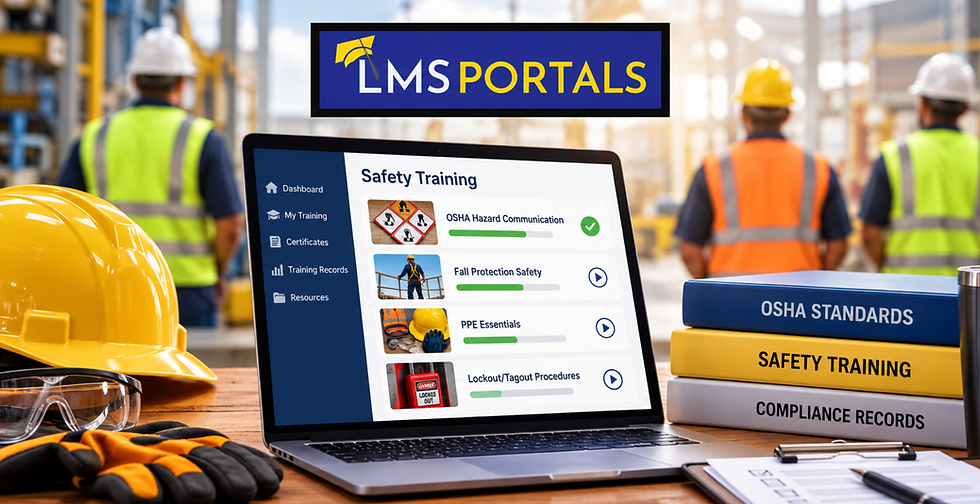
LMS Portals provides a flexible, multi-tenant learning management system designed to help organizations deliver, manage, and track training across multiple audiences and locations.
For manufacturers, this structure is particularly valuable because safety training requirements often vary by facility, department, equipment type, and employee responsibility.
With LMS Portals, manufacturers can create branded training portals for individual plants, operational divisions, or other employee groups.
Each portal can support its own training assignments and administrative responsibilities while remaining part of a broader learning environment.
The platform also supports learning paths, assessments, certificates, compliance management, and reporting, helping manufacturers organize safety education more effectively.
Custom Lockout/Tagout Course Development
One of the most significant advantages of working with LMS Portals is access to custom eLearning course development services.
Many manufacturers have detailed lockout/tagout policies, equipment procedures, and safety manuals but lack the internal resources to convert these materials into engaging online courses.
LMS Portals can help transform existing training documentation into interactive eLearning experiences tailored to an organization's needs.
Courses can incorporate equipment-specific images, realistic workplace scenarios, interactive knowledge checks, and assessments.
For example, a manufacturer could develop separate courses covering general hazardous energy awareness, maintenance employee responsibilities, and procedures associated with particular equipment categories.
This approach helps organizations build a more relevant training library without hiring a dedicated internal eLearning development team.
Compliance Management and Centralized Reporting
LMS Portals includes compliance management capabilities that help organizations assign required training, establish recurring assignments where appropriate, and monitor completion.
Administrators can track employee progress, review training histories, and generate reports across portals, groups, and individual learners.
For manufacturing organizations, these capabilities can reduce administrative work while improving visibility into safety training activities.
The platform also supports a broader training strategy, allowing manufacturers to manage lockout/tagout education alongside machine guarding, forklift safety, hazard communication, personal protective equipment, and other workplace training programs.
A Scalable Training Partnership
Manufacturers do not need to launch an extensive online training program immediately.
With LMS Portals, organizations can begin with a focused set of safety courses and expand their training libraries over time.
The combination of LMS technology, customizable portals, course development, and ongoing support provides a practical alternative to purchasing software and managing every aspect of course creation internally.
This makes LMS Portals especially attractive to manufacturers seeking to improve safety training without significantly increasing administrative overhead.
How Can Manufacturers Get Started With LMS-Based Lockout/Tagout Training?
Building a Practical Implementation Plan
Implementing an LMS-based lockout/tagout training program begins with understanding existing training requirements.
Manufacturers should identify employee roles, review current energy control procedures, evaluate existing training materials, and determine which instructional components are appropriate for online delivery.
Next, organizations can develop foundational courses and establish training assignments based on employee responsibilities.
Interactive assessments can reinforce essential concepts, while practical demonstrations and evaluations continue to address hands-on requirements.
As the program expands, manufacturers can introduce equipment-specific courses, update materials when procedures change, and use LMS reporting to monitor training effectiveness.
Creating a Stronger Safety Training Program
An LMS cannot eliminate hazardous energy risks or replace properly implemented lockout/tagout procedures.
However, it can make safety education more consistent, accessible, measurable, and manageable.
By centralizing training content, simplifying administration, supporting retraining, and providing better visibility into employee learning, an LMS helps manufacturers strengthen an essential component of their workplace safety programs.
LMS Portals combines a flexible learning management platform with custom course development services, helping manufacturers build training programs tailored to their equipment, employees, and operational requirements.
For organizations seeking to modernize lockout/tagout education, this combination offers a practical way to improve training delivery, reduce administrative complexity, and support a stronger culture of workplace safety.
About LMS Portals
LMS Portals provides a flexible, SaaS-based multi-tenant learning management system for delivering training to employees, customers, partners, clients, and other learning audiences.
Our multi-portal architecture enables organizations to launch dedicated, branded learning environments while centrally managing users, courses, compliance, reporting, and administration.
The platform includes tools for creating and delivering SCORM-compliant courses, a library of ready-made training courses, and Learning Paths for building structured training programs. LMS Portals also supports virtual instructor-led training, certification programs, automation, reporting, and social learning.
Together, these capabilities make LMS Portals a scalable solution for organizations managing training across multiple audiences.
Contact us today to get started or visit our Partner Program pages


Comments