
How Do Associations Separate Training Data Across Chapters?


Associations often operate as networks rather than as a single centralized organization. A national or international association may establish training standards and provide educational resources, while individual chapters, regions, affiliates, or member groups manage their own members and local programs.
That structure creates an important technology question:
How can an association separate training data across chapters while still maintaining centralized oversight?
Traditional learning management systems may place every learner, course, administrator, and training record into one shared environment. While permissions and groups can provide some organizational structure, this approach can become difficult to manage as an association grows.
A multi-tenant or multi-portal LMS offers another model. Individual chapters can operate within separate learning environments while the parent association maintains centralized administration, reporting, content management, and governance.
This combination of data separation and centralized control can make an LMS significantly easier to scale across a chapter-based association.
Why Do Associations Need to Separate Training Data?
Associations frequently provide education to multiple audiences, including members, chapter leaders, volunteers, employees, certification candidates, partners, and other stakeholders.
Although these audiences may participate in programs developed by the same association, their training data does not necessarily need to be managed together.
For example, a national association might have 40 chapters. Each chapter could have its own:
Members and learners
Chapter administrators
Training assignments
Course enrollments
Completion records
Reports
Communications
Local educational programs
At the same time, the national organization may need visibility across the entire network.
The challenge is therefore not simply separating data. Associations need to separate information where appropriate while preserving the ability to manage the broader training ecosystem centrally.
What Happens When Every Chapter Shares One LMS Environment?
A single shared LMS can work when an association is relatively small. As the number of chapters and learners increases, however, administration can become more complicated.
Administrators may need increasingly complex roles, groups, naming conventions, filters, and permissions to determine which learners belong to which chapter.
Reporting can become more difficult as well. A chapter administrator looking for a local training report may have to navigate information associated with many other chapters.
There can also be governance concerns. Associations may not want one chapter administrator viewing or modifying another chapter's learner records.
The larger and more decentralized the association becomes, the more important organizational boundaries within the LMS can become.
What Is Training Data Separation?
Training data separation is the practice of maintaining distinct boundaries between the learning information associated with different organizations, groups, or audiences.
Within an association, those boundaries might correspond to chapters, state organizations, regional offices, affiliates, committees, or partner organizations.
What Types of LMS Data Can Be Separated?
Depending on the LMS architecture and configuration, separation can apply to information such as learner profiles, enrollments, course assignments, completion records, assessment results, certificates, learning histories, administrative permissions, and reports.
The objective is to give each chapter access to the information it needs without unnecessarily exposing information belonging to other chapters.
This is particularly important when local administrators are responsible for managing their own learners.
A chapter administrator in Massachusetts, for example, may need to enroll members, assign courses, and run reports for that chapter. That administrator does not necessarily need access to equivalent records for chapters in California, Texas, or Florida.
How Does a Multi-Tenant LMS Separate Chapter Data?
A multi-tenant LMS is designed to support multiple learning environments within a broader platform.
Instead of treating every learner as part of one undifferentiated LMS instance, the platform can establish distinct environments for different organizations or audiences.
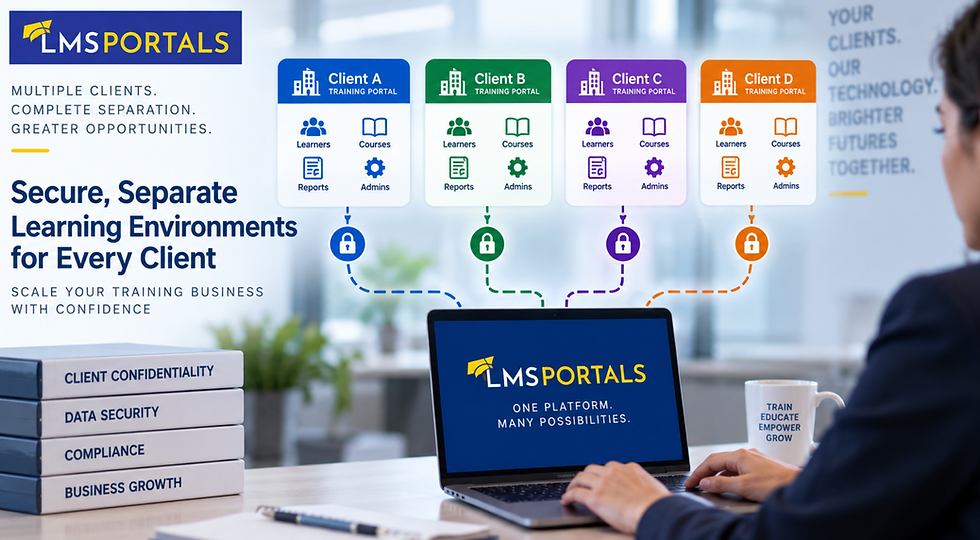
For associations, each chapter can potentially receive its own learning portal.
Each Chapter Can Have Its Own Learning Portal
A chapter portal provides a defined environment in which the chapter can manage its learners and training activities.
Depending on the association's requirements, a portal may have its own users, administrators, branding, course assignments, learning paths, communications, and reporting.
The result is a structure that more closely reflects how many associations already operate.
The national organization manages the overall association, while chapters manage their local responsibilities.
Chapter Administrators Can Be Given Defined Permissions
Data separation should be supported by administrative permissions.
Rather than giving every administrator broad access to the entire LMS, associations can establish roles based on responsibility.
A local administrator might be authorized to manage users and training within a specific chapter portal. A regional administrator could potentially oversee several related portals. Central administrators could maintain broader visibility across the association.
This reduces unnecessary access while also making the system easier for local administrators to use.
How Can an Association Maintain Centralized Oversight?
Separating chapter environments does not mean the association has to create completely disconnected LMS systems.
In fact, one of the major advantages of a multi-portal strategy is the ability to combine local autonomy with centralized oversight.
Central Administrators Can Manage the Broader Training Program
The parent association can maintain responsibility for organization-wide activities such as developing courses, establishing training standards, managing common resources, monitoring participation, and reviewing performance.
Instead of deploying an entirely separate LMS for every chapter, the association operates a coordinated learning ecosystem.
This can significantly reduce duplicated work.
Training Content Can Be Shared Across Chapters
Associations often have educational content that should be available throughout the organization.
Examples might include orientation programs, professional development courses, compliance training, leadership programs, certification preparation, or continuing education.
A multi-portal LMS can allow the association to centrally manage common content and make it available to multiple chapter portals.
This creates an important distinction between sharing content and sharing data.
Multiple chapters may use the same course while maintaining separate learner populations and training records.
Reporting Can Support Both Local and Organization-Wide Needs
Reporting requirements often differ depending on the administrator.
A chapter administrator may want to answer questions such as:
Which local members completed a required course?
Who still needs training?
Which certifications are approaching expiration?
How many learners participated in a particular program?
Central administrators may be interested in broader questions.
They may want to evaluate participation across chapters, compare program adoption, identify training trends, or measure overall completion of association-wide initiatives.
An LMS architecture that supports both levels can provide useful local reporting without sacrificing central visibility.
How Does Data Separation Improve LMS Privacy?
Separating training data can also support an association's broader approach to privacy and information governance.
Not every administrator needs access to every learner record.
Access Can Follow Organizational Responsibility
A useful principle for LMS administration is to provide access based on an individual's responsibilities.
If an administrator is responsible for Chapter A, that person can be given access to the learners and training activity associated with Chapter A without automatically receiving access to Chapters B, C, and D.
This reduces unnecessary exposure of learner information.
It can also simplify administration because local users see information that is relevant to their responsibilities rather than navigating a large organization-wide dataset.
Separation Can Support Clearer Data Governance
Associations may also establish different policies for different types of information.
For example, the national organization might determine which records must be retained, which courses are mandatory, which reports are required, and which administrators can access particular information.
Chapter-level separation provides a technical structure that can support these policies.
Technology alone does not establish privacy compliance, but an LMS architecture designed around clear organizational boundaries can make privacy and governance policies easier to implement.
Can Chapters Still Customize Their Training Programs?
Data separation does not have to eliminate local flexibility.
One of the advantages of a portal-based model is that associations can determine which elements should be standardized and which can be managed locally.
Associations Can Combine Central and Local Content
The parent organization might publish a core collection of courses that every chapter uses.
Individual chapters could then supplement those resources with their own programs.
For example, a national association might provide leadership training and certification programs, while a state chapter adds courses addressing local regulations, events, or professional requirements.
Both can exist within the same broader learning ecosystem.
Branding Can Reflect Individual Chapters
Associations may also want learning environments to reflect local identities.
Depending on the platform, individual portals can potentially incorporate chapter-specific branding, messaging, resources, and navigation.
Learners therefore receive an experience that feels relevant to their organization while the association retains the efficiencies of a centralized LMS platform.
How Does Chapter Data Separation Help an Association Scale?
Scalability becomes increasingly important as associations add chapters, programs, and learners.
A structure that works for five chapters may become difficult to administer with 50 or 100.
New Chapters Can Be Added Without Reorganizing the Entire LMS
With a portal-based architecture, a new chapter can be established as another defined learning environment rather than requiring administrators to restructure the entire LMS.
The association can develop a repeatable process for onboarding chapters.
That process might include creating the portal, applying branding, assigning administrators, publishing common courses, importing learners, and configuring reporting.
A repeatable model makes expansion more manageable.
Administrative Responsibility Can Be Distributed
Central training teams can quickly become overwhelmed if they are responsible for every routine learner-management task across every chapter.
Delegating appropriate responsibilities to chapter administrators helps distribute the workload.
Local administrators can handle activities such as learner management, enrollment, communication, and reporting while the central organization focuses on strategy, content, governance, and association-wide initiatives.
How Can LMS Portals Support Chapter-Based Associations?
LMS Portals is designed around a multi-portal architecture that can be particularly useful for organizations managing training across multiple audiences, business units, clients, partners, or chapters.
Rather than forcing every audience into a single learning environment, organizations can create separate branded portals while maintaining centralized control through one platform.
Create Dedicated Portals for Individual Chapters
With LMS Portals, an association can create dedicated learning portals for chapters, regions, affiliates, or other member groups.
This provides a logical separation between audiences and gives each chapter an environment for managing its training activities.
As the association expands, additional portals can be created to support new chapters or programs.
Delegate Administration Without Giving Up Central Control
LMS Portals allows organizations to distribute administrative responsibility.
Chapter administrators can manage the activities appropriate to their portal while central administrators maintain broader platform oversight.
For associations, this can reduce the administrative burden on a national training team while allowing chapters to respond more quickly to local training needs.
Centralize Course and Content Management
Associations do not necessarily need to recreate the same training materials separately for every chapter.
LMS Portals provides centralized capabilities for managing courses and learning resources that can be delivered across multiple portals.
This can help associations maintain consistency in core training while still supporting local learning requirements.
Deliver Branded Learning Experiences
Different chapters, programs, or affiliates may require distinct learner experiences.
LMS Portals enables organizations to create branded learning portals for different audiences while managing those environments through the broader platform.
This is particularly valuable for associations that want to maintain an organization-wide identity while still recognizing individual chapters or programs.
Simplify Training Administration and Reporting
Separating learners into appropriate portals can make administration more intuitive.
Instead of relying entirely on increasingly complicated groups and filters inside one large learner population, organizations can structure the LMS around recognizable organizational boundaries.
Chapter administrators can focus on their own audiences, while central teams maintain the visibility required to oversee the larger training operation.
Support Growth Without Deploying Separate LMS Platforms
An association could theoretically purchase and manage an independent LMS for every chapter, but that approach can introduce additional technology, administration, content-management, and support requirements.
A multi-portal platform provides an alternative.
LMS Portals allows an association to support multiple learning environments through a centralized platform, providing the separation chapters need without requiring each chapter to operate an entirely independent LMS.
What Should Associations Look for in an LMS for Chapter Training?
When evaluating an LMS, associations should look beyond basic course delivery.
The architecture of the platform matters, particularly when training will be distributed across many semi-independent organizations.
Evaluate Data Separation and Permissions
Associations should understand how the LMS separates users, records, administrative access, and reports.
It is also important to determine whether administrators can be assigned responsibility for specific chapters without receiving unnecessary access elsewhere.
Consider Centralized Content Management
If dozens of chapters need the same course, administrators should not have to maintain dozens of unrelated copies.
The LMS should support an efficient method for distributing and managing shared learning resources.
Plan for Future Growth
Associations should evaluate the system based not only on today's number of chapters but also on where the organization may be several years from now.
Questions worth considering include:
Can new chapter environments be created easily?
Can administration be delegated?
Can common courses be distributed efficiently?
Can central administrators maintain oversight as the number of portals increases?
These architectural considerations can have a significant impact on long-term LMS manageability.
Building a Scalable Training Environment for Association Chapters
Associations have a unique training challenge.
They need to operate as a unified organization while supporting chapters that may have their own learners, administrators, programs, and reporting requirements.
A multi-portal LMS provides a practical way to reflect that structure digitally.
By creating separate learning environments for chapters, associations can establish clearer data boundaries, delegate administration, simplify local reporting, and support greater privacy. At the same time, the parent organization can maintain centralized control over content, standards, reporting, and the broader learning strategy.
LMS Portals helps associations put this model into practice. Its multi-portal architecture enables organizations to create dedicated learning environments for chapters and other audiences while managing them through a centralized platform.
For associations planning to expand online training across multiple chapters, this approach can provide an important foundation for scalable administration, consistent learning experiences, and effective training data management.
About LMS Portals
LMS Portals provides a flexible, SaaS-based multi-tenant learning management system for delivering training to employees, customers, partners, clients, and other learning audiences.
Our multi-portal architecture enables organizations to launch dedicated, branded learning environments while centrally managing users, courses, compliance, reporting, and administration.
The platform includes tools for creating and delivering SCORM-compliant courses, a library of ready-made training courses, and Learning Paths for building structured training programs. LMS Portals also supports virtual instructor-led training, certification programs, automation, reporting, and social learning.
Together, these capabilities make LMS Portals a scalable solution for organizations managing training across multiple audiences.
Contact us today to get started or visit our Partner Program pages

Comments