
Practical AI And Automation For The Workplace: New Training Course

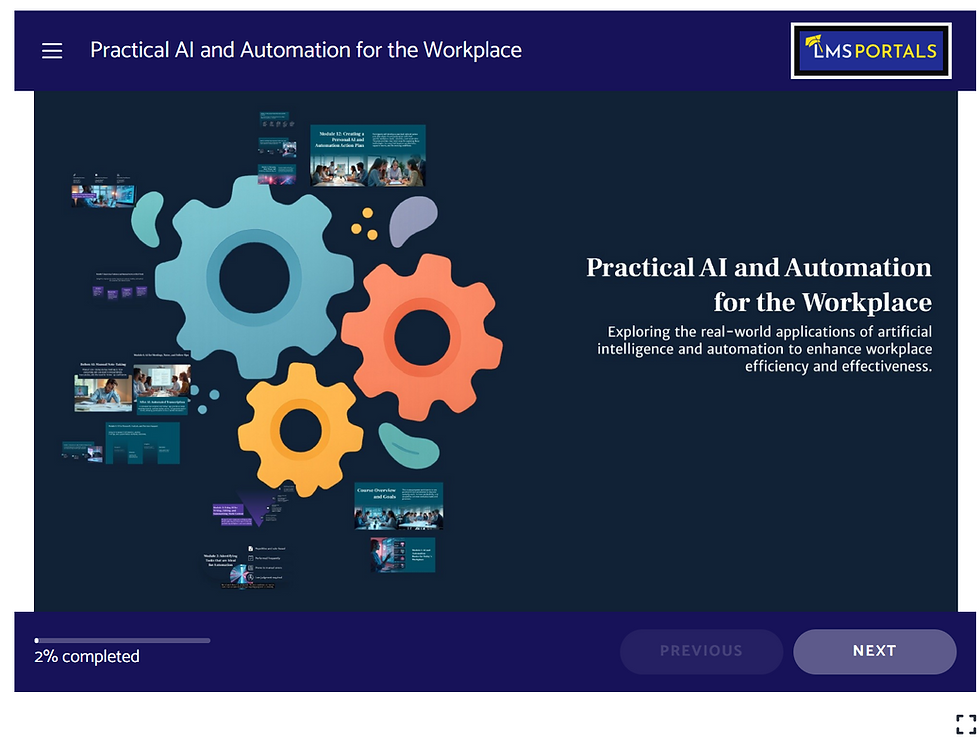
Artificial intelligence and automation are no longer future concepts. They are already reshaping how work gets done across operations, HR, customer service, finance, and compliance-driven environments. The challenge for many organizations is not whether to use AI, but how to apply it responsibly, productively, and at scale.
LMS Portals is pleased to announce the availability of Practical AI and Automation for the Workplace, a new professional training course designed to help organizations move from AI curiosity to real-world application.
This course is built for business users, not developers. It focuses on how employees and teams can use AI and automation to improve everyday work, streamline workflows, and support better decision-making while managing risk, privacy, and compliance concerns.
Why organizations need practical AI training now
AI tools are entering the workplace faster than policies, training, and governance structures can keep up. Employees are experimenting on their own, often without clear guidance, which introduces risks around data privacy, accuracy, and compliance.
At the same time, organizations that delay AI adoption risk falling behind competitors who are already using automation to reduce manual effort, speed up routine processes, and improve consistency across teams.
What most organizations need right now is not deep technical training. They need practical guidance that helps employees understand:
Where AI and automation fit into daily work
Which tasks are appropriate to automate
How to use AI responsibly and effectively
How to measure productivity gains and business impact
Practical AI and Automation for the Workplace was designed to address exactly these needs.
About the course: practical AI and automation for the workplace
This course prepares participants to use practical AI and automation to improve everyday work, increase productivity, and streamline common workplace tasks and processes.
Rather than focusing on theory or specific tools that may change quickly, the course emphasizes repeatable concepts, workflows, and decision frameworks that apply across roles and industries.
Course highlights
Designed for non-technical professionals
Focused on real workplace scenarios
Clear, structured modules with measurable outcomes
Suitable for internal training, professional development, and compliance-adjacent programs
SCORM-ready and easy to deploy through LMS Portals
What learners will gain
By completing the course, participants will:
Understand how AI and automation support everyday work
Identify tasks that are well suited for automation
Apply AI to writing, research, meetings, data handling, and service workflows
Manage risk, privacy, and accuracy when using AI
Measure productivity improvements and ROI
Create a practical, role-relevant AI and automation action plan
The course emphasizes clarity, responsibility, and usability, making it suitable for organizations at any stage of AI adoption.
Course structure and learning approach
The course is organized into 12 concise, workplace-focused modules that move learners from foundational understanding to practical application and measurement.
Each module is designed for efficient consumption and reinforced with assessment questions to ensure comprehension and engagement. The course can be delivered as a self-paced program or incorporated into broader learning initiatives.
A quiz-based structure reinforces learning without forcing unnecessary seat time, making the course well suited for modern professional audiences.
Ideal audiences for this course
This course is appropriate for a wide range of organizational roles, including:
Knowledge workers and individual contributors
Managers and team leaders
HR and learning professionals
Operations and process improvement teams
Compliance-aware industries such as healthcare, finance, education, and government
Because the content is tool-agnostic and role-neutral, it scales easily across departments and job functions.
Delivered through the LMS Portals multi-tenant LMS
The course is delivered through the LMS Portals platform, a multi-tenant learning management system designed to support organizations that need flexibility, scalability, and control.
Multi-tenant LMS architecture
LMS Portals allows organizations to create and manage multiple branded learning portals from a single system. This is ideal for:
Enterprises with multiple divisions or regions
Associations and professional bodies
Training providers serving multiple clients
Organizations offering both internal and external training
Each portal can have its own branding, users, courses, and reporting while being centrally managed.
Compliance management and certificate tracking
For organizations operating in regulated environments, LMS Portals includes built-in compliance management and certificate tracking capabilities.
Key features include:
Automated course completion tracking
Certificate issuance and expiration management
Compliance reporting by user, role, or organization
Audit-friendly records and history
These features make it easy to demonstrate training completion and ongoing compliance without relying on manual tracking or spreadsheets.
Open API integrations for flexible learning ecosystems
LMS Portals supports open API integrations, allowing the platform to connect with other business systems and tools.
Organizations can integrate LMS Portals with:
HR and employee information systems
CRM platforms
Identity and access management tools
Content providers and third-party services
This flexibility allows learning data to flow seamlessly across systems and supports automation strategies that extend beyond the LMS itself.
A growing library of ready-made courses
In addition to Practical AI and Automation for the Workplace, LMS Portals offers a growing library of ready-made courses that organizations can deploy quickly.
These courses are designed for professional and compliance-aware audiences and cover a range of workplace topics. Ready-made courses allow organizations to:
Launch training programs quickly
Reduce content development time
Maintain consistency across learners
Scale training without increasing administrative burden
Courses can be used as-is or combined with custom content for a blended learning approach.
Custom course development services
For organizations with unique requirements, LMS Portals also provides custom course development services.
Custom development is ideal when organizations need to:
Align training with internal policies and procedures
Address industry-specific regulations
Incorporate proprietary workflows or systems
Customize messaging and branding
LMS Portals works with clients to transform existing materials into engaging, trackable online courses that integrate seamlessly into the LMS.
Why organizations choose LMS Portals
Organizations choose LMS Portals because the platform is built for real-world training needs, not one-size-fits-all learning.
Key advantages include:
Multi-tenant architecture for scale and flexibility
Strong compliance and certificate management
Open API for integrations and automation
Support for both ready-made and custom courses
Practical, business-focused content offerings
This combination allows organizations to treat learning as a strategic asset rather than a standalone system.
Supporting responsible AI adoption
As AI continues to evolve, organizations must balance innovation with responsibility. Training plays a critical role in helping employees use AI tools safely, ethically, and effectively.
Practical AI and Automation for the Workplace supports responsible AI adoption by:
Emphasizing data privacy and risk management
Reinforcing the importance of human judgment
Encouraging verification and oversight
Providing structured decision frameworks
This makes the course especially valuable for organizations that want to enable AI use without introducing unnecessary risk.
Easy deployment and fast time to value
Because the course is SCORM-ready and delivered through LMS Portals, organizations can deploy it quickly with minimal setup.
The course can be:
Assigned to specific roles or departments
Rolled out organization-wide
Used as part of onboarding or upskilling programs
This flexibility allows organizations to move quickly while maintaining control and oversight.
Announcing availability
Practical AI and Automation for the Workplace is now available from LMS Portals.
Organizations looking to:
Improve productivity
Guide responsible AI use
Streamline workflows
Support employee development
Strengthen compliance and reporting
can now add this course to their learning portfolio.
About LMS Portals
At LMS Portals, we provide our clients and partners with a mobile-responsive, SaaS-based, multi-tenant learning management system that allows you to launch a dedicated training environment (a portal) for each of your unique audiences.
The system includes built-in, SCORM-compliant rapid course development software that provides a drag and drop engine to enable most anyone to build engaging courses quickly and easily.
We also offer a complete library of ready-made courses, covering most every aspect of corporate training and employee development.
If you choose to, you can create Learning Paths to deliver courses in a logical progression and add structure to your training program. The system also supports Virtual Instructor-Led Training (VILT) and provides tools for social learning.
Together, these features make LMS Portals the ideal SaaS-based eLearning platform for our clients and our Reseller partners.
Contact us today to get started or visit our Partner Program pages


Comments