
HR Metrics & Analytics: Turning Workforce Data into Business Decisions
- LMSPortals

- Dec 26, 2025
- 7 min read
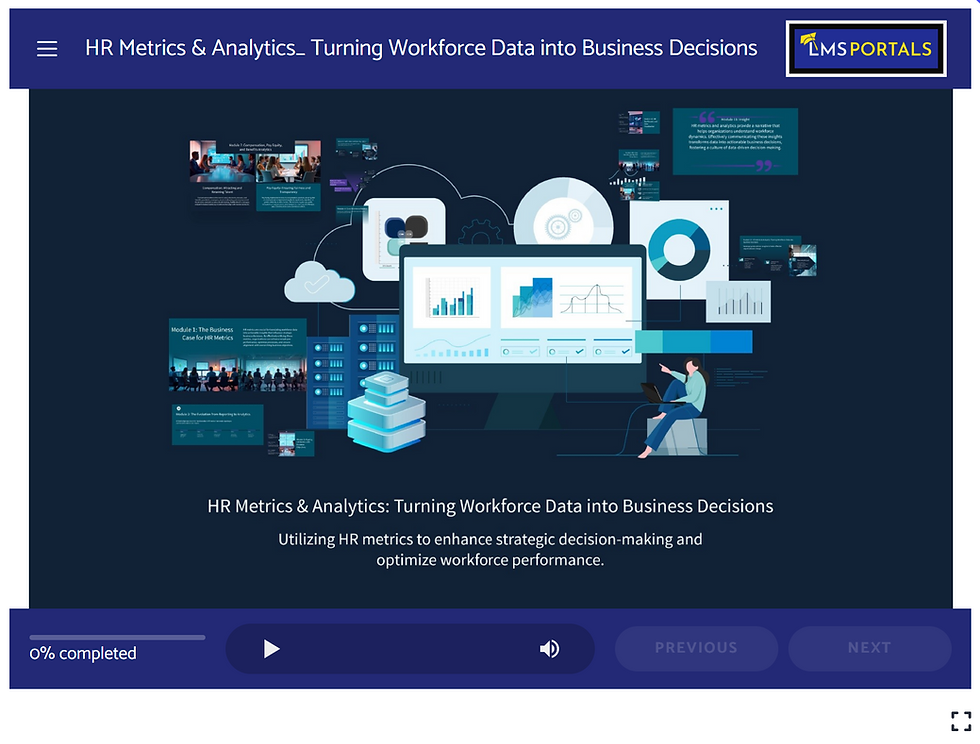
Organizations are asking more of HR than ever. It is no longer enough to report headcount, track turnover, or produce quarterly summaries. Business leaders want insight. They want HR to connect workforce activity to real outcomes like productivity, retention, customer experience, and growth. They also want faster answers, clearer dashboards, and a stronger link between people strategy and business strategy.
That is exactly why LMS Portals is making HR Metrics & Analytics: Turning Workforce Data into Business Decisions available to our partners and clients.
This course is designed for HR professionals, HR leaders, HR business partners, and operational leaders who need to work with data, communicate insights, and drive change. It is practical, business-facing, and built to help organizations move beyond reporting into decisions.
In this article, you will learn what the course covers, who it is for, and how LMS Portals makes it easy to deliver the training at scale using our multi-tenant learning platform with compliance tools, certificate management, and API integrations.
You will also see how this course fits into our broader approach: a growing library of ready-made courses plus custom course development services when you need training tailored to your policies, workflows, and internal content.
Why HR Metrics & Analytics Matters Right Now
HR teams are under pressure from two sides.
On one side, the workforce is changing quickly: tighter labor markets, shifting expectations, remote and hybrid work, rising turnover in some industries, and fast-moving skill requirements. On the other side, leadership wants HR to justify initiatives with evidence.
They want answers to questions like:
What is driving turnover in critical roles?
Which recruiting sources produce the best hires, not just the fastest hires?
Are we improving performance and capability, or just delivering training?
Where do engagement trends predict retention problems?
Are compensation and pay practices fair and defensible?
Which workforce actions will support the business plan this year?
HR metrics and analytics are not about collecting more numbers. They are about selecting the right metrics, connecting them to business goals, interpreting what the data is really saying, and making recommendations that leadership can act on.
That is the focus of this course.
Introducing the Course: HR Metrics & Analytics
HR Metrics & Analytics: Turning Workforce Data into Business Decisions gives learners a structured, practical path from fundamentals to application. It covers the metrics that matter, how to align them to strategy, and how to communicate insights clearly.
What learners will be able to do after completing the course
Identify key HR metrics that reflect workforce health and performance
Link HR metrics to business objectives so success can be measured accurately
Evaluate recruiting, learning, performance, compensation, and engagement data
Understand data quality, governance, and ethical use of workforce information
Build and interpret dashboards to support fast, informed decision-making
Communicate HR insights with clarity through data storytelling
Measure impact and adjust metrics as business strategy changes
Who this course is for
HR generalists moving toward analytics responsibilities
HR managers and HR business partners supporting leadership decisions
Talent acquisition leads and recruiting teams
L&D leaders who need to measure training impact and ROI
Compensation and benefits professionals
Operations leaders who partner with HR
Consultants supporting workforce strategy and HR transformation
This course works well across industries, including regulated sectors where compliance reporting and audit readiness are important.
Course Structure at a Glance
The course is organized into 12 modules that follow a simple arc: business relevance first, then functional metrics, then tools and communication, then application.
The business case for HR metrics
The evolution from reporting to analytics
Aligning HR metrics with business objectives
Core workforce metrics
Talent acquisition and hiring analytics
Performance and learning metrics
Compensation, pay equity, and benefits analytics
Employee engagement and experience metrics
HR data sources, quality, and governance
HR dashboards and data visualization
Communicating insights through HR data storytelling
Applying HR analytics to drive organizational change
A final exam is included at the end to confirm understanding and support certification.
Why This Course Works for Partners
If you distribute training through partners, you already know the challenge. Partners want content that sells. They want training that clients will actually use. They want programs that lead to renewals and recurring enrollments.
This course is partner-friendly for four reasons.
1. It is business-facing, not academic
Many analytics courses turn into spreadsheets and formulas. This one stays focused on decisions, leadership needs, and applied HR use cases.
2. It supports upsell beyond compliance
Compliance courses are necessary. They also tend to compete on price. HR analytics training raises the perceived value of your catalog and opens the door to broader HR and leadership development bundles.
3. It is evergreen and adaptable
Workforce analytics will remain relevant. Even as tools change, the decision frameworks, metric alignment, and storytelling skills remain valuable.
4. It positions you as a strategic provider
When partners offer training that helps leaders connect workforce actions to business outcomes, they shift from “training vendor” to “business partner.”
Deliver the Course Through Our Multi-Tenant LMS
Availability is only part of the story. Delivery matters. Tracking matters. Reporting matters. Managing multiple clients and multiple brands matters.
LMS Portals is built for that reality.
What “multi-tenant” means for partners
Our platform lets you run multiple separate training portals under one system. Each portal can have its own:
Branding and domain
Course catalog
Learner groups and roles
Reports and compliance settings
Certificates and completion rules
Administrators and permissions
This is ideal for:
Training providers serving multiple client companies
Associations training member organizations
Franchisors training franchisees
HR consultants delivering training to several accounts
Companies delivering extended enterprise training across customers, vendors, or regional groups
Multi-tenant matters because it keeps each client’s learning environment clean and organized while giving you centralized control.
Built-In Compliance Tracking and Certificate Management
Many training programs are not just “nice to have.” They are required. In those cases, a learning platform must do more than host content. It must prove training happened and remain audit-ready.
LMS Portals includes compliance features that support:
Assignments and required training rules
Due dates and reminders
Completion tracking and reporting
Learner history and transcripts
Certificate issuance on completion
Certificate tracking and renewals
When you deliver HR training, especially in regulated environments, certificates and documentation can be as important as the training itself. With LMS Portals, you can structure programs so the organization can demonstrate compliance and completion with confidence.
API Integrations That Fit Your Tech Stack
Training rarely lives in a vacuum. Many organizations want learning connected to the systems they already use.
LMS Portals supports API integrations that can help you:
Sync users from external systems
Automate enrollments based on roles or departments
Connect training completions to HR or compliance records
Pull completion data into dashboards or BI tools
Support SCORM enrollments through API-based services
If you are delivering training at scale, automation reduces friction. It also improves the customer experience because learners and admins spend less time dealing with manual processes.
Our Library of Ready-Made Courses
HR Metrics & Analytics is part of our broader strategy: help partners offer a credible library quickly, then expand with additional content as clients grow.
Our ready-made course library supports fast deployment so partners can:
Launch with a real catalog, not a blank portal
Offer immediate value to new clients
Create bundles by role or topic area
Refresh content regularly without rebuilding from scratch
Ready-made content matters because partners need speed. It also supports margin.
When you can deliver value quickly, you can focus your time where it pays: sales, relationships, and growth.
Custom Course Development Services
Many clients have existing materials, policies, and internal processes that need to be turned into training. Others need custom modules to reflect company-specific risk areas or workflows.
LMS Portals offers custom course development to meet those needs.
Common custom development requests we support
Converting policies, handbooks, or SOPs into interactive training
Building role-based learning paths by department
Creating onboarding programs with tracking and certification
Developing assessments and final exams tied to internal requirements
Updating and improving legacy training content for modern delivery
Custom courses are often the key to winning and retaining accounts because they make the program feel proprietary and aligned to the organization’s real environment. They also support long-term relationships because training updates become part of the ongoing service model.
How Partners Can Package This Course for Revenue
If you are offering HR Metrics & Analytics through partners, packaging matters. Here are a few proven ways to position it.
Option 1: Standalone course offering
Simple, clean, easy to sell. Ideal for organizations that want to build analytics capability quickly.
Option 2: HR analytics bundle
Pair this course with related topics such as:
Performance management fundamentals
Employee engagement strategies
Workforce planning basics
HR compliance reporting
DEI measurement and reporting
Option 3: Leadership reporting bundle
Position the course for leaders who need to interpret HR dashboards and act on insights.
Option 4: Add-on to a compliance portal
For partners who primarily sell compliance training, this course offers a natural upsell into business improvement.
Why LMS Portals Is a Good Fit for This Course
This course is about turning data into action. LMS Portals supports that mission by making training easier to distribute, track, verify, and report. Partners can deliver the course across multiple clients, maintain separate branded portals, issue certificates, track renewals, and integrate with existing systems through APIs.
That combination matters. Clients do not want content alone. They want a system that supports outcomes. They want proof of completion. They want a clean admin experience. They want scalability.
LMS Portals is built to deliver all of it.
Next Steps: Make the Course Available to Your Audience
If you are a training provider, consultant, or organization that serves multiple clients, HR Metrics & Analytics: Turning Workforce Data into Business Decisions is an excellent addition to your catalog. It is relevant, practical, and positioned for modern HR expectations.
With LMS Portals, you can deliver it through a multi-tenant platform designed for partner growth, supported by compliance tracking, certificate management, API integrations, a ready-made course library, and custom development services.
About LMS Portals
At LMS Portals, we provide our clients and partners with a mobile-responsive, SaaS-based, multi-tenant learning management system that allows you to launch a dedicated training environment (a portal) for each of your unique audiences.
The system includes built-in, SCORM-compliant rapid course development software that provides a drag and drop engine to enable most anyone to build engaging courses quickly and easily.
We also offer a complete library of ready-made courses, covering most every aspect of corporate training and employee development.
If you choose to, you can create Learning Paths to deliver courses in a logical progression and add structure to your training program. The system also supports Virtual Instructor-Led Training (VILT) and provides tools for social learning.
Together, these features make LMS Portals the ideal SaaS-based eLearning platform for our clients and our Reseller partners.
Contact us today to get started or visit our Partner Program pages


Comments