
How to Build an OSHA-Compliant Oil & Gas Safety Training Program


The oil and gas industry operates in one of the most demanding and hazardous environments in the world. Whether employees are working on offshore platforms, drilling rigs, refineries, pipelines, processing plants, or distribution terminals, they encounter workplace hazards that require specialized knowledge and disciplined execution. In these environments, safety is not simply a regulatory obligation—it is essential to protecting employees, maintaining operational continuity, and preserving an organization's reputation.
A successful safety program goes well beyond providing new employees with an orientation course. OSHA compliance requires organizations to establish a comprehensive training strategy that prepares workers for their specific responsibilities, reinforces critical safety procedures over time, and maintains accurate documentation demonstrating that required training has been completed.
Organizations that approach safety training as an ongoing business process rather than an annual compliance exercise are better equipped to reduce workplace incidents, improve operational efficiency, and foster a culture where safety becomes part of every decision employees make.
Understand Your OSHA Training Requirements
The first step in building an effective safety program is understanding which OSHA standards apply to your workforce. While every organization has unique operational requirements, most oil and gas companies must provide training covering multiple workplace hazards.
Common OSHA training topics include:
Hazard Communication (HazCom)
Lockout/Tagout (LOTO)
Personal Protective Equipment (PPE)
Confined Space Entry
Fall Protection
Fire Prevention and Emergency Response
Respiratory Protection
Process Safety Management (PSM)
Many employers must also comply with Department of Transportation (DOT) regulations, state occupational safety programs, environmental requirements, and customer-specific safety standards. Identifying every applicable requirement allows organizations to build a complete compliance program rather than reacting to regulations individually.
Develop Role-Based Learning Paths
Not every employee faces the same workplace risks. A refinery operator performs different tasks than a pipeline inspector, and an equipment mechanic requires different safety knowledge than a field supervisor.
Rather than assigning identical courses to every employee, organizations should organize training according to job responsibilities. Role-based learning paths ensure employees receive instruction directly related to the hazards they encounter while eliminating unnecessary training that provides little practical value.
As employees move into new positions or assume additional responsibilities, their required learning should evolve as well. A structured learning path helps organizations maintain compliance while supporting employee development throughout their careers.
Make Safety Training Continuous
One of the most common compliance mistakes is treating safety training as a one-time event. Employees complete orientation, receive a certificate, and may not revisit important topics until the following year.
In reality, regulations change, equipment is upgraded, procedures evolve, and people naturally forget information over time. Continuous learning keeps safety knowledge current while reinforcing behaviors that prevent workplace injuries.
Successful organizations supplement formal compliance courses with ongoing educational opportunities throughout the year. Monthly safety topics, toolbox talks, refresher courses, policy updates, and lessons learned from recent incidents all help maintain employee awareness without disrupting productivity.
A culture of continuous learning demonstrates that safety is an everyday responsibility rather than an annual administrative requirement.
Focus Training on High-Risk Activities
Certain workplace activities consistently present greater risk than others. These tasks deserve additional attention within every safety training program because they are frequently associated with serious incidents.
Organizations should devote additional instructional time to subjects such as energy isolation, confined space entry, fall protection, hazardous chemical handling, hot work, equipment inspections, emergency response procedures, and permit-to-work systems.
Rather than simply reviewing regulations, effective programs explain why procedures exist, demonstrate how they should be applied, and provide practical examples employees can relate to their daily work.
Scenario-based learning, real incident case studies, and interactive exercises make training more engaging while improving long-term knowledge retention.
Build a Strong Safety Culture
Regulatory compliance establishes the minimum acceptable standard for workplace safety, but organizations with exceptional safety records consistently go beyond minimum requirements.
Employees should feel empowered to report hazards, ask questions, stop unsafe work, and participate in improving workplace safety. When workers believe leadership genuinely values their input, they become active participants in maintaining a safe work environment instead of simply following instructions.
Leadership involvement is equally important. Supervisors who participate in training, reinforce safety expectations during daily operations, and model safe behavior send a powerful message that safety remains a core organizational priority.
A strong safety culture develops gradually through consistent leadership, open communication, and continuous learning.
Maintain Accurate Training Documentation
Delivering effective safety training is only part of OSHA compliance. Organizations must also maintain complete and accurate records demonstrating that required instruction has been delivered.
Training documentation becomes especially important during OSHA inspections, customer audits, insurance reviews, or incident investigations.
Organizations should maintain records that include:
Course completion dates
Assessment scores
Certifications earned
Refresher training history
Employee acknowledgments
Individual training transcripts
While many organizations continue to rely on spreadsheets or paper files, digital recordkeeping significantly reduces administrative effort while providing immediate access to complete employee training histories whenever they are needed.
Include Contractors in Your Safety Program
Contractors perform a substantial amount of work throughout the oil and gas industry. Whether supporting maintenance projects, equipment installations, inspections, or construction activities, contractors must understand the same workplace expectations as permanent employees.
Standardized contractor onboarding helps ensure every worker receives consistent instruction regarding site-specific hazards, emergency procedures, reporting expectations, permit systems, and company safety policies before beginning work.
Managing contractor training alongside employee learning also improves visibility into overall compliance across multiple worksites.
Learn From Incidents and Near Misses
Some of the most valuable training material comes directly from an organization's own operations.
Incident investigations, near misses, safety observations, equipment failures, and audit findings provide insight into where employees may require additional education. Rather than viewing these events as isolated occurrences, organizations should use them to strengthen future training.
If repeated incidents indicate confusion surrounding equipment inspections, lockout procedures, or hazard recognition, those topics should receive additional emphasis in future learning programs.
Using operational data to guide training priorities ensures learning remains practical, relevant, and focused on real workplace challenges.
Deliver Consistent Training Across Multiple Locations
Many oil and gas companies operate across multiple states, regions, or even countries. Delivering consistent training across drilling sites, refineries, maintenance facilities, terminals, and corporate offices becomes increasingly difficult when each location manages its own materials independently.
A centralized training strategy ensures employees receive the same approved content regardless of where they work. When regulations change or procedures are updated, revised materials can be distributed immediately across the entire organization.
Standardization reduces compliance gaps while reinforcing a consistent safety culture throughout the enterprise.
Measure the Effectiveness of Your Training
Assigning courses and tracking completion is important, but organizations should also evaluate whether training is producing measurable improvements in workplace safety.
Assessment scores, supervisor observations, audit findings, incident trends, employee feedback, and compliance metrics all provide valuable insight into the effectiveness of a training program.
Reviewing these indicators regularly allows organizations to improve course content, address emerging risks, and ensure training continues to support operational objectives.
Use Technology to Simplify Compliance
Managing safety training manually becomes increasingly difficult as organizations grow. Multiple facilities, hundreds of employees, contractors, and recurring certification requirements quickly overwhelm spreadsheets and paper records.
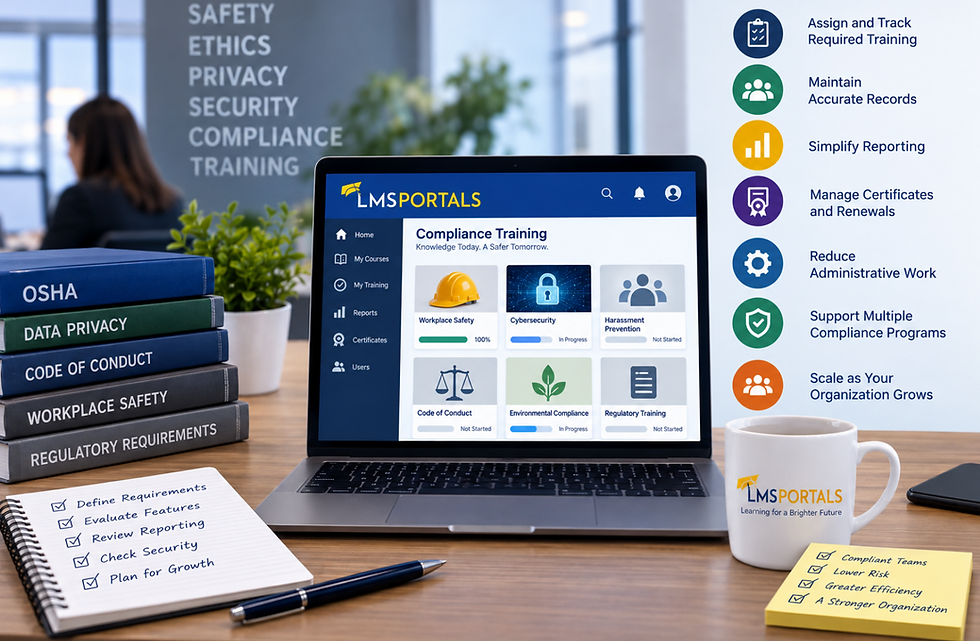
Modern learning management systems automate many routine administrative tasks while providing greater visibility into compliance across the organization.
A centralized LMS allows organizations to:
Automatically assign required courses by job role
Track learner progress in real time
Issue certificates automatically
Monitor certification expiration dates
Generate audit-ready compliance reports
Deliver consistent training to every location
Automation reduces administrative overhead while allowing safety professionals to focus on improving workplace performance rather than managing paperwork.
How LMS Portals Supports OSHA Compliance Training
As organizations expand, managing OSHA compliance across multiple facilities, operating regions, business units, and contractors becomes increasingly complex.
LMS Portals provides a centralized learning platform designed to simplify safety training administration while supporting the operational flexibility required by the oil and gas industry.
Multi-Tenant Learning Portals for Complex Organizations
Oil and gas companies often support multiple divisions, operating regions, joint ventures, contractors, and customer organizations. LMS Portals' multi-tenant architecture allows each of these groups to have its own branded learning portal with separate administrators, learners, course catalogs, and reporting.
This approach provides local autonomy while maintaining centralized oversight, making it easier to standardize compliance training across an entire organization.
Automated Compliance Tracking and Reporting
Tracking compliance manually can quickly become overwhelming as workforces grow. LMS Portals automatically records course completions, assessment results, certifications, and learner progress, providing safety managers with real-time visibility into training status.
Comprehensive reporting tools make it easy to identify overdue training, monitor compliance by location or department, and generate audit-ready reports whenever they are needed.
Flexible Support for Safety Training Content
Every organization develops its training program differently. LMS Portals supports a wide variety of learning content, including SCORM-compliant eLearning courses, instructional videos, PDF documents, policies, assessments, learning paths, and digital certificates.
This flexibility allows organizations to combine internally developed safety materials with third-party OSHA and industry compliance courses within a single learning environment.
Learning Paths That Match Job Roles
Different positions require different competencies. LMS Portals enables administrators to create structured learning paths based on employee roles, ensuring workers receive the right training at the right time.
As employees change positions or assume additional responsibilities, new learning requirements can be assigned automatically, helping organizations maintain compliance while reducing manual administration.
Cloud-Based Access for Remote Operations
Oil and gas employees frequently work in remote locations where traditional classroom training is impractical. Because LMS Portals is cloud-based, employees can access assigned training from virtually anywhere using a desktop computer, laptop, tablet, or smartphone.
This flexibility allows organizations to deliver consistent learning across geographically dispersed operations without interrupting productivity.
A Scalable Platform for Long-Term Growth
As organizations expand through acquisitions, new facilities, or additional operating regions, LMS Portals scales alongside the business. New learning portals, users, administrators, and training programs can be added without requiring a complete redesign of the learning environment.
This scalability makes LMS Portals an ideal solution for organizations seeking a long-term platform that can support evolving compliance requirements and organizational growth.
Summary
Building an OSHA-compliant oil and gas safety training program requires much more than satisfying regulatory requirements. It requires a structured, continuous learning strategy that prepares employees for the hazards they face, reinforces safe work practices, and maintains accurate documentation demonstrating compliance.
Organizations that invest in role-based learning, ongoing education, standardized training delivery, and modern learning technology create safer workplaces while reducing administrative burden and regulatory risk.
By combining proven safety training practices with the centralized management, automation, and scalability of LMS Portals, oil and gas companies can simplify OSHA compliance, improve workforce readiness, and build a stronger safety culture across every facility and every employee.
About LMS Portals
At LMS Portals, we provide our clients and partners with a mobile-responsive, SaaS-based, multi-tenant learning management system that allows you to launch a dedicated training environment (a portal) for each of your unique audiences.
The system includes built-in, SCORM-compliant rapid course development software that provides a drag and drop engine to enable most anyone to build engaging courses quickly and easily.
We also offer a complete library of ready-made courses, covering most every aspect of corporate training and employee development.
If you choose to, you can create Learning Paths to deliver courses in a logical progression and add structure to your training program. The system also supports Virtual Instructor-Led Training (VILT) and provides tools for social learning.
Together, these features make LMS Portals the ideal SaaS-based eLearning platform for our clients and our Reseller partners.
Contact us today to get started or visit our Partner Program pages


Comments