
How to Evaluate an LMS for Compliance Training

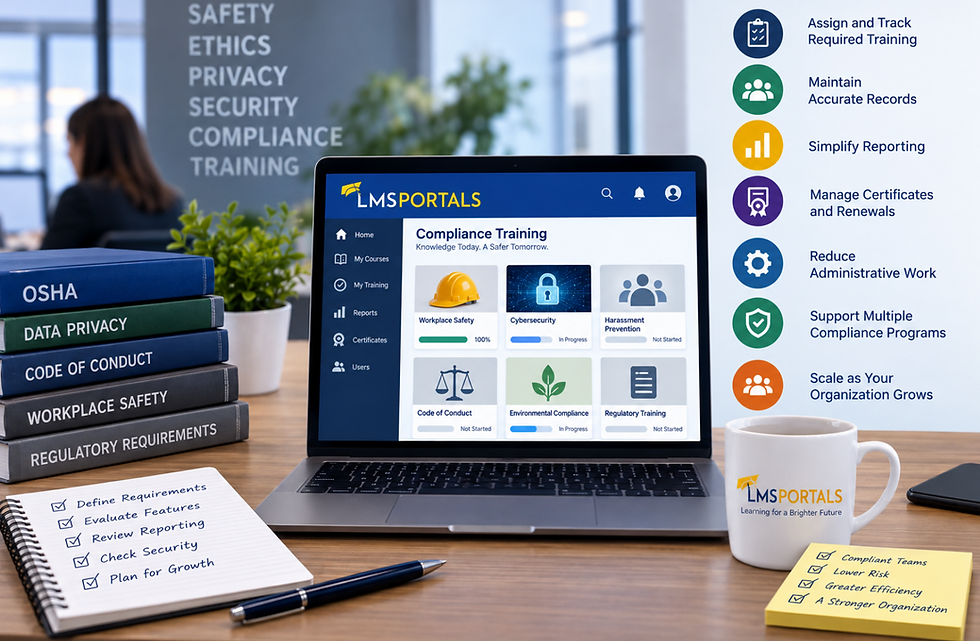
Compliance training places different demands on a learning management system than many other types of employee development. It is not enough for an organization to simply make courses available. Administrators often need to assign required training, monitor completion, maintain accurate records, issue certificates, support recurring requirements, and produce documentation when needed.
For this reason, selecting an LMS for compliance training should begin with the business and administrative requirements surrounding the training program rather than with a long checklist of LMS features.
The right platform should make compliance training easier to deliver, easier to track, and easier to manage as the organization grows. It should also provide administrators with confidence that training records can be accessed when they are needed.
The following considerations can help organizations evaluate an LMS for compliance training and determine whether a platform can support both current requirements and future programs.
Start With Your Compliance Training Requirements
Before comparing LMS platforms, organizations should define exactly what they expect the system to manage.
Identify the Training That Must Be Tracked
Compliance training can cover a wide range of subjects depending on the organization and industry. Programs may include workplace safety, cybersecurity, data privacy, harassment prevention, ethics, regulatory requirements, operational procedures, or industry-specific certifications.
The important question from an LMS perspective is how each program must be administered.
Organizations should determine which courses are mandatory, which employees or groups must complete them, how frequently training must occur, and what records need to be maintained.
These requirements create the foundation for evaluating LMS capabilities.
Consider Different Learner Groups
Compliance requirements may not apply equally to everyone.
Certain courses might be required only for managers, employees in specific locations, contractors, particular job roles, or employees working with specific equipment or information.
An LMS should make it practical to organize learners and assign appropriate training without forcing administrators to manage every enrollment individually.
Evaluate Course Assignment and Enrollment Capabilities
Assigning training is one of the most important functions of a compliance LMS.
Look for Efficient User Management
Administrators should be able to add and organize learners efficiently.
As training programs grow, manually assigning individual courses to individual employees can create a significant administrative burden.
The LMS should provide a structured way to manage users and training assignments so administrators can quickly determine who needs access to specific programs.
Consider How New Learners Are Handled
Compliance training is rarely a one-time initiative. New employees, contractors, partners, or other learners continually enter the organization.
When evaluating an LMS, consider how easily administrators can enroll new learners and provide access to required training.
A scalable process becomes increasingly important as learner populations grow.
Determine How the LMS Tracks Course Completion
Completion tracking is central to compliance training.
An organization may eventually need to demonstrate that a specific learner completed a specific course at a specific time.
Review the Training Records Maintained by the LMS
Organizations should determine what information the LMS records when learners interact with courses.
Depending on the training format, useful information may include enrollment status, course progress, completion status, completion dates, assessment results, and certificates.
Administrators should also consider how easily they can locate an individual learner's training history.
The objective is to create a reliable centralized record rather than maintaining separate spreadsheets and manual documentation.
Evaluate Support for eLearning Standards
Organizations using professionally developed online courses should consider whether the LMS supports established eLearning standards such as SCORM.
SCORM enables interactive eLearning courses to communicate information with the LMS, including completion and other learner activity supported by the course.
For organizations that purchase compliance courses from third-party providers or develop their own interactive training, SCORM support can provide greater flexibility when building the course library.
Examine Reporting Capabilities
Compliance administrators need visibility into the status of training programs.
Can Administrators Quickly Identify Incomplete Training?
An LMS should make it easy to determine which learners have completed required training and which have not.
Administrators should evaluate how quickly they can answer questions such as:
Who has completed the required course?
Who still needs to complete it?
When was the training completed?
Which courses has a specific learner completed?
What training activity has occurred within a department or group?
The easier it is to access this information, the less time administrators need to spend assembling reports manually.
Consider Audit and Documentation Needs
Organizations should also consider situations in which training records may need to be produced for customers, auditors, regulators, management, or other stakeholders.
The exact documentation required will vary by organization and regulatory environment.
An LMS does not determine whether an organization is compliant with a particular law or regulation. However, it can provide the infrastructure for maintaining and retrieving the training records that support the organization's compliance processes.
Evaluate Certificate Management
Certificates are an important component of many compliance and certification programs.
Determine How Certificates Are Issued
Organizations should determine whether certificates can be generated when learners successfully complete designated courses or programs.
Automating certificate issuance eliminates the need for administrators to manually create and distribute documents after every completion.
It also gives learners a convenient way to document their achievements.
Consider Ongoing Certification Requirements
Some compliance programs require training to be repeated periodically.
When evaluating an LMS, organizations should consider how they will manage recurring training, certification periods, and historical completion records.
Even if these requirements are relatively simple today, they may become more complicated as the organization adds learners and training programs.
Consider Automation Capabilities
One of the strongest reasons to implement an LMS for compliance training is to reduce administrative work.
Identify Your Manual Processes
Organizations should document the tasks currently required to administer compliance programs.
These may include adding users, assigning courses, sending instructions, checking completion status, issuing certificates, updating spreadsheets, and preparing reports.
Then evaluate which of these activities can be streamlined or automated through the LMS.
The objective is not simply to digitize an inefficient process. The LMS should help create a more efficient workflow.
Look Beyond Initial Implementation
A compliance program that requires significant manual intervention may be manageable with 100 learners but difficult with 1,000.
Organizations should therefore evaluate how administrative requirements will change as training volume increases.
Automation becomes increasingly valuable as the number of learners, courses, locations, and compliance programs grows.
Evaluate Support for Multiple Compliance Programs
Many organizations manage more than one compliance initiative.
Different departments or business units may have entirely different requirements.
Determine Whether Training Can Be Separated
For example, an organization might manage workplace safety training for employees, cybersecurity training for contractors, product certification for partners, and regulatory education for customers.
These programs may require different courses, administrators, branding, and reporting.
The LMS should provide enough flexibility to keep programs organized without requiring entirely separate technology systems.
Consider Multi-Portal LMS Architecture
Organizations with multiple audiences, clients, divisions, or locations may benefit from a multi-portal LMS.
Instead of placing every learner and course into one large training environment, organizations can create dedicated learning portals for different groups.
Central administrators can maintain oversight while individual portals support their own users, courses, administrators, and training programs.
This model can be especially valuable for consulting firms and training providers that deliver compliance training to multiple clients.
Consider the Learner Experience
Compliance training needs to be administratively effective, but learners also need to be able to use the system easily.
Make Required Training Easy to Find
Learners should not have to search through emails, shared drives, or multiple websites to locate required training.
A centralized learning portal gives them a clear destination for accessing courses and other resources.
The easier the process is, the fewer support requests administrators are likely to receive.
Evaluate Mobile and Responsive Access
Learners may access training from different devices and locations.
Organizations should evaluate whether the LMS provides a responsive experience that allows learners to access appropriate training content from desktop computers, tablets, and mobile devices.
The courses themselves should also be evaluated for compatibility with the devices learners are expected to use.
Review LMS Security and Access Controls
Compliance programs can involve employee information and training records, making platform security an important consideration.
Understand User Access
Organizations should determine how learners and administrators access the LMS and how permissions are managed.
Not every administrator should necessarily have access to every learner, course, or training program.
This becomes particularly important when multiple departments, clients, or external audiences use the same platform.
Ask Vendors About Their SaaS Practices
Organizations should review the vendor's policies and practices related to hosting, security, backups, system availability, data management, and other SaaS considerations relevant to their requirements.
For organizations with formal security or procurement processes, these topics should be addressed during vendor evaluation rather than after implementation.
Evaluate Scalability
The LMS should support more than the organization's immediate compliance requirements.
Consider Future Learner Growth
An organization may begin with one mandatory course for several hundred employees and eventually expand into multiple programs serving employees, contractors, customers, and partners.
Replacing an LMS can be disruptive.
Evaluating scalability early can help organizations select a platform capable of supporting future requirements.
Consider Future Training Audiences
The organization may also discover new uses for its LMS.
A system initially purchased for compliance training could later support onboarding, professional development, customer education, partner enablement, certification, or other programs.
A flexible platform gives organizations the opportunity to expand without introducing another training system.
Why LMS Portals for Compliance Training?
LMS Portals provides organizations with a flexible platform for creating, delivering, managing, and tracking compliance training.
Its multi-portal architecture is particularly valuable for organizations that need to support multiple training programs or audiences.
Create Dedicated Compliance Training Portals
With LMS Portals, organizations can create branded learning portals for different departments, business units, locations, customers, partners, members, or clients.
Each portal can support its own users, courses, administrators, and training programs while the organization maintains centralized oversight.
This approach can help keep compliance programs organized as the number of audiences and requirements grows.
Deliver SCORM Compliance Courses
LMS Portals supports SCORM-based eLearning, enabling organizations to deliver interactive compliance courses developed internally or obtained from compatible third-party course providers.
SCORM support also helps organizations maintain flexibility in how compliance content is developed and sourced.
Centralize Training Records and Reporting
Rather than relying on spreadsheets and disconnected systems, LMS Portals provides a centralized environment for managing learners, courses, enrollments, and completion activity.
Administrators gain greater visibility into training activity and can access the records needed to manage their programs.
Support Certificates and Learning Paths
Organizations can use certificates to recognize successful course completion and learning paths to organize multiple courses into structured training programs.
Learning paths can be particularly useful when a compliance or certification requirement includes several courses or learning activities that should be completed as part of a larger program.
Combine Online Courses With Live Training
Not every compliance program is entirely self-paced.
LMS Portals supports Zoom integration, enabling organizations to incorporate live webinars into broader learning initiatives alongside online courses and other training resources.
Reduce Compliance Training Administration
Centralized user management, course delivery, training records, reporting, certificates, and automation can reduce the administrative effort required to operate compliance programs.
This becomes increasingly valuable as organizations add learners, courses, clients, or business units.
Choosing an LMS for Long-Term Compliance Training
Evaluating an LMS for compliance training should ultimately come down to whether the platform makes the entire training process easier to manage.
Organizations should look beyond the ability to host courses and consider assignment, user management, completion tracking, reporting, certificates, automation, security, scalability, and support for different learner populations.
The platform should also fit the organization's operational model.
A company training one internal workforce may have different requirements than a consulting firm delivering compliance programs to dozens of clients or an enterprise managing training across multiple business units.
LMS Portals is designed to support these more complex training environments through centralized administration and flexible, branded learning portals.
By bringing courses, learners, training records, certificates, live training, and multiple audiences together within one platform, organizations can build a compliance training infrastructure that is easier to manage today and capable of expanding as requirements evolve.
About LMS Portals
LMS Portals provides a flexible, SaaS-based multi-tenant learning management system for delivering training to employees, customers, partners, clients, and other learning audiences.
Our multi-portal architecture enables organizations to launch dedicated, branded learning environments while centrally managing users, courses, compliance, reporting, and administration.
The platform includes tools for creating and delivering SCORM-compliant courses, a library of ready-made training courses, and Learning Paths for building structured training programs. LMS Portals also supports virtual instructor-led training, certification programs, automation, reporting, and social learning.
Together, these capabilities make LMS Portals a scalable solution for organizations managing training across multiple audiences.
Contact us today to get started or visit our Partner Program pages


Comments