
Compliance Risk in Construction Training: The Hidden Exposure Most Firms Miss


Construction companies operate in one of the most heavily regulated and high-risk environments in the economy. Safety standards, certification requirements, and regulatory oversight are not optional. They are foundational to staying in business.
Yet despite this, most firms still treat training as a checkbox exercise rather than a measurable risk factor.
That gap creates real exposure.
Not theoretical exposure. Financial, legal, and operational exposure that shows up fast when something goes wrong.
Here are the core challenges driving compliance risk in construction training today:
1. Fragmented Training Records
Training data lives everywhere. Spreadsheets. Paper files. Email confirmations. Third-party course providers.
There is no single source of truth.
When an audit happens or an incident occurs, companies scramble to prove compliance. Often, they can’t.
2. Expired Certifications Go Unnoticed
OSHA certifications, equipment licenses, safety training. All time-bound.
Without active monitoring, certifications expire quietly.
Workers remain on job sites without valid credentials. That creates immediate liability.
3. No Visibility Into High-Risk Roles
Not all employees carry the same level of risk.
A crane operator, a site supervisor, and a new laborer each present different compliance exposure levels.
Most systems treat them the same. That’s a problem.
4. Training Completion ≠ Compliance
Completing a course does not equal being compliant.
Was the training relevant to the job role? Is it still valid? Does it align with current regulations?
Most organizations cannot answer these questions in real time.
5. Manual Tracking Does Not Scale
As projects expand across locations, states, and subcontractors, manual tracking breaks down.
The larger the operation, the higher the risk of gaps.
And those gaps are exactly where incidents occur.
6. Subcontractor Risk Is Largely Invisible
Construction firms rely heavily on subcontractors.
But do you know if their teams are compliant?
In most cases, the answer is no. That risk still flows back to the primary contractor.
7. Reactive Compliance Culture
Most companies only dig into training records after something happens:
An OSHA inspection
A workplace incident
A legal claim
By then, it’s too late to fix the underlying problem.
The Real Cost of Training Compliance Gaps
When training compliance fails, the consequences are immediate and measurable:
OSHA fines and penalties
Project shutdowns or delays
Increased insurance premiums
Legal liability exposure
Loss of contracts or bids
Reputational damage
But the biggest cost is often operational disruption.
A single compliance issue can cascade across a project, impacting timelines, staffing, and revenue.
Why Traditional LMS Platforms Fall Short
Most learning management systems were not built for compliance risk.
They were built to:
Deliver content
Track course completion
Generate basic reports
That’s not enough for construction.
What’s missing is a way to connect training data to actual risk.
Without that connection, companies are flying blind.
Introducing a Risk-Based Approach to Training
To manage compliance effectively, construction firms need to shift from tracking activity to measuring risk.
That means answering questions like:
Which job sites carry the highest compliance exposure?
Which roles present the greatest risk right now?
Which workers are out of compliance today?
Where are certifications about to expire?
This is where a new approach is required.
LMS Portals: Built for Compliance-Critical Environments
LMS Portals is designed specifically to address these gaps.
Not just as a training platform, but as a compliance risk management system.
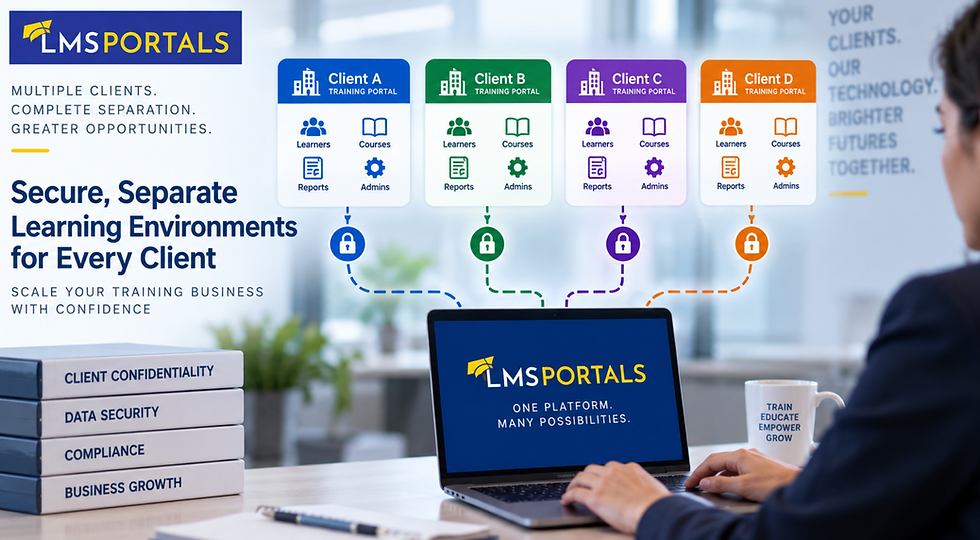
At its core is a multi-tenant architecture that allows construction firms to manage:
Multiple job sites
Business units
Subcontractor organizations
Client-specific training environments
All within a single platform.
But the real differentiator is the Compliance Risk Dashboard.
The Compliance Risk Dashboard: Turning Training Data Into Action
Instead of static reports, LMS Portals introduces a dynamic, risk-based view of training compliance.
1. Real-Time Compliance Scoring
Every user, role, and site can be assigned a compliance score based on:
Required training completion
Certification validity
Role-specific requirements
Regulatory alignment
This creates a clear, quantifiable measure of risk.
Not just “completed” or “not completed,” but a weighted risk profile.
2. Role-Based Risk Modeling
High-risk roles can be defined and monitored separately.
For example:
Crane operators
Heavy equipment drivers
Site supervisors
Each role can have its own required learning paths and compliance thresholds.
This ensures that risk is prioritized where it matters most.
3. Certification Tracking With Expiration Awareness
The system continuously monitors certification timelines.
Instead of reacting after expiration, teams can:
Identify upcoming expirations
Trigger renewal workflows
Prevent non-compliant workers from being assigned to projects
4. Site-Level Risk Visibility
Compliance risk is not uniform across projects.
The dashboard allows firms to:
Compare job sites
Identify high-risk locations
Take corrective action before issues escalate
5. Subcontractor Compliance Management
With multi-tenant capabilities, subcontractors can be brought into the same ecosystem.
This allows:
Visibility into subcontractor training status
Enforcement of compliance requirements
Reduction of downstream liability
6. Automated Alerts and Escalation
Instead of relying on manual oversight, the system flags:
Missing training
Expired certifications
At-risk roles or teams
This shifts compliance from reactive to proactive.
A Practical Example
Consider a mid-sized construction firm managing multiple job sites across three states.
Without a risk-based system:
Training records are stored across systems
Certification expirations are tracked manually
Subcontractor compliance is assumed, not verified
Now introduce LMS Portals:
Each job site operates as its own portal
Every worker is mapped to a role with defined requirements
Compliance scores are calculated daily
Expiring certifications trigger alerts weeks in advance
Subcontractors are required to maintain compliance within the system
The result:
Immediate visibility into risk
Fewer compliance gaps
Faster audit response
Reduced exposure to fines and incidents
Moving From Compliance Tracking to Risk Management
The construction industry does not have a training problem.
It has a visibility problem.
Training is happening. Courses are being completed.
But without a way to measure and manage risk, companies are exposed.
LMS Portals bridges that gap.
By connecting training data to compliance risk, it gives construction firms a clear, actionable view of where they stand at any given moment.
Why This Matters Now
Regulatory pressure is increasing.
Projects are becoming more complex.
Workforces are more distributed.
And subcontractor networks are expanding.
All of this compounds compliance risk.
At the same time, clients and partners are demanding higher standards of accountability.
Firms that can demonstrate real-time compliance visibility will have a competitive advantage.
Those that cannot will face increasing scrutiny.
Final Thought
In construction, risk is part of the business.
But unmanaged risk is not.
Training compliance should not be a guessing game or a last-minute scramble.
It should be measurable, visible, and actionable.
That’s the shift.
And that’s exactly what LMS Portals is built to deliver.
About LMS Portals
At LMS Portals, we provide our clients and partners with a mobile-responsive, SaaS-based, multi-tenant learning management system that allows you to launch a dedicated training environment (a portal) for each of your unique audiences.
The system includes built-in, SCORM-compliant rapid course development software that provides a drag and drop engine to enable most anyone to build engaging courses quickly and easily.
We also offer a complete library of ready-made courses, covering most every aspect of corporate training and employee development.
If you choose to, you can create Learning Paths to deliver courses in a logical progression and add structure to your training program. The system also supports Virtual Instructor-Led Training (VILT) and provides tools for social learning.
Together, these features make LMS Portals the ideal SaaS-based eLearning platform for our clients and our Reseller partners.
Contact us today to get started or visit our Partner Program pages


Comments