
What Regulated Industries Need From a Modern LMS


Organizations operating in regulated industries face a unique set of challenges when it comes to employee training, compliance management, certifications, and reporting. Whether the industry is healthcare, construction, manufacturing, financial services, energy, transportation, pharmaceuticals, or government contracting, training is no longer just about delivering information. It is about proving compliance, reducing operational risk, and maintaining accountability across employees, contractors, vendors, and partners.
A modern Learning Management System (LMS) must go far beyond basic course delivery. Regulated organizations need a centralized platform that supports compliance tracking, certification management, reporting, automation, scalability, and secure training delivery across multiple departments, locations, and external audiences.
As regulations continue to evolve and workforce models become more distributed, the expectations placed on LMS platforms have increased significantly. Companies now need systems that are flexible, scalable, easy to administer, and capable of supporting both internal employees and extended enterprise training initiatives.
The Growing Complexity of Compliance Training
Compliance training requirements have become increasingly complex over the past decade. Organizations must now manage:
Recurring certifications
OSHA and workplace safety requirements
HIPAA and healthcare compliance
Financial compliance and ethics training
Cybersecurity awareness programs
Contractor onboarding
Vendor certifications
Audit documentation
Equipment operation training
Environmental and regulatory compliance
Continuing education requirements
For many organizations, spreadsheets, disconnected systems, and manual tracking processes are still being used to manage critical training records. These outdated methods create operational risks and make audits significantly more difficult.
A modern LMS provides a centralized framework that allows organizations to automate training management while maintaining accurate records and accountability.
Centralized Compliance Tracking
One of the most important requirements for regulated industries is centralized compliance tracking.
Managers need immediate visibility into:
Who completed required training
Which employees are overdue
What training is assigned by role or department
Audit-ready completion records
Contractor and subcontractor compliance status
Without centralized tracking, organizations often struggle to maintain consistency across multiple locations, departments, and business units.
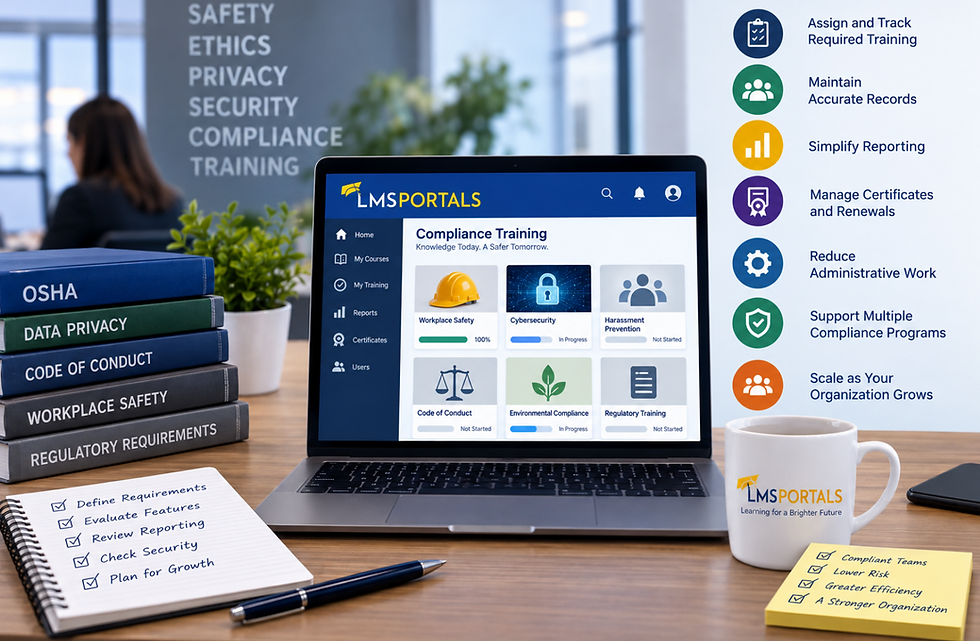
Modern LMS platforms like LMS Portals help organizations consolidate training records into a single system where administrators can monitor compliance activity in real time.
This becomes especially important for organizations managing distributed workforces, remote employees, subcontractors, or external partners.
Automated Certification and Renewal Management
In regulated industries, certifications frequently expire and require ongoing renewal training.
Manual tracking of expiration dates is inefficient and risky. Missed certifications can result in:
Regulatory fines
Safety incidents
Operational shutdowns
Increased insurance exposure
Failed audits
Contract violations
A modern LMS should automate certification management by:
Sending reminder notifications
Automatically reassigning recurring training
Tracking expiration dates
Issuing digital certificates
Maintaining historical records
Escalating overdue training to supervisors
Automation reduces administrative workload while improving accountability throughout the organization.
For companies managing large workforces or multiple client environments, these automated workflows become essential for maintaining operational efficiency.
Multi-Tenant Training Management
Many regulated organizations operate across multiple divisions, subsidiaries, clients, or geographic regions. Others provide training to external audiences such as franchisees, vendors, contractors, or customers.
Traditional LMS platforms are often not designed to support these complex organizational structures.
Modern multi-tenant LMS architecture allows organizations to create separate branded training portals under a centralized administrative framework.
This provides several advantages:
Organizational Separation
Each department, client, contractor group, or business unit can maintain its own branded portal environment while corporate administrators retain centralized oversight.
Role-Based Administration
Regional managers or client administrators can manage their own users, reporting, and training assignments without accessing other organizational data.
Scalable Growth
Organizations can rapidly deploy new training environments without rebuilding infrastructure.
Consistent Compliance Standards
Corporate administrators can maintain standardized training requirements across multiple entities while still allowing customization where needed.
LMS Portals was specifically designed around multi-tenant LMS architecture, allowing organizations to manage multiple training portals from a centralized platform.
This structure is particularly valuable for:
Safety consulting firms
Healthcare networks
Franchise systems
Manufacturing organizations
Government contractors
Compliance training providers
Workforce development organizations
External training companies
SCORM Compatibility and Content Flexibility
Regulated industries often rely on specialized third-party training content. Organizations may purchase courses from external providers or develop custom content internally.
A modern LMS must support industry-standard content formats such as:
SCORM 1.2
Video-based training
Assessments and quizzes
Interactive learning modules
Custom course development
SCORM compatibility allows organizations to maintain flexibility when sourcing or creating training materials.
Many organizations also require the ability to:
Upload proprietary procedures
Deliver customer-specific training
Customize onboarding programs
Localize content for international teams
Update training materials quickly
Modern platforms should support both off-the-shelf content libraries and custom course development workflows.
LMS Portals supports SCORM-based course delivery and allows organizations to deploy customized learning programs across multiple audiences.
Reporting and Audit Readiness
Regulated industries are heavily audit-driven. Organizations must be able to quickly produce accurate training records during inspections, audits, legal reviews, or client compliance reviews.
An LMS should provide detailed reporting capabilities including:
Completion reports
Certification status
Training histories
User transcripts
Department-level compliance dashboards
Course activity tracking
Assessment results
Expiration monitoring
The ability to generate audit-ready reports on demand is critical.
Without reliable reporting, organizations often spend significant time manually gathering records during audits.
Modern LMS reporting tools reduce this administrative burden while improving confidence in compliance documentation.
Contractor and Vendor Compliance Management
Many organizations today rely heavily on subcontractors, temporary workers, vendors, and external partners.
This creates additional compliance challenges because organizations must often verify that external workers completed required training before gaining site access or participating in operations.
A modern LMS should support:
External user management
Contractor onboarding
Vendor-specific training assignments
Compliance verification
Site-specific certifications
Digital acknowledgments
Secure external access
This functionality is especially important in industries such as:
Construction
Energy
Utilities
Manufacturing
Transportation
Logistics
Government contracting
Multi-tenant LMS platforms are particularly effective in these scenarios because each contractor organization can operate within its own secure training environment.
Mobile Accessibility and Remote Training
Today’s workforce is increasingly mobile and geographically distributed.
Field employees, technicians, drivers, healthcare workers, and contractors may not work from a traditional office environment.
Modern LMS platforms must provide:
Mobile-friendly interfaces
Remote access
Browser-based training
Self-paced learning
Cloud-based accessibility
Cross-device compatibility
Training systems that are difficult to access often result in low completion rates and administrative frustration.
Cloud-based LMS platforms simplify deployment while allowing users to complete required training from virtually any location.
User Experience Matters
Compliance training has historically suffered from poor user experiences.
Complicated systems, outdated interfaces, and difficult navigation reduce participation and increase resistance from employees.
Modern LMS platforms should focus on:
Clean user interfaces
Simplified navigation
Easy course enrollment
Streamlined reporting
Automated workflows
Clear dashboards
Reduced administrative complexity
Organizations benefit when compliance systems are easy to use because adoption rates improve significantly.
An LMS should support compliance goals without creating unnecessary administrative burdens for users or managers.
Scalability for Growing Organizations
As organizations expand, training requirements become more difficult to manage.
Growth often introduces:
Multiple locations
New business units
Additional regulations
Increased employee counts
More contractors and vendors
Expanded reporting requirements
Many organizations outgrow entry-level LMS platforms because they cannot scale effectively.
Modern LMS platforms should allow organizations to:
Add unlimited users
Launch new training portals quickly
Expand course libraries
Increase reporting capabilities
Support enterprise-level growth
Scalability is especially important for organizations that plan to expand compliance programs over time.
Security and Data Management
Regulated industries frequently handle sensitive operational and employee data.
A modern LMS should provide:
Secure cloud hosting
User permission controls
Role-based access management
Data protection standards
Secure authentication
Reliable backup systems
Organizations must ensure that training records remain secure while still being easily accessible for authorized administrators and auditors.
Why Modern LMS Platforms Are Strategic Business Assets
Many organizations still view training systems as administrative tools.
In reality, a modern LMS can become a strategic operational asset.
An effective LMS helps organizations:
Reduce compliance risk
Improve workforce accountability
Streamline onboarding
Increase operational consistency
Reduce administrative costs
Improve audit readiness
Standardize procedures
Support workforce development
Improve customer and contractor training
For training providers, consultants, and organizations managing external audiences, a multi-tenant LMS can also create new revenue opportunities through scalable training delivery models.
How LMS Portals Supports Regulated Industries
LMS Portals was designed to address many of the operational and compliance challenges faced by regulated organizations.
Key platform capabilities include:
Multi-Tenant LMS Architecture
Organizations can manage multiple branded training portals from a centralized administrative environment.
Compliance Tracking
Administrators can monitor training completion, certifications, and compliance activity across departments, contractors, and external organizations.
SCORM Support
The platform supports SCORM-based training content including custom-developed compliance courses and third-party content libraries.
Flexible Deployment Models
Organizations can support both internal workforce training and external training audiences from a single platform.
Cloud-Based Accessibility
Users can access training remotely across desktop and mobile environments.
Reporting and Administrative Oversight
Managers can generate compliance reports and monitor organizational training activity through centralized dashboards.
Scalable Infrastructure
The platform supports organizations ranging from small businesses to large distributed enterprises.
The Future of Compliance Training
Regulatory requirements are not becoming simpler. Organizations are facing increasing pressure to document training, manage workforce compliance, and demonstrate operational accountability.
At the same time, workforce structures are becoming more decentralized and dependent on contractors, vendors, and remote employees.
The modern LMS is evolving from a simple course delivery system into a centralized compliance management platform.
Organizations that invest in scalable, automated, multi-tenant learning systems position themselves to:
Improve operational efficiency
Reduce compliance risk
Simplify audits
Strengthen workforce accountability
Support long-term organizational growth
For regulated industries, training management is no longer optional administrative overhead. It is now a core operational function tied directly to safety, compliance, risk management, and business continuity.
A modern LMS provides the infrastructure needed to manage that responsibility effectively.
About LMS Portals
At LMS Portals, we provide our clients and partners with a mobile-responsive, SaaS-based, multi-tenant learning management system that allows you to launch a dedicated training environment (a portal) for each of your unique audiences.
The system includes built-in, SCORM-compliant rapid course development software that provides a drag and drop engine to enable most anyone to build engaging courses quickly and easily.
We also offer a complete library of ready-made courses, covering most every aspect of corporate training and employee development.
If you choose to, you can create Learning Paths to deliver courses in a logical progression and add structure to your training program. The system also supports Virtual Instructor-Led Training (VILT) and provides tools for social learning.
Together, these features make LMS Portals the ideal SaaS-based eLearning platform for our clients and our Reseller partners.
Contact us today to get started or visit our Partner Program pages


Comments