
OSHA Hazardous Energy Control Training


Every day, workers across manufacturing plants, warehouses, construction sites, utilities, food processing facilities, and industrial operations perform maintenance, servicing, and repair work on equipment that contains hazardous energy. While these tasks are essential to keeping operations running efficiently, they also present one of the most significant workplace safety risks when equipment is not properly isolated before work begins.
Unexpected startup of machinery or the release of stored energy can cause catastrophic injuries in a matter of seconds. Crushing injuries, amputations, electrocutions, burns, and fatalities often occur because a machine was energized unexpectedly or because stored energy was released while employees were performing maintenance.
OSHA's Hazardous Energy Control standard—commonly known as Lockout/Tagout (LOTO)—provides employers with a structured process for preventing these incidents. Comprehensive OSHA Hazardous Energy Control Training helps employees understand how to identify hazardous energy sources, safely isolate equipment, and follow procedures that protect both themselves and their coworkers.
Organizations that invest in high-quality training not only improve workplace safety but also strengthen regulatory compliance, reduce downtime caused by accidents, and foster a culture where safety is everyone's responsibility.
Understanding Hazardous Energy
Hazardous energy extends far beyond electricity. Many workplace injuries occur because employees fail to recognize that machines can store or generate multiple forms of energy.
Common hazardous energy sources include:
Electrical Energy
Electrical systems can remain energized even after equipment has been switched off. Capacitors, backup power systems, and improperly isolated circuits can all create serious hazards during maintenance activities.
Mechanical Energy
Moving machine parts, rotating shafts, flywheels, springs, and counterweights can release tremendous force if not properly secured before servicing begins.
Hydraulic Energy
Pressurized hydraulic systems store significant energy. Unexpected pressure release can cause equipment movement or high-pressure fluid injection injuries.
Pneumatic Energy
Compressed air systems may continue to hold pressure after equipment shutdown, creating hazards if air lines are not isolated and safely relieved.
Thermal Energy
Steam systems, heated equipment, and hot process lines may retain dangerous temperatures long after operations stop.
Chemical Energy
Pressurized chemicals, reactive substances, and process materials may require additional isolation procedures before maintenance work can safely begin.
Effective Hazardous Energy Control Training teaches employees how to recognize every energy source associated with a machine—not just the obvious ones.
OSHA Lockout/Tagout Requirements
OSHA's Lockout/Tagout standard (29 CFR 1910.147) establishes requirements for controlling hazardous energy during servicing and maintenance of machines and equipment.
Employers are responsible for developing and implementing a comprehensive energy control program that includes:
Written energy control procedures
Appropriate lockout and tagout devices
Employee training
Periodic inspections of procedures
Enforcement of safe work practices
The objective is simple: ensure that machinery cannot be started and stored energy cannot be released until all maintenance work has been completed safely.
Failure to comply with OSHA's requirements continues to rank among the agency's most frequently cited workplace safety violations each year, making effective training an essential part of every industrial safety program.
Who Needs Hazardous Energy Control Training?
Many employees mistakenly believe Lockout/Tagout only applies to maintenance technicians. In reality, OSHA identifies several categories of employees who require different levels of training.
Authorized Employees
Authorized employees perform lockout/tagout procedures and service equipment. They require detailed instruction on:
Energy isolation procedures
Equipment shutdown methods
Lock application and removal
Stored energy release
Verification of isolation
Equipment restoration
Affected Employees
Affected employees operate equipment or work near machinery that may be locked out during maintenance. They must understand:
The purpose of lockout/tagout
Recognition of lockout devices
Prohibited activities
Restart restrictions
Communication requirements
Other Employees
Employees who work in areas where lockout/tagout activities occur should understand the basic purpose of energy control procedures and know never to remove or bypass locks or tags.
Comprehensive training ensures every employee understands their specific responsibilities within the organization's overall energy control program.
The Seven Steps of an Effective Lockout/Tagout Procedure
Although individual procedures vary by equipment, most Lockout/Tagout programs follow a consistent sequence.
1. Prepare for Shutdown
Employees identify all energy sources connected to the equipment and review the applicable written energy control procedure.
Preparation includes understanding:
Primary energy sources
Secondary energy sources
Stored energy hazards
Equipment-specific shutdown instructions
2. Shut Down the Equipment
The equipment is stopped using its normal operating controls according to established procedures.
This step helps minimize equipment damage and prepares the system for complete energy isolation.
3. Isolate All Energy Sources
Every energy source supplying the equipment must be disconnected or isolated.
This may involve:
Disconnect switches
Circuit breakers
Valve closures
Hydraulic isolation
Pneumatic shutoff
Mechanical blocking
4. Apply Lockout/Tagout Devices
Authorized employees attach individually assigned locks and warning tags to every energy-isolating device.
Each employee performing maintenance applies their own lock whenever required.
Personal accountability is one of the fundamental principles of Lockout/Tagout safety.
5. Release Stored Energy
Residual energy must be relieved, disconnected, restrained, or otherwise rendered safe.
Examples include:
Bleeding hydraulic pressure
Venting compressed air
Discharging capacitors
Blocking moving parts
Allowing equipment to cool
Releasing spring tension
6. Verify Isolation
Before work begins, employees verify that all hazardous energy has been successfully isolated.
Verification may include:
Attempting equipment startup
Testing electrical circuits
Checking pressure gauges
Confirming zero energy state
Verification is one of the most critical—and frequently overlooked—steps in the entire process.
7. Restore Equipment to Service
After maintenance is complete:
Tools are removed.
Guards are reinstalled.
Employees are safely positioned.
Locks and tags are removed by the individuals who applied them.
Equipment is restarted using established procedures.
Following these steps consistently helps eliminate dangerous shortcuts that often lead to workplace injuries.
Common Lockout/Tagout Mistakes
Even organizations with written procedures can experience incidents when employees become complacent or fail to follow established protocols.
Common mistakes include:
Assuming Equipment Is Safe
Never assume a machine is de-energized simply because it appears to be off.
Failing to Identify Every Energy Source
Machines often contain multiple energy sources that must all be isolated.
Skipping Verification
Attempting to save time by skipping verification can have devastating consequences.
Removing Someone Else's Lock
Employees should never remove another person's lock unless specific company procedures authorize it under controlled conditions.
Inadequate Communication
Poor communication during shift changes or group lockout situations can expose employees to unnecessary risk.
Regular refresher training reinforces these critical concepts and helps prevent unsafe habits from developing over time.
Building a Strong Hazardous Energy Control Program
Training is only one component of an effective Lockout/Tagout program.
Organizations should also establish:
Written Equipment-Specific Procedures
Generic instructions are rarely sufficient.
Each machine should have clearly documented shutdown, isolation, verification, and restart procedures.
Routine Program Audits
Periodic inspections help identify gaps before they lead to incidents.
Audits should evaluate:
Employee performance
Procedure accuracy
Documentation
Equipment changes
Training effectiveness
Supervisor Accountability
Supervisors play a critical role in reinforcing safe behaviors and ensuring employees consistently follow procedures.
Visible leadership commitment encourages stronger compliance throughout the organization.
Continuous Improvement
As equipment, processes, and regulations evolve, energy control procedures should be reviewed and updated regularly.
A proactive approach keeps programs effective long after initial implementation.
Benefits of OSHA Hazardous Energy Control Training
Comprehensive training delivers measurable benefits across the organization.
Reduced Workplace Injuries
Proper Lockout/Tagout procedures dramatically reduce the likelihood of serious injuries during servicing and maintenance activities.
Improved OSHA Compliance
Employees who understand OSHA requirements are more likely to follow documented procedures consistently.
Lower Workers' Compensation Costs
Preventing severe injuries helps reduce medical expenses, insurance claims, and lost productivity.
Increased Employee Confidence
Workers who understand proper energy isolation procedures feel more confident performing maintenance safely.
Better Equipment Protection
Correct shutdown and restart procedures help reduce accidental equipment damage and costly repairs.
Stronger Safety Culture
Consistent training demonstrates that employee safety is a core organizational value.
When safety becomes part of everyday operations, compliance improves naturally.
Why Deliver Hazardous Energy Control Training Through LMS Portals?
Providing effective safety training requires more than quality content. Organizations also need a reliable system to deliver, track, and manage employee learning across multiple locations and teams.
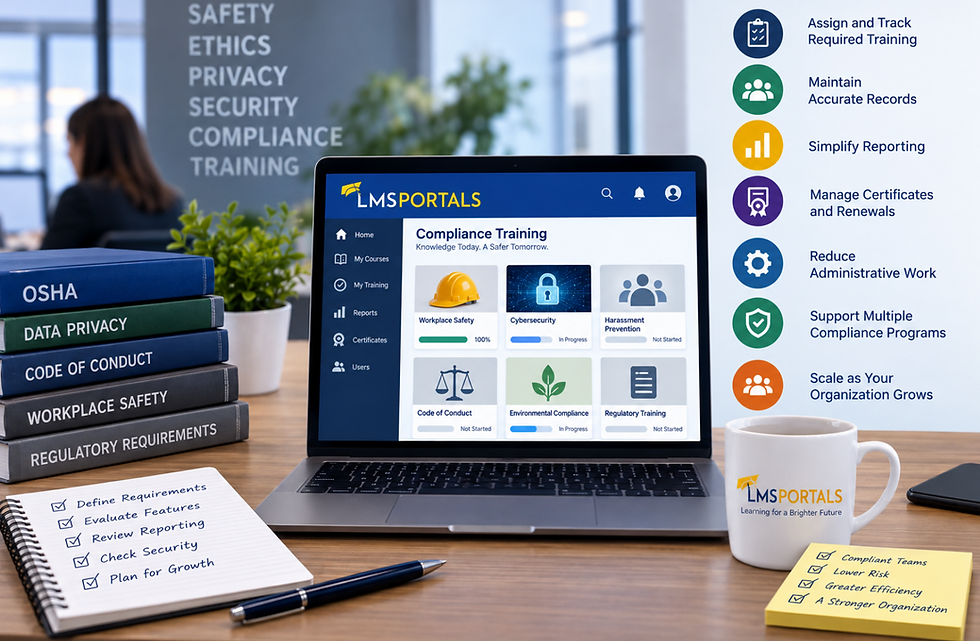
LMS Portals provides an enterprise learning management platform that makes OSHA Hazardous Energy Control Training easier to administer while improving compliance and learner engagement.
Key benefits include:
Centralized Training Management
Manage all Lockout/Tagout training from a single platform while providing employees with consistent learning experiences across departments, facilities, or client organizations.
Branded Learning Portals
Create fully branded training portals for individual business units, contractors, customers, or multiple client organizations while maintaining centralized administrative control.
Automated Compliance Tracking
Monitor course completions, training progress, certifications, and reporting through real-time dashboards that simplify OSHA documentation and internal audits.
Flexible Learning Delivery
Employees can complete Hazardous Energy Control Training from desktop computers, laptops, tablets, or mobile devices, making it easier to schedule training around operational demands.
Interactive Learning Experiences
Deliver engaging multimedia courses featuring videos, knowledge checks, real-world scenarios, and assessments that improve knowledge retention and learner participation.
Scalable for Growing Organizations
Whether training a single facility or thousands of employees across multiple locations, LMS Portals scales to meet changing organizational needs without increasing administrative complexity.
Comprehensive Reporting
Generate detailed reports that demonstrate compliance, identify overdue training, and provide documentation for inspections, internal reviews, and regulatory audits.
Expand Your Safety Training Library
Beyond Hazardous Energy Control Training, organizations can deliver hundreds of additional workplace safety, compliance, leadership, HR, cybersecurity, and industry-specific courses through the same learning platform, creating a centralized solution for workforce development.
Creating a Safer Workplace Through Effective Training
Hazardous energy remains one of the most serious risks in industrial workplaces, but it is also one of the most preventable. A well-designed Lockout/Tagout program supported by comprehensive employee training significantly reduces the likelihood of life-altering injuries while helping organizations meet OSHA requirements.
Training should not be viewed as a one-time compliance exercise. It is an ongoing investment in employee safety, operational excellence, and organizational resilience. When employees understand how to recognize hazardous energy, follow established procedures, and verify equipment isolation before beginning work, they become active participants in creating a safer workplace.
By combining expert OSHA Hazardous Energy Control Training with the powerful learning management capabilities of LMS Portals, organizations can streamline compliance, strengthen safety culture, simplify recordkeeping, and ensure every employee has access to the knowledge they need to work safely every day.
About LMS Portals
At LMS Portals, we provide our clients and partners with a mobile-responsive, SaaS-based, multi-tenant learning management system that allows you to launch a dedicated training environment (a portal) for each of your unique audiences.
The system includes built-in, SCORM-compliant rapid course development software that provides a drag and drop engine to enable most anyone to build engaging courses quickly and easily.
We also offer a complete library of ready-made courses, covering most every aspect of corporate training and employee development.
If you choose to, you can create Learning Paths to deliver courses in a logical progression and add structure to your training program. The system also supports Virtual Instructor-Led Training (VILT) and provides tools for social learning.
Together, these features make LMS Portals the ideal SaaS-based eLearning platform for our clients and our Reseller partners.
Contact us today to get started or visit our Partner Program pages


Comments