
How Can an LMS Track Manufacturing Safety Training?

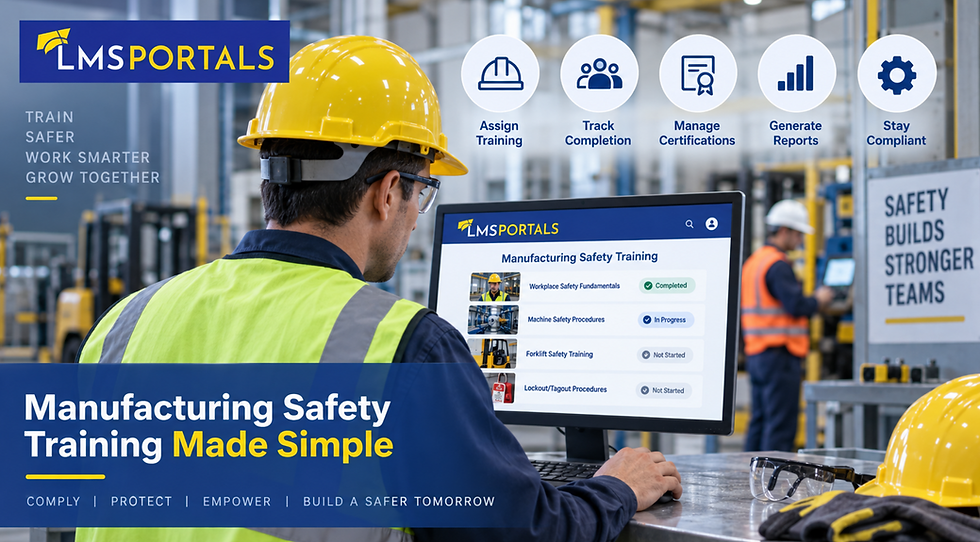
Manufacturing organizations depend on employees having the knowledge and skills needed to work safely around machinery, equipment, materials, vehicles, production processes, and other potential workplace hazards. Safety training is therefore not simply an onboarding activity. It is an ongoing responsibility that may involve initial instruction, refresher training, certifications, equipment-specific training, policy updates, and documentation of employee completion.
A learning management system (LMS) can help manufacturers bring these activities into a structured training environment.
Rather than relying on spreadsheets, paper records, emails, and separate departmental systems, manufacturers can use an LMS to assign safety training, track completion, maintain employee training histories, monitor certifications, and generate reports.
For organizations operating multiple plants, facilities, divisions, or locations, LMS technology can also provide centralized oversight while allowing individual locations to manage training for their own employees.
Why Manufacturing Safety Training Can Be Difficult to Track
Manufacturing environments often have more complicated training requirements than conventional office workplaces.
Employees Have Different Safety Training Requirements
Training requirements can vary considerably according to an employee's responsibilities.
A machine operator may require training related to equipment operation and machine safety.
A forklift operator may have different requirements.
Maintenance employees, supervisors, warehouse personnel, production workers, temporary employees, and contractors may each need their own combination of safety courses.
As the number of employees and job functions increases, manually determining who requires which training can become difficult.
An LMS provides a centralized system for organizing these different requirements.
Safety Training Is Often Recurring
Some safety topics need to be addressed periodically rather than only when an employee is hired.
Manufacturers may need to provide refresher training, respond to changing workplace procedures, introduce new equipment, or deliver updated instruction following changes in regulations or company policies.
An LMS helps organizations maintain an ongoing training process instead of treating safety education as a one-time event.
How an LMS Tracks Manufacturing Safety Training
At its core, an LMS connects learners with training activities and records what happens after training is assigned.
Tracking Course Enrollment and Completion
When an employee is enrolled in a safety course, the LMS can maintain a record of the assignment and the learner's progress.
Depending on the course and LMS configuration, administrators may be able to monitor information such as:
Course assignments and enrollments
Training status
Course completion
Completion dates
Assessment results
Learning activity
Certification information
Historical training records
This gives safety and training administrators a centralized view of employee participation.
Instead of contacting individual supervisors or reviewing separate spreadsheets, administrators can use LMS records to determine whether required learning activities have been completed.
Maintaining Individual Training Histories
Safety training frequently accumulates over an employee's entire period of employment.
An employee might complete orientation training followed by machine-specific courses, safety refreshers, new equipment training, cybersecurity education, leadership training, and additional certifications.
An LMS can maintain these activities as part of an employee's training history.
This historical record can become especially useful when an organization needs to review an employee's qualifications or demonstrate that training was provided.
Using an LMS to Assign Safety Training
Tracking becomes much easier when training assignments are organized from the beginning.
Assigning Training by Job Role
Different manufacturing positions involve different risks and responsibilities.
Manufacturers can structure training programs around job functions so employees receive learning appropriate to their responsibilities.
Examples could include training for:
Production employees
Machine operators
Maintenance technicians
Warehouse personnel
Forklift operators
Supervisors
Quality control personnel
Contractors and temporary workers
This approach can reduce unnecessary training while helping ensure required instruction reaches the appropriate audience.
Creating Safety Learning Paths
Individual safety courses can also be grouped into structured learning paths.
For example, a new production employee might follow a learning path containing general workplace safety, emergency procedures, personal protective equipment, machine safety, and department-specific training.
Learning paths provide administrators with a way to organize multiple requirements into a defined training program.
They can also make the learner experience easier by clearly showing employees which activities they are expected to complete.
How an LMS Supports Manufacturing Safety Onboarding
The first days and weeks of employment are an important period for establishing workplace safety expectations.
Standardizing New-Hire Safety Training
Without a centralized training system, onboarding may vary from supervisor to supervisor or facility to facility.
An LMS allows manufacturers to create standardized safety orientation programs that can be assigned consistently to new employees.
Online onboarding might cover subjects such as workplace safety policies, hazard awareness, emergency procedures, personal protective equipment, reporting procedures, and organizational expectations.
Employees can complete foundational online material before moving into hands-on training.
Combining Online and Practical Training
Manufacturing safety training cannot be completely replaced by eLearning.
Employees may need to demonstrate that they can operate machinery, follow lockout procedures, use protective equipment, or perform other physical tasks correctly.
An LMS can support a blended training strategy in which online instruction provides foundational knowledge while instructors or supervisors handle demonstrations and practical evaluation.
This allows manufacturers to use the appropriate training method for each requirement while maintaining a broader training program around those activities.
Tracking Manufacturing Compliance Training
Manufacturers may need to demonstrate that required training has been provided to appropriate employees.
Reliable records are therefore an important part of safety training management.
Creating Centralized Training Records
When training information is distributed among spreadsheets, paper documents, emails, and local systems, retrieving records can take significant administrative effort.
An LMS centralizes training information.
Administrators can review employee learning records, completion dates, assessment information, and other available data without reconstructing training histories from multiple sources.
Supporting Audit Readiness
Safety inspections, customer reviews, internal audits, insurance requirements, and regulatory activities may create situations where a manufacturer needs to produce training documentation.
Centralized LMS reporting can make those records easier to locate.
Instead of beginning the documentation process when an audit occurs, manufacturers can maintain training records as part of normal operations.
This creates a more sustainable approach to audit readiness.
Tracking Safety Certifications and Recurring Training
A completed safety course may not represent a permanent qualification.
Some training needs to be renewed or repeated.
Managing Certification Requirements
Manufacturers can use an LMS to organize training programs associated with certifications or other recurring requirements.
The training system provides administrators with a centralized place to monitor learning activity rather than depending on individual employees or managers to maintain separate records.
This can be particularly valuable for organizations with hundreds or thousands of employees.
Identifying Training Gaps
One of the advantages of centralized tracking is the ability to identify employees who have not completed required activities.
Administrators can use training reports to distinguish between completed and outstanding requirements.
Managers can then follow up with the appropriate employees before incomplete training becomes a larger operational problem.
Using LMS Reporting for Manufacturing Safety Programs
LMS reporting turns individual course activity into information that administrators can use to manage the overall training program.
Monitoring Completion Across the Workforce
Safety administrators can review training activity across groups of employees rather than checking each learner individually.
This can provide visibility into questions such as which employees have completed a required course, which learners still have outstanding assignments, and when specific training activities were completed.
For large manufacturing organizations, this visibility can significantly simplify administration.
Reporting Across Facilities
Manufacturers with multiple locations face another challenge: maintaining organizational standards while allowing each facility to manage local requirements.
An LMS can provide centralized reporting that helps corporate administrators understand training activity across the organization.
Individual plants or departments can manage their learners while corporate training and safety teams maintain broader visibility.
How LMS Automation Can Simplify Safety Training
The administrative work associated with training can increase rapidly as the workforce grows.
Automation can help reduce repetitive tasks.
Reducing Manual Course Administration
Instead of repeatedly coordinating courses through email and spreadsheets, organizations can use LMS processes to manage enrollments, course delivery, learning paths, and training records.
This reduces the amount of manual administration required to operate the program.
It can also create greater consistency in how training is assigned and documented.
Supporting Training at Scale
Automation becomes increasingly valuable when a manufacturer has many employees, locations, or training requirements.
A process that is manageable for 50 employees may become difficult with 500 or 5,000.
An LMS provides an infrastructure that allows the training program to grow without requiring administrative work to increase at the same rate.
How an LMS Supports Multiple Manufacturing Facilities
Manufacturers frequently operate more than one plant, warehouse, distribution center, or business unit.
This creates a balance between centralization and local control.
Creating Dedicated Training Environments
A multi-portal LMS can provide separate learning environments for different facilities, divisions, or audiences.
Each location can have its own learners, courses, administrators, and training programs.
For example, a manufacturer might establish one learning portal for each production facility while maintaining corporate-level oversight.
Individual facilities can then address local requirements without operating completely separate LMS platforms.
Maintaining Centralized Oversight
Corporate administrators can maintain broader visibility across the training environment while local administrators handle day-to-day training activities.
This model can help manufacturers standardize company-wide safety programs while still accommodating differences among facilities, departments, and employee groups.
How Safety Training Data Can Improve Manufacturing Operations
LMS data is useful for more than proving that a course was completed.
Finding Patterns in Training Activity
Centralized training information can help organizations identify patterns.
For example, administrators may discover that a particular facility has unusually high levels of incomplete training or that certain groups consistently require additional follow-up.
Training teams can use this information to investigate potential process issues.
Connecting Training to Continuous Improvement
Manufacturing organizations frequently use continuous improvement principles in production and quality management.
A similar approach can be applied to training.
Completion data, assessment results, learner activity, and feedback can help training administrators evaluate whether programs are being used effectively and where changes may be needed.
An LMS therefore becomes not only a course delivery system but also a source of information for improving training operations.
Benefits of Using an LMS for Manufacturing Safety Training
Centralizing safety training within an LMS can provide several important advantages.
More Consistent Safety Training
Standardized courses and learning paths help manufacturers deliver consistent information across shifts, departments, and locations.
Employees with similar responsibilities can receive the same foundational instruction even when they work in different facilities.
Better Visibility Into Training Status
Managers can gain a clearer understanding of completed and outstanding training requirements.
This reduces dependence on manually maintained spreadsheets and informal communication.
Stronger Training Documentation
Centralized records make it easier to maintain historical documentation of employee training.
These records can support internal management, customer requirements, compliance activities, and audit preparation.
More Scalable Training Administration
As a manufacturing organization expands, the LMS can support additional learners, courses, departments, and training audiences without requiring an entirely new administrative process.
Benefits of Working with LMS Portals for Manufacturing Training
Manufacturers often need an LMS that can support both centralized corporate programs and training requirements that differ among facilities, departments, or workforce groups.
LMS Portals is designed around a multi-portal architecture that can help organizations manage these different training environments from a centralized platform.
Dedicated Portals for Plants and Facilities
Manufacturers can create branded learning portals for different plants, facilities, divisions, business units, or other training audiences.
Each portal can support its own users, courses, administrators, and training programs.
This provides organizations with separation between learning environments while keeping them within a common LMS infrastructure.
Centralized LMS Administration
LMS Portals provides centralized management across multiple learning portals.
Corporate administrators can maintain oversight while responsibilities can also be distributed to portal-level administrators.
For manufacturers with multiple facilities, this can provide a practical balance between corporate control and local training administration.
SCORM-Compliant eLearning
LMS Portals supports SCORM-based eLearning content.
Manufacturers can use interactive courses created internally or provided by third-party content developers and training providers.
SCORM support also gives organizations greater flexibility when developing specialized safety, equipment, process, or compliance training.
Learning Paths for Structured Safety Programs
Learning paths can organize multiple courses into defined training programs.
Manufacturers can use them for new-hire safety orientation, job-specific training, supervisor development, compliance programs, or other structured learning requirements.
Live Training and Zoom Integration
Manufacturing training frequently includes instructor-led components.
LMS Portals supports live training and Zoom integration, enabling organizations to incorporate virtual instructor-led sessions alongside self-paced eLearning and other learning activities.
This supports blended training programs where online and live instruction are both required.
Centralized Reporting
Reporting provides administrators with visibility into learner activity and course completion across training portals.
Manufacturers can use these records to monitor training participation, identify outstanding requirements, maintain employee histories, and support audit readiness.
Support for Employees, Contractors, Partners, and Other Audiences
Manufacturing organizations may need to train more than their direct employees.
Contractors, distributors, dealers, suppliers, customers, and other external groups may also require product, process, compliance, or safety-related education.
The multi-portal structure of LMS Portals allows organizations to create dedicated training environments for these audiences while managing them from a centralized platform.
Building a More Effective Manufacturing Safety Training Program
Manufacturing safety depends on more than delivering a course. Organizations need a repeatable process for determining who requires training, delivering appropriate instruction, documenting completion, identifying gaps, and maintaining reliable records over time.
LMS technology provides the infrastructure for managing that process.
By centralizing courses, learning paths, employee records, reporting, live training, and other learning activities, manufacturers can reduce administrative complexity while gaining greater visibility into workforce training.
For manufacturers with multiple facilities or training audiences, the benefits can be even greater. A multi-portal approach enables individual plants, departments, and external groups to have dedicated learning environments while the organization maintains centralized oversight.
LMS Portals provides manufacturers with this combination of centralized administration and flexible learning portals, helping organizations build scalable training programs for safety, compliance, onboarding, workforce development, and other critical manufacturing training needs.
About LMS Portals
LMS Portals provides a flexible, SaaS-based multi-tenant learning management system for delivering training to employees, customers, partners, clients, and other learning audiences.
Our multi-portal architecture enables organizations to launch dedicated, branded learning environments while centrally managing users, courses, compliance, reporting, and administration.
The platform includes tools for creating and delivering SCORM-compliant courses, a library of ready-made training courses, and Learning Paths for building structured training programs. LMS Portals also supports virtual instructor-led training, certification programs, automation, reporting, and social learning.
Together, these capabilities make LMS Portals a scalable solution for organizations managing training across multiple audiences.
Contact us today to get started or visit our Partner Program pages


Comments