
How Can an LMS Support Nonprofit Training?
- LMSPortals

- 1 hour ago
- 13 min read
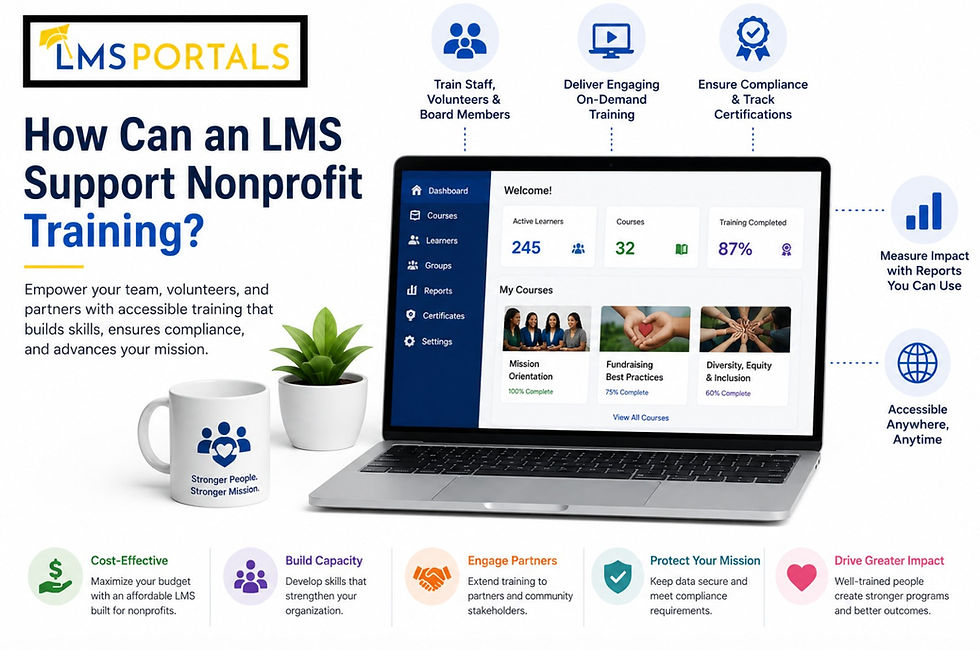
Nonprofit organizations often have some of the most diverse training audiences of any type of organization. Employees may need onboarding, compliance, leadership, and professional development. Volunteers may require orientation and role-specific instruction. Board members may need governance and ethics training. Chapters or affiliates may have their own local programs. Community partners, grantees, members, or program participants may also need education.
At the same time, nonprofits frequently need to manage all of this with limited administrative resources and tight budgets.
This creates a difficult balancing act. Training needs to be consistent enough to support quality, compliance, and organizational standards, but flexible enough to serve very different audiences. Programs may be delivered nationally or globally. Some learners may participate once, while others return every year. Staff members may wear several hats and have limited time to manage enrollments, reminders, records, and reporting.
A learning management system (LMS) can help nonprofits create a more structured and scalable approach. Instead of managing training through email, shared folders, spreadsheets, webinar links, and disconnected records, organizations can bring courses, learning paths, webinars, training records, certifications, and reporting into a centralized environment.
For nonprofits with chapters, partner organizations, member groups, or other distinct audiences, a multi-tenant LMS can extend that model even further by providing separate learning portals while maintaining centralized oversight.
The objective is not simply to put nonprofit training online. It is to build a system that makes education easier to deliver, easier to manage, and more valuable to the people the organization serves.
Why Nonprofit Training Can Be Difficult to Manage
Nonprofit organizations often operate with more complexity than their size might suggest. A relatively small central staff may be responsible for supporting employees, volunteers, chapters, program participants, board members, partners, and other stakeholders.
Each group may have different training needs.
Employees may need workplace compliance and professional development
Volunteers may need orientation before interacting with the public
Board members may require governance and fiduciary training
Regional chapters may need access to common organizational programs while also delivering local content
Community partners may need training on procedures, grant requirements, or service delivery standards
The training challenge is therefore not simply a question of learner volume. It is a question of how many different audiences the nonprofit needs to support and how independently those audiences need to operate.
Manual Processes Become Difficult as Programs Grow
Many nonprofits begin by distributing training through email, shared documents, live webinars, or recorded presentations. Staff members maintain participant lists in spreadsheets and issue certificates manually.
That can work when the training program is small. As participation grows, the administrative workload grows with it.
Someone needs to enroll new learners, send instructions, answer access questions, monitor completion, remind participants, reconcile webinar attendance, issue certificates, and produce reports for leadership, funders, auditors, or grant programs.
An LMS can reduce much of this administrative burden by providing one system for organizing and tracking the learning process.
Use an LMS for Employee Onboarding
Nonprofits need strong employee onboarding just as much as commercial organizations do, but the onboarding process may be highly dependent on individual managers.
One new hire may receive an excellent introduction to the organization while another receives a collection of links and documents.
An LMS can provide a consistent foundation.
Create a Repeatable New-Hire Program
A nonprofit can create a structured onboarding learning path containing organizational mission and values, policies, workplace conduct, cybersecurity, data privacy, program information, and job-specific material.
Every new employee receives the same foundational experience while departments can add training relevant to particular roles.
This can be especially valuable for remote or distributed organizations where new employees may not spend their first week at a central office.
The LMS gives them a clear place to begin and provides administrators with visibility into what they have completed.
Train Volunteers Before They Begin Serving
Volunteers can be essential to nonprofit operations, but they can also create unique training challenges.
Some organizations may have hundreds or thousands of volunteers who participate periodically rather than working every day. They may not have company email addresses, may join for a single event, or may need different training depending on the work they perform.
Create Structured Volunteer Orientation
An LMS can provide volunteers with a dedicated onboarding experience before they begin participating in programs.
Training might cover the organization's mission, code of conduct, safety procedures, privacy expectations, working with vulnerable populations, emergency procedures, program-specific responsibilities, or other relevant topics.
Instead of relying entirely on coordinators to repeat the same orientation every time a new group arrives, the foundational material can be delivered online.
Live orientation can still be used where appropriate, but staff members can spend that time on discussion and practical preparation rather than repeatedly presenting the same information.
Support Board Member Training
Board members have responsibilities that differ significantly from employees and volunteers.
They may need education related to nonprofit governance, fiduciary responsibilities, ethics, conflicts of interest, risk management, strategic planning, fundraising responsibilities, or organizational policies.
Board membership also changes over time, making consistent onboarding important.
Build a Board Education Program
A nonprofit can create a learning path specifically for new board members and maintain additional resources for ongoing governance education.
This provides a consistent baseline of knowledge while allowing board members to access training on their own schedules.
It also creates a documented record showing which board members completed important organizational training.
For organizations subject to governance or funding requirements, maintaining that record may have additional value.
Deliver Compliance Training Across the Organization
Nonprofits may face many of the same training compliance requirements as other employers, including workplace conduct, cybersecurity, privacy, safety, and policy-related training.
Depending on their programs, nonprofits may also have specialized requirements related to grants, government contracts, healthcare, education, accessibility, safeguarding, financial controls, or other areas.
Keep Required Training Organized
An LMS can help nonprofits define which training applies to which groups and organize those requirements into structured programs.
Employees in one role may require one set of courses, while program staff working directly with clients require additional training. Supervisors may have separate responsibilities. Volunteers may need only the requirements relevant to their activities.
The organization can also maintain due dates, completion records, and recurring training requirements where appropriate.
This creates a more reliable compliance process than relying on individual managers or program directors to maintain separate spreadsheets.
Manage Recurring Training and Certifications
Some nonprofit training requirements need to remain current over time.
Employees or volunteers may need annual refresher training, periodic safety certification, safeguarding updates, professional credentials, or other recurring qualifications.
Simply recording that someone completed a course once may not be enough.
Track Current Status, Not Just Historical Completion
A volunteer who completed a required certification three years ago may no longer satisfy the organization's current requirement. A staff member's professional credential may expire. An annual policy course may need to be repeated.
An LMS with compliance and recertification capabilities can help administrators maintain visibility into these recurring requirements.
Instead of waiting until a certification has already expired, staff can identify upcoming renewals and take action before a gap develops.
This can be particularly valuable for nonprofits whose programs depend on qualified employees, volunteers, or service providers.
Use Learning Paths for Structured Programs
Nonprofit education frequently involves more than a single course.
A volunteer may need to complete orientation, safeguarding, privacy, safety, and role-specific training. A program manager may need leadership development, compliance, and operational training. A board member may need a series of governance modules.
Learning paths can organize these requirements into clearly defined programs.
Make Training Easier for Learners to Navigate
Instead of giving learners access to a large library and expecting them to determine what applies, the nonprofit can provide structured journeys.
A volunteer path might contain all requirements that must be completed before service begins. A manager path might combine leadership and compliance courses. A chapter leader path might include governance, brand standards, fundraising procedures, and reporting requirements.
This improves the learner experience and makes administration easier because progress can be monitored across the entire program.
Support Chapters and Affiliates
Many nonprofits operate through chapters, affiliates, regional offices, or independent local organizations.
The central organization may want to provide consistent training while still giving local groups flexibility.
This is where a multi-tenant LMS can be particularly valuable.
Create Separate Training Portals for Chapters
A national nonprofit could create a learning portal for each chapter or regional organization.
Each portal can contain its own learners, administrators, branding, course catalog, and local programs. The national organization can distribute shared training across these environments while maintaining broader oversight.
This allows chapters to manage their own audiences without requiring them to purchase and operate independent LMS platforms.
It also provides the central organization with a more consistent training infrastructure across the network.
Support Member Organizations and Partners
Some nonprofits serve other organizations rather than only individual members.
A foundation may work with grantees. A professional nonprofit may support member organizations. A national organization may need to train local partners that deliver programs in their communities.
These relationships can be difficult to manage inside one shared LMS environment.
Give Partner Organizations Their Own Learning Environment
A multi-portal model allows the nonprofit to provide separate training environments to partner organizations while maintaining control over shared educational content.
A partner administrator can potentially manage its own participants. The nonprofit can publish required courses, resources, webinars, and learning paths to that partner's portal.
This reduces the administrative burden on the central team and creates a more professional experience for partner organizations.
The LMS becomes part of the nonprofit's broader support infrastructure.
Train Program Participants and Community Audiences
Some nonprofits also use education as part of their mission.
They may provide financial literacy programs, workforce development, health education, leadership training, accessibility education, technical assistance, or other learning directly to the communities they serve.
An LMS can help extend these programs beyond live workshops.
Turn Educational Programs Into Ongoing Resources
A nonprofit that traditionally delivers a two-hour workshop could supplement it with online courses, exercises, recorded webinars, and additional resources.
Participants can learn at their own pace and return to the material when necessary.
For workforce development programs, the nonprofit could build structured learning paths. For public education programs, courses can provide scalable access to expertise that may otherwise require repeated staff delivery.
This can help the organization extend its reach without requiring a proportional increase in instructor time.
Combine eLearning With Webinars and Live Programs
Nonprofit training does not need to become entirely self-paced.
Live webinars, workshops, coaching, and instructor-led programs can remain important parts of the learning strategy.
An LMS can help bring these different formats together.
Create a Blended Learning Experience
Participants might complete a short online course before attending a webinar, use the live session for discussion and practical application, and return to the LMS afterward for additional resources or follow-up training.
This approach can make live sessions more productive because participants arrive with a common baseline of knowledge.
It also creates a clearer training record. Instead of webinar attendance being maintained separately from course completion, relevant activity can become part of the learner's broader history.
For nonprofits delivering frequent webinars, this can significantly simplify administration.
Reduce Repetitive Training Work
Nonprofit employees often have broad responsibilities. A program manager may also be responsible for onboarding volunteers. An HR leader may manage compliance training along with several other functions. Chapter staff may have only limited time available for learning administration.
The LMS should reduce repetitive work rather than create another administrative burden.
Automate Routine Parts of the Process
Training assignments, structured learning paths, notifications, reminders, certificates, and reporting can reduce the amount of manual intervention required.
The central team can create a program once and use it repeatedly.
Instead of emailing the same presentation to every new volunteer group, the organization can maintain a volunteer orientation course. Instead of individually reminding 100 employees about training, administrators can use the LMS to support routine communication and focus on people who remain overdue.
The objective is to make training scalable without requiring the training team to grow at the same rate as the learner population.
Maintain Better Training Records
Nonprofits may need training records for many reasons.
Funders may ask for evidence that program staff have appropriate qualifications.
Government contracts may include training requirements. Insurance providers may request documentation. Boards may want visibility into compliance. Internal leadership may need evidence that volunteers or staff completed required programs.
Without a centralized system, producing these records can become time-consuming.
Build Documentation Into Everyday Training
An LMS can maintain information about course completion, learning paths, assessments, webinars, certifications, and other training activity.
This creates a more reliable record than trying to reconstruct history from email, spreadsheets, shared drives, and paper certificates.
For recurring requirements, the organization can also distinguish between historical completion and current compliance status.
The result is a training record that supports both day-to-day administration and audit readiness.
Use Reporting to Demonstrate Training Impact
Nonprofits often need to demonstrate results to boards, donors, grantmakers, and other stakeholders.
Training data can become part of that story.
Reporting can show how many people participated, which programs were completed, how engagement differs across chapters or partners, and where additional support may be needed.
Turn Learning Activity Into Program Insight
Suppose a nonprofit operates a national volunteer education program. Reporting could show participation by region, completion rates across chapters, and which courses generate the strongest engagement.
A foundation delivering training to grantees might evaluate which partner organizations are participating most actively.
A professional nonprofit might use continuing education data to understand member interests and guide future programming.
This information can help organizations improve training while also demonstrating how education contributes to the nonprofit's mission.
Protect Limited Training Budgets
Cost matters for every organization, but it can be especially important for nonprofits.
Technology investments need to deliver clear value, and staff time is often just as important as software cost.
The cheapest LMS is not necessarily the most economical if it requires extensive manual administration. Similarly, a powerful enterprise platform may provide far more complexity than a nonprofit actually needs.
Evaluate Cost Through the Entire Training Process
Nonprofits should consider the cost of creating courses, managing learners, administering chapters or partners, sending reminders, hosting webinars, maintaining records, generating reports, and supporting the platform.
A multi-tenant LMS can be particularly valuable when it eliminates the need for multiple chapters, member organizations, or partner groups to purchase independent systems.
Centralized content can also reduce duplication. Instead of every chapter recreating the same training, the central organization can develop a course once and distribute it where needed.
This allows the nonprofit to direct more resources toward program quality rather than repetitive administration.
Use Training to Strengthen the Nonprofit Network
Training can do more than satisfy compliance requirements.
It can help create consistency across a distributed organization.
When staff, volunteers, chapters, partners, and board members share a common understanding of the nonprofit's mission, policies, service model, and expectations, the organization can operate more cohesively.
Scale Knowledge Without Losing the Mission
A growing nonprofit can face a difficult problem: the people who originally built the organization may understand its mission and methods deeply, but that knowledge can become diluted as the network expands.
Structured online training gives nonprofits a way to capture and distribute institutional knowledge.
Programs can explain not only what employees and volunteers should do, but why the organization approaches its work in a particular way.
That can help preserve culture and consistency as more people become involved.
How LMS Portals Supports Nonprofit Training
LMS Portals provides a multi-tenant learning platform that can support nonprofits with diverse and distributed training audiences.
Organizations can use the platform to manage employees, volunteers, chapters, member organizations, partners, program participants, or other learner populations while maintaining centralized oversight.
Create Dedicated Portals for Different Audiences
Nonprofits can create separate branded portals for chapters, regions, partner organizations, volunteer groups, member organizations, or other audiences.
Each portal can maintain its own users, administrators, course catalog, learning paths, and training programs.
This can provide local groups with greater autonomy while allowing the nonprofit's central team to maintain a common training infrastructure.
Maintain and Distribute Shared Content
Organizations can maintain course content centrally and make appropriate training available across multiple portals.
A national nonprofit might maintain core training on mission, policies, cybersecurity, safeguarding, or volunteer expectations and distribute those courses across regional portals.
Individual chapters can then add local programs where appropriate.
This provides consistency without requiring every audience to have exactly the same training environment.
Build Structured Learning Paths
LMS Portals supports learning paths that can organize courses into defined programs for different learner populations.
Nonprofits can create employee onboarding, volunteer orientation, board training, chapter leadership programs, compliance paths, professional development, or program-participant education.
This helps learners understand what they need to complete and gives administrators a more structured way to monitor progress.
Support Webinars and Other Learning Activities
Nonprofits frequently rely on webinars and virtual meetings to reach distributed audiences.
LMS Portals can support webinars and meetings alongside self-paced courses, quizzes, surveys, and other learning activities.
This enables organizations to combine live and asynchronous learning within a broader training strategy rather than maintaining each format in a separate system.
Manage Compliance and Recertification
For training that needs to remain current, LMS Portals provides compliance and recertification capabilities.
Organizations can use these tools to manage recurring requirements for employees, volunteers, contractors, or other populations.
This can be particularly valuable for safety, safeguarding, certifications, policy training, or other requirements with renewal schedules.
Maintain Training Records and Reporting
LMS Portals provides training records and reporting capabilities that help organizations maintain visibility into learner activity.
Nonprofits can use reporting to monitor completion, identify gaps, support audits, evaluate participation, and better understand engagement across different audiences or portals.
For distributed organizations, this can provide central leadership with visibility while allowing individual groups to manage their own programs.
Develop Custom eLearning Courses
Many nonprofits possess extensive subject-matter expertise but do not have internal resources for professional eLearning development.
LMS Portals also provides custom course development services.
Existing presentations, manuals, policies, recorded webinars, program materials, subject-matter expertise, and other resources can become the foundation for online courses.
Organizations can create custom training around volunteer onboarding, program delivery, safeguarding, leadership, compliance, member education, community programs, or other nonprofit-specific needs.
Combining course development with the LMS can provide a more complete approach to turning nonprofit knowledge into scalable learning.
Make Training Part of the Nonprofit Infrastructure
For nonprofits, training is often deeply connected to the mission.
Employees need the skills to deliver programs effectively
Volunteers need to understand their responsibilities
Board members need to govern responsibly
Chapters need consistency
Partners need to understand program requirements
Communities may depend on the organization for education and professional development
Managing all of these audiences through disconnected tools can place unnecessary pressure on already limited administrative resources.
An LMS provides an opportunity to create a more structured approach. Common training can be developed once and reused. Learning paths can organize requirements.
Webinars and online courses can work together. Training records can provide evidence of participation. Recurring requirements can be monitored. Reporting can provide insight into engagement and program performance.
For nonprofits with chapters, affiliates, partner organizations, or other distributed populations, a multi-tenant architecture can extend this approach by giving each audience its own learning environment while the central organization maintains broader oversight.
LMS Portals is designed to support this model through separate branded portals, centralized content management, learning paths, webinars, training records, compliance management, recertification, reporting, and custom eLearning development.
The value of an LMS for a nonprofit is ultimately not about adding another piece of technology.
It is about creating an infrastructure that helps the organization train more people consistently, manage programs with fewer administrative demands, and extend its knowledge and mission to every audience it serves.
About LMS Portals
At LMS Portals, we provide our clients and partners with a mobile-responsive, SaaS-based, multi-tenant learning management system that allows you to launch a dedicated training environment (a portal) for each of your unique audiences.
The system includes built-in, SCORM-compliant rapid course development software that provides a drag and drop engine to enable most anyone to build engaging courses quickly and easily.
We also offer a complete library of ready-made courses, covering most every aspect of corporate training and employee development.
If you choose to, you can create Learning Paths to deliver courses in a logical progression and add structure to your training program. The system also supports Virtual Instructor-Led Training (VILT) and provides tools for social learning.
Together, these features make LMS Portals the ideal SaaS-based eLearning platform for our clients and our Reseller partners.
Contact us today to get started or visit our Partner Program pages


Comments