
Why Is LMS Data Isolation Important for Training Providers?

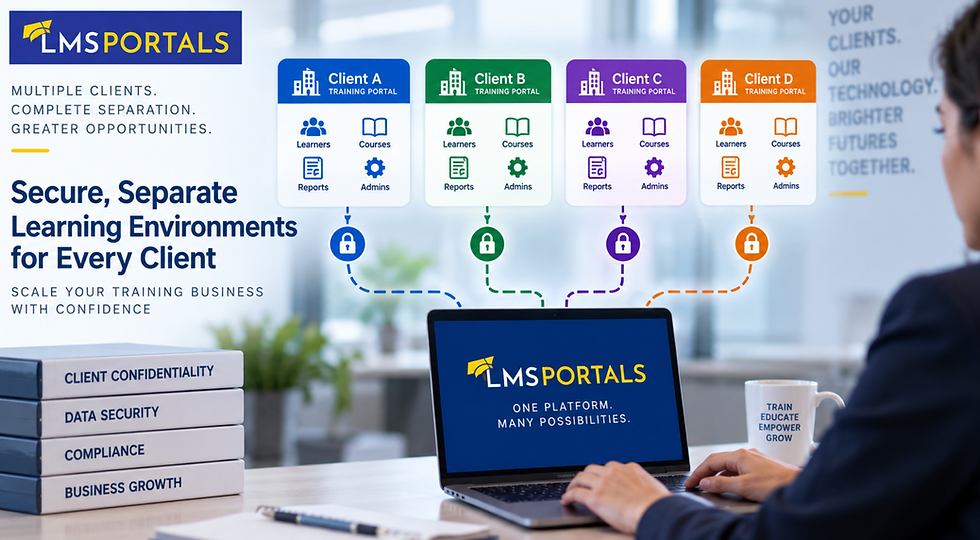
Training providers often serve multiple clients at the same time. Each client may have its own learners, administrators, courses, training records, reports, branding, and business requirements. While these audiences may all be supported through the same learning management system (LMS), they should not necessarily have access to the same information.
This is where LMS data isolation becomes important.
Data isolation is the separation of data belonging to different customers, organizations, portals, or groups within a shared technology environment. In a multi-tenant or multi-portal LMS, data isolation helps ensure that one client cannot access another client's learners, training records, administrative information, or other restricted data.
For training providers, this is more than a technical consideration. Effective data isolation can support client confidentiality, strengthen security, simplify administration, and make it possible to scale a training business across many customers without operating a completely separate LMS for each one.
What Is Data Isolation in an LMS?
LMS data isolation refers to the controls and architecture used to keep the information associated with one customer or training environment separated from information belonging to others.
Separating Client Training Environments
Consider a training company that provides compliance training to 50 corporate clients.
The training provider may want to manage all 50 clients from one centralized LMS.
However, each client should typically see only its own employees, courses, assignments, reports, and training records.
Client A should not be able to view Client B's learners.
Client B's administrators should not be able to access Client C's training reports.
Data isolation creates boundaries that help maintain this separation while allowing the training provider to operate the overall environment.
Isolation Does Not Necessarily Mean Separate Systems
Data isolation should not be confused with running an entirely separate LMS installation for every client.
A multi-tenant LMS can serve many organizations from a shared platform while logically separating their information and access.
This model can provide the efficiency of centralized technology with the separation required for individual customer environments.
Why Training Providers Need Data Isolation
The need for isolation becomes increasingly important as a training company adds clients.
Every Client Has Its Own Data
A training provider may collect or manage information such as learner names, email addresses, enrollment information, course activity, assessment results, certifications, training histories, and administrative records.
Clients generally expect their information to remain within their authorized environment.
Data isolation helps enforce those boundaries.
Clients May Be Unrelated Organizations
Unlike an internal corporate LMS, a training provider's LMS may serve organizations with no relationship to one another.
Some may even operate within the same industry or compete in the same markets.
This makes separation particularly important.
The LMS should be structured so that access is based on the user's organization, portal, role, and permissions rather than simply giving every administrator access to the broader system.
How Data Isolation Supports LMS Data Privacy
Privacy is one of the primary reasons training providers should consider how their LMS separates customer information.
Limiting Access to Appropriate Users
A well-structured LMS should help ensure that users can access only the information necessary for their responsibilities.
A client administrator may need to see training activity for employees within that client's organization, for example, but should not require access to learners associated with other customers.
This principle helps reduce unnecessary exposure of information.
Creating Clearer Data Boundaries
When many customers are managed within the same system, clearly defined boundaries make the environment easier to understand and control.
Rather than relying entirely on administrators to remember which information belongs to which customer, the LMS architecture itself can help establish separation.
This can become especially important as the number of customers, administrators, and learners increases.
Data Isolation and Role-Based Access Control
Data isolation and user permissions work together.
Different Users Need Different Levels of Access
A training provider may have several types of users within its LMS environment.
Internal LMS administrators may require broad access across clients
Client administrators may need access only to their own organization's training environment
Managers may need information about specific groups of employees, while learners may require access only to their own courses and records
Role-based access controls help determine what each type of user can do
Data isolation helps determine which client environment and information those permissions apply to.
Reducing Administrative Risk
Without clearly separated environments, administrators may have to manually navigate large collections of users, courses, and records belonging to many different customers.
That increases complexity.
Separating client environments can simplify administration by providing each client with a defined space containing the users and training resources relevant to that organization.
How Data Isolation Supports Multi-Tenant LMS Architecture
Data isolation is particularly important in multi-tenant LMS environments.
What Is a Multi-Tenant LMS?
A multi-tenant LMS allows multiple customers or organizations to use a shared technology platform.
The training provider can centrally manage the overall system while individual customers operate within their respective learning environments.
This architecture can help training companies avoid deploying and maintaining a separate LMS instance for every customer.
Combining Efficiency with Separation
The business advantage of multi-tenancy comes from sharing infrastructure while preserving appropriate organizational boundaries.
Training providers can maintain courses centrally, manage customers from a common administrative environment, and potentially reuse training resources across multiple audiences.
At the same time, individual customers can have separate learners, administrators, assignments, reports, and other information.
Data isolation is therefore a foundational concept behind an effective multi-tenant training model.
Why Data Isolation Matters for Client Reporting
Reporting is one of the most important LMS functions for many training providers.
Clients want visibility into their own training programs.
Providing Client-Specific Reports
A client administrator may need to answer questions such as:
Which employees completed required training?
Who has outstanding assignments?
What courses have employees taken?
What assessment results were recorded?
Which learners completed a certification program?
When was required training completed?
The administrator should be able to access relevant information without seeing records belonging to other customers.
Data isolation helps establish this reporting boundary.
Supporting Client Self-Service
Without client-specific environments, training providers may have to generate reports manually and send them to customers.
As the client base grows, this can create considerable administrative work.
Giving authorized client administrators access to their own training environment can enable more self-service while maintaining separation from other customers.
Data Isolation Can Support Compliance Training
Many training providers specialize in compliance-related education.
These programs can create additional recordkeeping requirements.
Maintaining Separate Compliance Records
A training provider might deliver the same compliance course to hundreds of companies.
The course content may be shared, but the learner records should remain associated with the appropriate customer.
Data isolation helps keep those training histories organized by client.
This makes it easier for administrators to retrieve the appropriate records when a customer requests information.
Supporting Audit Readiness
Clients may need training records for internal audits, customer requirements, regulatory reviews, certification processes, or other compliance activities.
A properly structured LMS can help training providers quickly locate the relevant client's records.
Rather than searching a combined pool of learner information, administrators can work within a defined customer environment.
Data Isolation Helps Training Providers Protect Their Client Relationships
There is also a business dimension to data isolation.
Training providers are often trusted with information related to their customers' employees and training operations.
Strengthening Client Confidence
Customers want confidence that their training environment is appropriately separated from other organizations using the same platform.
Being able to explain how users, administrators, records, and reporting are separated can help a training provider demonstrate a more mature approach to LMS administration.
This can become especially important when working with larger organizations that have formal security and vendor-review processes.
Supporting Enterprise Sales
Enterprise customers may ask detailed questions about platform architecture, permissions, privacy, security, and data separation during procurement.
A training provider using an LMS designed for multiple customer environments may be better positioned to address these questions than one relying on informal workarounds.
The underlying LMS architecture can therefore become part of the training provider's overall service proposition.
How Data Isolation Helps Training Providers Scale
What works for five clients may not work for 50 or 500.
Scalability is one of the strongest reasons to establish a structured approach to customer separation.
Avoiding Administrative Complexity
Imagine managing thousands of learners belonging to hundreds of customers within one undifferentiated environment.
Administrators would need to constantly determine which learners, courses, reports, and records belonged to each client.
Dedicated client environments provide structure.
Each new customer can be placed into an appropriate learning environment rather than simply being added to an increasingly complicated shared user population.
Standardizing Client Deployment
A multi-portal approach can also help training providers develop a repeatable customer onboarding process.
When a new client signs up, the provider can establish a dedicated portal, configure branding, add administrators, enroll learners, assign content, and manage reporting within that environment.
This creates a model that can be repeated as the training business grows.
Data Isolation and Branded Client Training Portals
Training providers often want customers to feel that they have their own learning environment.
Data separation and branding work well together.
Creating a Dedicated Client Experience
A client portal can provide a focused environment containing the customer's branding, learners, administrators, courses, and training programs.
This can create a more professional customer experience than placing every learner into one generic training site.
The client sees an environment organized around its needs while the training provider maintains control of the underlying LMS.
Supporting White-Label Training Services
For companies selling training as a service, branded portals can become an important component of the offering.
A training provider can potentially create learning environments for individual customers without building or maintaining a separate technology platform for each organization.
Combined with appropriate data isolation, this model can support scalable white-label training services.
Centralized Course Management Without Sharing Client Data
Separating customer information does not mean everything needs to be duplicated.
Reusing Training Content
A training provider may deliver the same safety, compliance, leadership, technical, or professional development courses to many clients.
A multi-portal LMS can allow training content to be centrally managed while making appropriate courses available to different client environments.
This reduces unnecessary duplication.
Separating Content Management from Learner Records
This distinction is important.
The provider may want to share a course across multiple portals while keeping each client's enrollments, progress, results, and reports separate.
An effective LMS architecture allows centralized content management and client-specific learner management to coexist.
Data Isolation for Different Training Provider Business Models
The value of data isolation extends beyond traditional corporate training companies.
Compliance Training Providers
Compliance providers may serve many organizations that take the same required courses but need completely separate learner records and reporting.
Professional Associations
Associations may provide education to chapters, member organizations, employers, or other groups that require their own learning environments.
Franchise Training Providers
Organizations supporting franchise networks may need centralized content with separate training environments for individual franchisees.
Consultants and Training Companies
Consultants can use dedicated portals to provide each client with its own branded training environment while maintaining centralized oversight.
Extended Enterprise Training
Companies that educate customers, partners, distributors, dealers, or other external audiences can use similar isolation principles to separate different organizations and learner populations.
Benefits of Working with LMS Portals for Training Providers
The multi-portal architecture of LMS Portals is particularly relevant to training providers because it is designed to support multiple learning audiences from a centralized platform.
Dedicated Learning Portals
Training providers can create separate learning portals for individual customers, organizations, departments, or other audiences.
Each portal can support its own users, courses, administrators, branding, and training programs.
This provides a structured approach to separating client learning environments.
Centralized Administration
Although customers can operate in separate portals, the training provider can maintain centralized oversight.
This allows the provider to manage multiple client environments without operating completely independent LMS platforms.
For a growing training business, centralized administration can substantially simplify customer management.
Multi-Tenant Data Separation
The LMS Portals model allows organizations to establish distinct portal environments within the broader platform.
This structure helps training providers organize users, training activities, and administrative access around individual client environments rather than combining every customer into one general-purpose learning population.
Branded Client Portals
Training providers can create branded learning environments for their customers.
This can help providers deliver a more professional client experience and can support private-label or white-label training business models.
SCORM-Compliant eLearning
LMS Portals supports SCORM-based eLearning, enabling providers to deliver interactive courses created with compatible authoring tools.
Training providers can use their own proprietary content or appropriate third-party courses as part of their client programs.
Learning Paths
Courses can be organized into structured learning paths for onboarding, compliance, certification, professional development, and other training programs.
This allows providers to package multiple learning activities into repeatable programs that can be delivered to appropriate audiences.
Live Training and Zoom Integration
LMS Portals supports live training and Zoom integration, allowing providers to combine self-paced eLearning with virtual instructor-led sessions.
This can be useful for training businesses that offer blended programs rather than relying entirely on asynchronous courses.
Centralized Reporting
Training providers can maintain visibility into learning activity while individual client environments remain logically separated.
This combination supports both provider-level administration and client-specific training management.
Building a Scalable Training Business with Data Isolation
For training providers, LMS data isolation is ultimately about creating boundaries without sacrificing efficiency.
Customers need confidence that their learners, administrators, training records, and reports are appropriately separated from other organizations. At the same time, the training provider needs an efficient way to manage courses, customers, reporting, and administration across the entire business.
Operating a completely separate LMS for every client can create unnecessary complexity. Placing every customer into one undifferentiated learning environment creates a different set of challenges.
A multi-tenant, multi-portal LMS provides another approach: centralized technology combined with distinct client learning environments.
For training companies planning to expand their customer base, this architecture can become increasingly valuable. New client portals can be added within an established framework while the provider retains centralized oversight of the broader training operation.
LMS Portals is designed around this model, giving training providers the ability to create and manage dedicated learning portals for different clients and audiences from a centralized platform.
With the right LMS architecture, data isolation can help training providers strengthen client privacy, simplify administration, support compliance programs, deliver branded customer experiences, and build a more scalable foundation for growing their training business.
About LMS Portals
LMS Portals provides a flexible, SaaS-based multi-tenant learning management system for delivering training to employees, customers, partners, clients, and other learning audiences.
Our multi-portal architecture enables organizations to launch dedicated, branded learning environments while centrally managing users, courses, compliance, reporting, and administration.
The platform includes tools for creating and delivering SCORM-compliant courses, a library of ready-made training courses, and Learning Paths for building structured training programs. LMS Portals also supports virtual instructor-led training, certification programs, automation, reporting, and social learning.
Together, these capabilities make LMS Portals a scalable solution for organizations managing training across multiple audiences.
Contact us today to get started or visit our Partner Program pages


Comments