
Transforming LMS Data into a Strategic Asset


A Learning Management System (LMS) has traditionally been viewed as a tool for delivering online training, tracking course completions, and maintaining compliance records. While these functions remain essential, modern organizations are beginning to recognize that their LMS generates something even more valuable than completed training—it generates data.
Every learner interaction provides meaningful insight into how employees develop new skills, engage with learning content, and prepare for their roles. Course enrollments, assessment scores, certifications, learning paths, and completion histories collectively create a comprehensive picture of workforce readiness and organizational performance.
Companies that leverage this information effectively can identify skills gaps, improve compliance, optimize training investments, and make more informed business decisions. Rather than serving solely as a repository for training records, today's LMS has become a strategic business intelligence platform.
Why LMS Data Matters
Training data has value far beyond regulatory reporting. Every interaction employees have with learning content contributes to a growing collection of information that can help organizations improve both learning outcomes and business performance.
What Data Does an LMS Collect?
A modern LMS captures a wide variety of information throughout the learner journey, including:
Course enrollments and completions
Assessment scores and certifications
Learning Path progress
User engagement and activity
Historical compliance records
Individually, these metrics provide useful snapshots. Together, they reveal trends that help organizations understand workforce capabilities and identify opportunities for improvement.
Beyond Basic Training Records
Many organizations use LMS reports only when an auditor requests documentation or a manager asks who has completed required training. While these reports are important, they represent only a small fraction of the value available within learning data.
Patterns within learner activity often reveal whether employees are mastering important concepts, where departments require additional support, and which training initiatives are producing measurable results. Organizations that analyze these patterns gain insights that extend well beyond compliance and into operational performance.
Looking Beyond Course Completions
Completion rates are one of the most commonly measured LMS metrics, but they rarely provide a complete picture of learning effectiveness.
Completion Rates Tell Only Part of the Story
A course may achieve a 100 percent completion rate while still failing to improve employee performance. Learners may complete mandatory training simply because it is required, without fully understanding the material.
Conversely, lower completion rates may not indicate poor engagement at all.
Scheduling conflicts, workload demands, or technical barriers can all influence participation.
Without additional data, organizations risk making decisions based on incomplete information.
Measuring Learning Effectiveness
Assessment scores, quiz performance, certification success, and learner progress provide much deeper insight into whether training is actually improving knowledge and skills.
When employees consistently perform well after completing training, organizations gain confidence that their learning programs are achieving meaningful results. If assessment scores remain low, administrators can investigate whether course content, instructional design, or learner support requires improvement.
Understanding Learner Behavior
Modern LMS platforms also reveal how employees interact with learning materials.
Time spent within courses, repeated content reviews, learning path progression, and course completion timelines all help organizations understand learner engagement.
These insights enable instructional designers to create more effective learning experiences while helping managers better support employee development.
Identifying Skills Gaps with Learning Analytics
One of the greatest advantages of LMS data is its ability to reveal workforce strengths and weaknesses before they become operational challenges.
Turning Data into Workforce Insights
Learning analytics often uncover trends that would otherwise remain hidden.
Departments may consistently struggle with technical certifications. Newly promoted supervisors may require additional leadership development. Customer-facing employees may benefit from enhanced communication training.
Instead of relying on assumptions, organizations can use objective learning data to determine where additional education will have the greatest impact.
Prioritizing Training Investments
Training budgets are rarely unlimited.
By analyzing assessment performance, certification records, and departmental learning activity, organizations can focus resources on the programs that address the most significant business needs.
This targeted approach increases the return on training investments while ensuring employees receive education that directly supports organizational objectives.
Strengthening Compliance Through Better Visibility
Compliance remains one of the primary reasons organizations implement an LMS, particularly in highly regulated industries.
Keeping Certifications Current
Healthcare organizations, manufacturers, financial institutions, educational organizations, and government agencies must often maintain extensive records demonstrating that employees have completed required training within specified timeframes.
An LMS simplifies this process by continuously monitoring employee progress and certification status.
Organizations can easily:
Track certification expiration dates
Monitor mandatory annual training
Generate audit-ready completion reports
Maintain centralized historical training records
Automated tracking significantly reduces administrative workload while helping prevent costly compliance oversights.
Simplifying Regulatory Audits
Preparing for an audit no longer requires searching through spreadsheets, filing cabinets, or email records.
Centralized reporting allows administrators to quickly produce documentation showing course completions, assessment scores, certifications, and historical training activity. This not only saves time but also demonstrates a well-managed compliance program.
Improving Learning Programs with Analytics
The most successful organizations treat learning as a continuous process rather than a one-time event.
Finding Opportunities to Improve Courses
Analytics help identify courses that require attention.
If learners consistently struggle with the same assessment questions, the course content may need clarification. If many employees abandon a course before completion, instructional design or course length may require adjustment.
Learning data allows organizations to improve course quality using measurable evidence instead of assumptions.
Increasing Learner Engagement
Employee engagement is one of the strongest indicators of training effectiveness.
Reviewing learner activity helps administrators understand which courses encourage active participation and which ones fail to capture attention. Small adjustments to course structure, multimedia content, or assessments can often produce significant improvements in learner engagement.
Optimizing Your Course Library
Over time, organizations often build extensive training libraries containing hundreds of courses.
Analytics help determine which courses continue delivering value and which have become outdated. Administrators can retire obsolete content, update popular courses, and identify new training opportunities based on employee interests and organizational priorities.
Using LMS Data to Support Better Business Decisions
Learning data provides value well beyond the training department.
Empowering Human Resources
Human Resources teams use LMS reporting to monitor onboarding progress, evaluate employee development, support succession planning, and identify individuals who are preparing for leadership opportunities.
Objective learning records help HR professionals make better-informed decisions regarding promotions, professional development, and workforce planning.
Supporting Department Managers
Managers benefit from immediate visibility into team readiness.
Whether monitoring safety certifications, technical qualifications, or professional development goals, managers can quickly identify employees who require additional training while recognizing those who consistently invest in expanding their skills.
Providing Executive-Level Insights
Executive leadership increasingly views workforce capability as a competitive advantage.
Organization-wide dashboards provide leadership teams with visibility into compliance status, certification coverage, departmental performance, and overall learning investment. These insights support strategic planning while demonstrating the business value of employee development initiatives.
Building a Culture of Continuous Learning
Organizations that foster ongoing learning consistently outperform those that view training solely as a compliance requirement.
Recognizing High-Performing Learners
Learning analytics make it easy to identify employees who actively pursue professional development beyond mandatory assignments.
These individuals often emerge as future leaders, subject matter experts, and mentors who strengthen the organization's long-term capabilities.
Encouraging Professional Development
When organizations recognize learning achievements and provide employees with opportunities to expand their knowledge, participation naturally increases.
Continuous learning becomes part of the organization's culture, supporting innovation, adaptability, and long-term employee engagement.
Why Real-Time Reporting Matters
Access to current information enables faster and more effective decision-making.
Making Faster Decisions
Real-time dashboards eliminate the delays associated with manually compiling reports.
Administrators can immediately identify overdue training, expiring certifications, or departments falling behind on compliance requirements, allowing corrective action before problems escalate.
Monitoring Organizational Progress
Because reporting updates continuously, organizations gain ongoing visibility into workforce readiness rather than relying on outdated monthly summaries.
This proactive approach enables leaders to respond quickly to changing business needs while maintaining confidence in the accuracy of their learning data.
Protecting and Managing Learning Data
As organizations rely more heavily on learning analytics, protecting employee information becomes increasingly important.
Keeping Employee Information Secure
Training records frequently contain personally identifiable information, certification histories, assessment results, and compliance documentation.
Organizations should ensure their LMS provides secure authentication, role-based permissions, encrypted communications, audit logging, and strong administrative controls to safeguard sensitive information.
Making Data Accessible Across the Organization
Security should never come at the expense of usability.
An effective LMS makes learning data accessible to authorized administrators through intuitive dashboards, customizable reports, and flexible export options, allowing stakeholders throughout the organization to make informed decisions using accurate information.
How LMS Portals Transforms Learning Data into Business Intelligence
LMS Portals was designed to help organizations move beyond simply delivering online training. Its comprehensive reporting and analytics capabilities enable administrators to transform learning activity into actionable business intelligence.
Comprehensive Reporting
LMS Portals provides detailed reports covering learner activity, course completions, certifications, assessments, Learning Paths, surveys, webinars, and historical training records, giving administrators a complete picture of organizational learning.
Real-Time Dashboards
Interactive dashboards provide immediate visibility into compliance status, learner progress, and workforce development initiatives, allowing organizations to respond quickly to emerging trends.
Multi-Portal Reporting
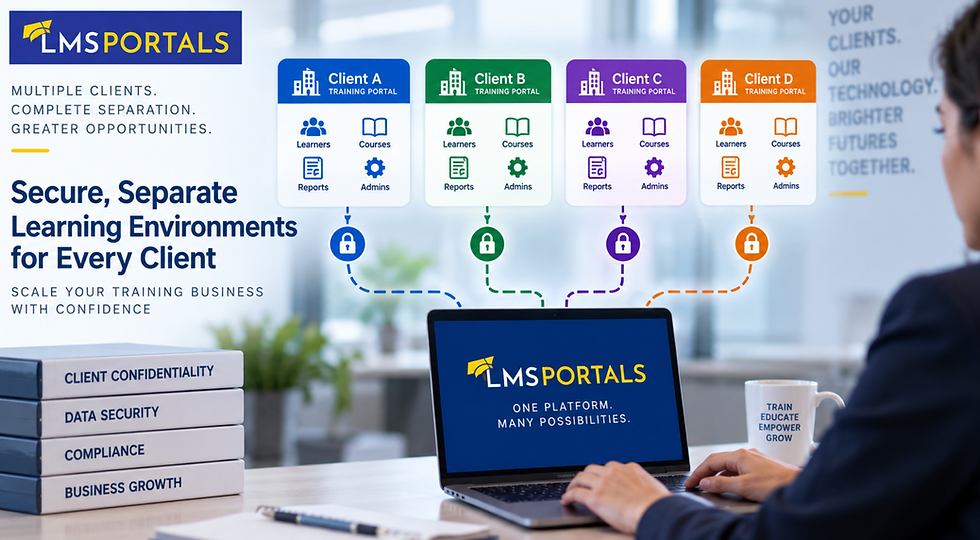
Organizations managing multiple branded learning portals can monitor activity across individual portals while maintaining centralized administrative oversight, making LMS Portals particularly valuable for associations, consultants, franchises, healthcare organizations, and training providers.
Easy Data Export
Administrators can export learning data for executive reporting, compliance documentation, business analysis, or integration into existing organizational workflows.
LMS Portals helps organizations:
Monitor compliance in real time
Evaluate training effectiveness
Track learner progress across multiple portals
Generate comprehensive administrative reports
Transform learning data into strategic business insight
Turning Learning Data into a Competitive Advantage
Every training program generates valuable information. Organizations that recognize the strategic value of this data gain insights that extend well beyond course completions and compliance reporting.
Learning analytics reveal workforce strengths, identify development opportunities, support better business decisions, and help organizations continuously improve both employee performance and training effectiveness.
As businesses continue investing in employee development, learning data will become an increasingly important competitive asset. Organizations that embrace data-driven learning strategies will be better positioned to build stronger workforces, respond to changing business demands, and maximize the return on every training investment.
With comprehensive reporting, real-time dashboards, powerful analytics, and multi-portal management capabilities, LMS Portals enables organizations to transform everyday learning data into meaningful business intelligence—turning their Learning Management System into a true strategic asset.
About LMS Portals
At LMS Portals, we provide our clients and partners with a mobile-responsive, SaaS-based, multi-tenant learning management system that allows you to launch a dedicated training environment (a portal) for each of your unique audiences.
The system includes built-in, SCORM-compliant rapid course development software that provides a drag and drop engine to enable most anyone to build engaging courses quickly and easily.
We also offer a complete library of ready-made courses, covering most every aspect of corporate training and employee development.
If you choose to, you can create Learning Paths to deliver courses in a logical progression and add structure to your training program. The system also supports Virtual Instructor-Led Training (VILT) and provides tools for social learning.
Together, these features make LMS Portals the ideal SaaS-based eLearning platform for our clients and our Reseller partners.
Contact us today to get started or visit our Partner Program pages

Comments