
How to Stay Compliant with New York Employee Training Laws


New York has some of the most comprehensive workplace compliance requirements in the country. While federal employment laws establish minimum standards for workplace protections, New York has enacted additional regulations that require employers to take a more proactive approach to employee education and compliance.
Today's employers are expected to do more than publish policies in an employee handbook. They must ensure employees understand workplace expectations, know how to report concerns, and receive ongoing training that reflects current legal requirements.
As workplace regulations continue to evolve, organizations that invest in structured compliance training place themselves in a much stronger position to reduce legal risk while creating a safer and more respectful workplace.
Federal Requirements vs. New York Requirements
Many employers mistakenly assume that complying with federal regulations automatically satisfies state requirements. In New York, however, employers often face additional obligations that exceed federal standards.
State-specific training requirements, annual refresher programs, and expanded employee protections mean organizations must regularly review their compliance programs to ensure they remain current.
Understanding these differences is the foundation of an effective compliance strategy.
Why Compliance Training Matters
Protecting Your Organization
Effective compliance training reduces the likelihood of workplace complaints, regulatory investigations, and employment litigation. Educated employees are better equipped to recognize inappropriate conduct, follow company policies, and report concerns before problems escalate.
For employers, this translates into reduced legal exposure and stronger organizational resilience.
Creating a Respectful Workplace Culture
Compliance training is not simply about avoiding penalties. It also reinforces organizational values and helps build a culture where employees understand expectations for professional conduct and mutual respect.
When employees know their rights and responsibilities, workplace communication improves and employee confidence grows.
Demonstrating Good Faith
If a workplace issue does arise, documented training demonstrates that the employer made reasonable efforts to educate employees and promote compliance.
This documentation can become an important component of defending employment claims or responding to agency investigations.
New York Sexual Harassment Prevention Training Requirements
Who Must Receive Training
New York requires every employer, regardless of size, to provide annual sexual harassment prevention training.
The requirement applies to virtually every employee, including full-time workers, part-time employees, temporary staff, seasonal employees, exempt employees, non-exempt employees, and individuals who work only part of their time within New York.
Organizations should also ensure that new hires receive training as quickly as practical after joining the company.
Employer Responsibilities
Employers are responsible for ensuring training is delivered consistently, accurately, and in accordance with New York's minimum standards.
The responsibility extends beyond assigning courses. Employers should also maintain documentation showing that employees completed the required training.
Why Annual Training Matters
Annual refresher training reinforces expectations while allowing organizations to incorporate changes to company policies and evolving legal guidance.
Regular education also reminds employees how to recognize inappropriate conduct and encourages prompt reporting when concerns arise.
What the Training Must Include
New York's required sexual harassment prevention training must explain what sexual harassment is under both state and federal law.
Employees should learn about behaviors that constitute unlawful harassment, understand how harassment affects individuals and organizations, and become familiar with examples drawn from realistic workplace situations.
Training should also explain internal reporting procedures, employees' legal rights, available remedies, and protections against retaliation.
New York also expects the training to include interactive components, such as quizzes, discussion opportunities, or knowledge assessments that encourage employee participation.
Expanding Beyond Sexual Harassment Training
Anti-Discrimination Education
Although New York specifically mandates sexual harassment prevention training, many employers choose to broaden their compliance curriculum to include anti-discrimination education.
Employees benefit from understanding protections related to race, color, religion, age, disability, pregnancy, national origin, gender identity, sexual orientation, military status, marital status, and other protected characteristics recognized under federal, state, and local law.
Comprehensive training encourages respectful behavior throughout the workplace while reducing organizational risk.
Diversity, Equity, and Inclusion
Many organizations also integrate diversity and inclusion training into their compliance programs.
While not always legally mandated, these programs support respectful workplace interactions, improve communication, and reinforce organizational values that contribute to employee engagement and retention.
Manager Training Requires Additional Attention
Supervisors Have Greater Responsibility
Managers and supervisors occupy a unique position within any organization.
Because they oversee employees and frequently receive workplace complaints, they require additional compliance education beyond what general employees receive.
Handling Employee Complaints
Managers should understand how to respond appropriately when an employee raises a concern.
Training should explain how to document complaints, preserve confidentiality whenever possible, avoid making promises that cannot be kept, and escalate concerns through the organization's established reporting procedures.
Preventing Retaliation
Retaliation claims often create greater legal exposure than the original complaint itself.
Manager training should emphasize that employees must never experience adverse treatment for reporting suspected misconduct or participating in workplace investigations.
Workplace Violence Prevention
A Growing Area of Compliance
Workplace violence prevention has become an increasingly important component of organizational compliance programs.
Employers across New York continue strengthening their training efforts to help employees recognize warning signs, respond appropriately to threats, and understand emergency procedures.
Building Employee Awareness
Training helps employees identify concerning behavior, report safety issues early, and contribute to a culture where everyone shares responsibility for workplace safety.
Organizations operating in healthcare, education, public service, and other higher-risk industries often implement more comprehensive workplace violence programs.
Industry-Specific Training Requirements
Healthcare Organizations
Healthcare employers frequently provide training covering HIPAA privacy requirements, infection prevention, patient safety, mandatory reporting obligations, and workplace violence prevention.
Because healthcare regulations evolve regularly, ongoing education is critical.
Financial Services
Financial organizations commonly provide training in anti-money laundering, fraud prevention, privacy regulations, cybersecurity awareness, and ethical business practices.
Regular updates help organizations remain aligned with changing regulatory expectations.
Manufacturing and Industrial Employers
Manufacturers often focus on OSHA compliance, hazard communication, lockout/tagout procedures, equipment safety, and emergency response training.
These programs help reduce workplace injuries while supporting regulatory compliance.
Education and Public Sector Employers
Schools, colleges, universities, and government organizations frequently require training related to child protection, Title IX, cybersecurity, data privacy, ethics, and mandatory reporting responsibilities.
Maintaining Accurate Training Records
Why Documentation Matters
Providing training alone is not sufficient.
Organizations should maintain complete records demonstrating when employees completed required courses, what content was delivered, and how learning was verified.
Well-maintained documentation provides valuable evidence during audits, investigations, insurance reviews, or employment litigation.
Digital Recordkeeping Simplifies Compliance
Modern learning management systems automatically record completion dates, assessment scores, acknowledgments, certificates, and learner activity.
This eliminates much of the manual effort traditionally associated with compliance tracking.
Supporting Remote and Hybrid Employees
Consistent Learning Across Every Location
Today's workforce is increasingly distributed across offices, home environments, and multiple states.
Online compliance training allows every employee to receive the same learning experience regardless of location.
Flexible Training Schedules
Employees can complete assigned training at convenient times while employers maintain centralized oversight of participation and completion.
This flexibility improves completion rates while minimizing disruption to daily operations.
Keeping Compliance Training Current
Employment Laws Continue to Change
New York regularly updates workplace regulations, while federal agencies continue issuing new guidance affecting employers.
Organizations should review their compliance programs at least annually to ensure training reflects current legal expectations.
Continuous Improvement
Updating training materials also provides opportunities to strengthen company policies, improve reporting procedures, and address emerging workplace risks before they become significant problems.
Building a Long-Term Culture of Compliance
Leadership Sets the Example
Successful compliance programs begin with organizational leadership.
When executives and managers actively support employee training, compliance becomes part of the company's culture rather than simply another annual requirement.
Compliance Is an Ongoing Process
The most effective organizations reinforce workplace expectations throughout the year instead of limiting compliance discussions to annual training events.
Continuous communication strengthens employee engagement while helping prevent problems before they occur.
Common Compliance Mistakes
Relying Only on Employee Handbooks
Policies are important, but distributing a handbook does not replace legally required employee training.
Employees must actively participate in meaningful learning experiences.
Inconsistent Training Delivery
Organizations with multiple offices should ensure every employee receives the same high-quality compliance education.
Consistency reduces confusion and supports equal treatment across the workforce.
Poor Documentation
Incomplete training records can create significant challenges during audits or legal proceedings.
Employers should maintain accurate documentation that demonstrates compliance with applicable training requirements.
Outdated Course Content
Using training materials that no longer reflect current laws or regulations can undermine an otherwise effective compliance program.
Regular content reviews help organizations remain current.
Using Technology to Simplify Compliance
Automating Administrative Work
Learning management systems automate course assignments, reminders, reporting, certifications, and recordkeeping.
This significantly reduces administrative workload while improving consistency.
Improving Visibility
Real-time dashboards allow administrators to identify overdue learners, monitor completion rates, and quickly generate reports for internal reviews or regulatory requests.
Supporting Organizational Growth
As organizations expand into additional offices or states, centralized learning platforms allow compliance programs to grow without dramatically increasing administrative effort.
How LMS Portals Helps New York Employers Stay Compliant
A Centralized Learning Management System
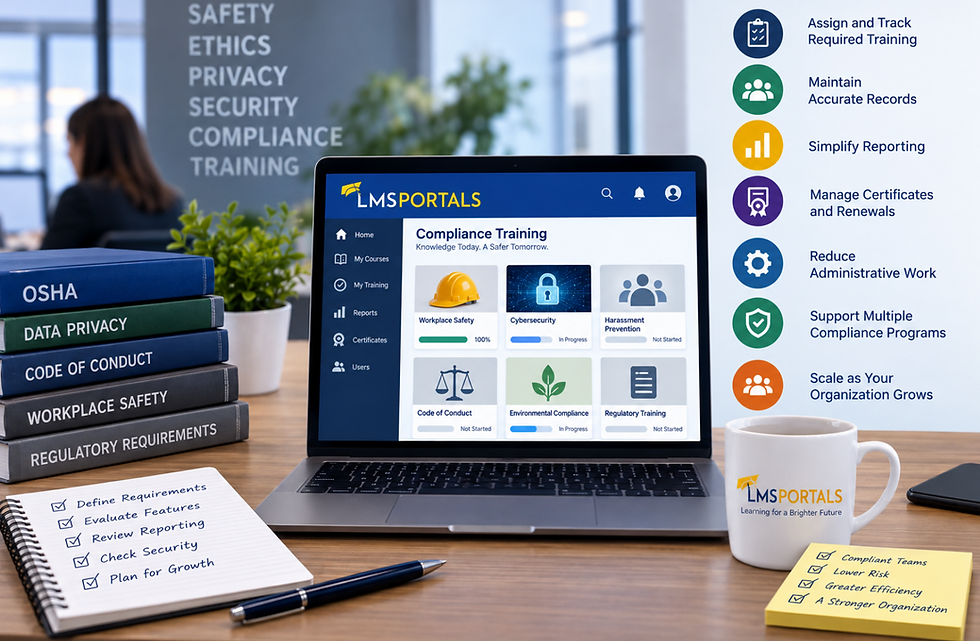
LMS Portals provides organizations with a powerful cloud-based learning management system that simplifies every aspect of compliance training administration.
Administrators can assign required courses, monitor learner progress, and manage training records through an intuitive centralized dashboard.
Multi-Tenant Learning for Complex Organizations
Organizations with multiple business units, franchises, departments, clients, or partner organizations can create fully branded learning portals while maintaining centralized administrative oversight.
Each portal operates independently while corporate administrators retain complete visibility across the entire organization.
Automated Compliance Tracking
LMS Portals automatically tracks employee enrollments, course completions, assessment scores, certificates, and learning history.
Automation reduces manual administrative work while helping organizations maintain accurate compliance documentation.
Comprehensive Reporting
Powerful reporting tools allow administrators to generate completion reports, verify employee participation, identify overdue learners, and prepare documentation for internal audits or regulatory reviews.
Access to an Extensive Compliance Training Library
LMS Portals offers access to a comprehensive compliance course library covering sexual harassment prevention, workplace discrimination, ethics, diversity and inclusion, cybersecurity awareness, workplace safety, leadership development, HR compliance, and many other essential business topics.
Organizations can also upload and manage their own custom training content alongside the library.
Flexible Learning for Modern Workforces
Employees can complete training from virtually anywhere using desktops, laptops, tablets, or mobile devices.
This flexibility supports remote, hybrid, field-based, and multi-location employees while ensuring every learner receives a consistent educational experience.
A Platform That Grows with Your Business
Whether your organization has a single office or hundreds of branded training portals,
LMS Portals scales alongside your growth.
By combining automated compliance management, detailed reporting, flexible online learning, multi-tenant capabilities, and an extensive compliance training library, LMS Portals helps New York employers confidently meet evolving employee training requirements while building safer, stronger, and more compliant workplaces.
About LMS Portals
At LMS Portals, we provide our clients and partners with a mobile-responsive, SaaS-based, multi-tenant learning management system that allows you to launch a dedicated training environment (a portal) for each of your unique audiences.
The system includes built-in, SCORM-compliant rapid course development software that provides a drag and drop engine to enable most anyone to build engaging courses quickly and easily.
We also offer a complete library of ready-made courses, covering most every aspect of corporate training and employee development.
If you choose to, you can create Learning Paths to deliver courses in a logical progression and add structure to your training program. The system also supports Virtual Instructor-Led Training (VILT) and provides tools for social learning.
Together, these features make LMS Portals the ideal SaaS-based eLearning platform for our clients and our Reseller partners.
Contact us today to get started or visit our Partner Program pages


Comments