
Construction Safety Training Records: What Contractors Need to Track
- LMSPortals

- 1 day ago
- 11 min read
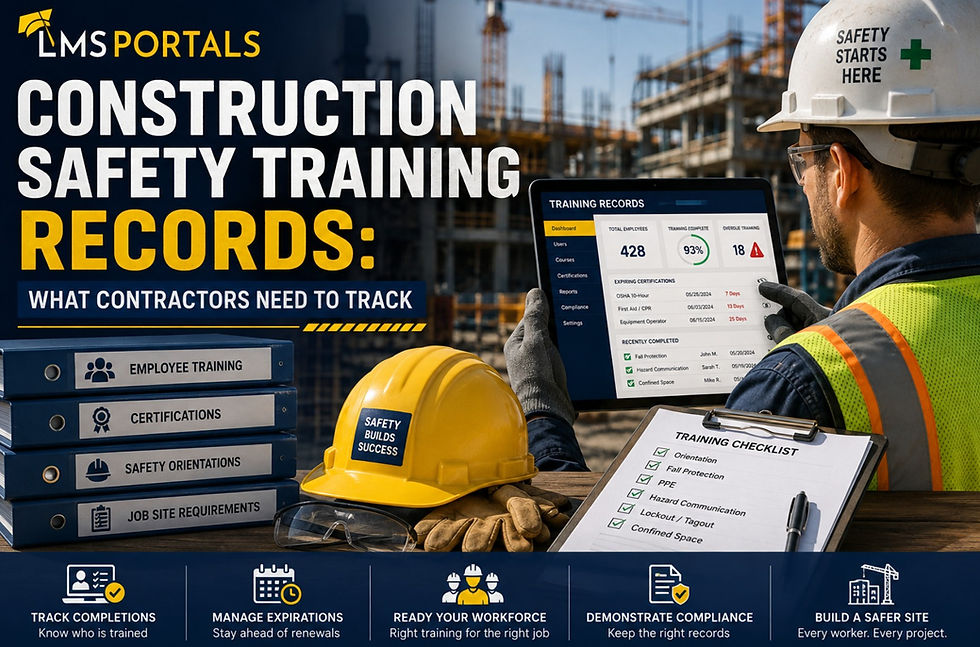
Construction companies invest significant time and resources in safety training. New hires complete orientation. Equipment operators earn certifications. Supervisors attend specialized programs. Workers receive training on fall protection, personal protective equipment, hazard communication, lockout/tagout, confined spaces, and other job-specific risks.
But delivering the training is only part of the responsibility.
Contractors also need reliable records showing who received training, what training was completed, when it occurred, and when additional or refresher training may be required. As workforces grow and employees move between projects, maintaining accurate construction safety training records can become increasingly complicated.
For companies managing employees, subcontractors, multiple jobsites, and recurring training requirements, spreadsheets and paper certificates can quickly become difficult to maintain. A more structured approach can help contractors demonstrate compliance, prepare workers for jobsite requirements, identify training gaps, and respond more effectively when documentation is requested.
Why Construction Safety Training Records Matter
Training records provide contractors with evidence that required safety education has occurred. They can also help safety managers determine whether workers are qualified or prepared to perform particular tasks.
Good recordkeeping is therefore about more than maintaining documentation. It provides visibility into the safety readiness of the workforce.
Training Records Support a Stronger Safety Program
A contractor may have excellent safety policies, but those policies are only effective if workers understand the requirements that apply to their jobs.
Training records help connect the company's safety program to individual employees. Safety managers can see which courses have been assigned, which employees have completed them, and where additional training may be necessary.
This information becomes particularly useful when preparing crews for new projects. Rather than relying on supervisors to remember who completed which program, administrators can review documented training histories before assigning employees to work.
Documentation Can Be Critical When Questions Arise
Construction companies may need to produce training documentation for many reasons. A general contractor may request evidence of subcontractor training. A customer may establish specific site requirements. An internal safety audit may identify records that need to be reviewed. Documentation may also become important following an incident or regulatory inspection.
In these situations, knowing that training probably occurred is not the same as being able to demonstrate it.
A structured training record can help establish what training was provided, who completed it, and when it occurred.
What Should Construction Safety Training Records Include?
The information contractors need to maintain will vary depending on the type of training, employee responsibilities, project requirements, company policies, and applicable regulations. However, several pieces of information are commonly useful across construction safety programs.
Employee and Worker Information
Training records need to be associated with the correct individual. At a minimum, contractors may want to capture the worker's name and an internal employee or worker identifier.
Depending on the organization, records may also include the employee's job title, department, supervisor, location, project assignment, employer or subcontractor, and other information that helps administrators organize the workforce.
This becomes increasingly important as contractors grow. Two employees may have similar names, workers may transfer between projects, and subcontractors may have personnel working across multiple sites. Consistent worker identification helps prevent training histories from becoming fragmented or assigned incorrectly.
Course or Training Program
The record should clearly identify the training the worker completed.
Rather than using broad descriptions such as "safety training," contractors should use recognizable course or program names whenever possible. Examples might include Fall Protection Awareness, Hazard Communication, Lockout/Tagout Awareness, Confined Space Awareness, Personal Protective Equipment, Electrical Safety, Ladder Safety, or a company-specific jobsite orientation.
Consistent course naming makes it easier to search records, generate reports, and determine whether workers have completed the training required for a particular role or project.
Training Completion Date
The completion date is one of the most important pieces of information in a training record.
It establishes when the employee completed the course and provides a starting point for determining whether refresher or recurring training may be necessary.
For online training, an LMS can typically record the completion date automatically. Instructor-led training may require an administrator or instructor to enter or upload the completion information.
Training Provider or Instructor
Contractors may also want to record who provided the training.
Depending on the program, this could be an internal safety manager, outside training organization, equipment manufacturer, authorized instructor, or online course provider.
For instructor-led programs, companies may choose to maintain additional documentation related to the instructor or training provider when appropriate.
Assessment or Evaluation Results
Some training programs include quizzes, tests, practical evaluations, or demonstrations of competency.
When assessments are used, contractors may want to retain the learner's score, pass/fail result, number of attempts, or other relevant information.
For practical skills, documentation may also indicate that the employee successfully demonstrated a required procedure or competency.
The objective is to maintain enough information to show not simply that someone attended training, but that applicable completion requirements were satisfied.
Track Certifications and Expiration Dates
One of the biggest challenges in construction training management is keeping track of credentials that do not remain current indefinitely.
Employees may hold certifications, qualifications, or company training credentials with different renewal schedules. When those records are spread across spreadsheets, email attachments, shared drives, and paper files, expiration dates can easily be overlooked.
Record Certification Details
For each applicable certification or credential, contractors may want to maintain information such as the certification name, issuing organization, date earned, expiration or renewal date, certificate number, and supporting documentation.
The exact information required will depend on the credential.
Keeping these details connected to the worker's training profile gives safety administrators a more complete picture of workforce qualifications.
Monitor Upcoming Expirations
Recording an expiration date is useful. Knowing that the expiration is approaching is much more useful.
Contractors should have a process for identifying certifications and training requirements that will expire within a defined period. That might mean reviewing credentials that expire within the next 30, 60, or 90 days.
This gives safety teams time to schedule refresher training before a worker's qualification lapses and helps reduce last-minute disruptions to project staffing.
Track Recurring and Refresher Training
Not every construction safety topic is completed once and forgotten. Training may need to be repeated because of regulatory requirements, company policies, customer requirements, changing job responsibilities, new equipment, or observed performance issues.
Know When Training Needs to Be Repeated
Contractors should distinguish between one-time training and training that requires renewal or periodic reassignment.
A good training management process should make it easy to determine when the employee last completed the requirement and when the next training event should occur.
This becomes especially important when a contractor has hundreds or thousands of employees. Manually calculating renewal dates across a large workforce creates unnecessary administrative work and increases the possibility of something being missed.
Document Retraining
Retraining should generally create a new training record rather than replacing the employee's previous history.
Maintaining historical records allows contractors to see the progression of training over time. An employee record might show initial training followed by subsequent refresher courses or recertification activities.
That historical perspective can be valuable during audits, internal reviews, and investigations.
Maintain Records for Jobsite and Company Orientations
Construction companies often provide training that is specific to the organization or project rather than a general safety topic.
A corporate safety orientation might cover company policies, reporting procedures, emergency expectations, stop-work authority, incident reporting, and other internal requirements. Individual projects may require additional orientation related to site access, emergency procedures, restricted areas, specific hazards, or customer requirements.
Separate General and Project-Specific Training
Contractors may benefit from distinguishing between company-wide training and project-specific requirements.
An employee might have completed the company's general safety orientation but still need a separate orientation before entering a particular jobsite.
Tracking these requirements independently helps contractors avoid assuming that completion of one training program satisfies every project requirement.
It can also make reporting easier when a project manager needs a list of workers who have completed a specific site orientation.
Track Training by Role and Job Responsibility
Construction workers do not all require the same training.
A project manager, equipment operator, electrician, laborer, superintendent, and safety professional may each have different requirements.
Create Role-Based Training Requirements
Rather than assigning courses individually every time a worker joins the company, contractors can establish training requirements based on job roles or groups.
For example, all employees might receive basic safety orientation and hazard communication training, while supervisors receive additional training related to incident reporting and safety leadership. Employees performing specialized work can receive additional training associated with those responsibilities.
Role-based training helps standardize expectations and reduces the administrative work required to manage assignments.
Update Requirements When Roles Change
Training requirements should also evolve when employees change positions or responsibilities.
An employee promoted into a supervisory position may require additional safety leadership training. A worker assigned to operate new equipment may need equipment-specific instruction. Someone moving to a different project may need a new site orientation.
Connecting training assignments to roles, groups, or projects makes it easier to respond to these changes.
Don't Forget Subcontractor Training Records
Subcontractor management can add another layer of complexity to construction safety training.
A general contractor may need confidence that subcontractor personnel have completed specific training before working on a project, while subcontractors themselves need to maintain records for their employees.
Establish Clear Documentation Requirements
Contractors should define what training documentation subcontractors are expected to provide and how that information will be maintained.
Depending on the project, subcontractors may need to submit certificates, training rosters, orientation records, qualification documents, or other evidence before employees are permitted to perform certain work.
A standardized process can reduce the amount of time project teams spend chasing documentation.
Give Subcontractors Their Own Training Environment
For organizations managing large subcontractor networks, it may be useful to provide subcontractors with access to dedicated online training environments.
Each subcontractor can enroll its workers, complete required courses, and maintain training records while the general contractor retains broader oversight.
This approach can be significantly easier to scale than collecting individual certificates by email and manually transferring information into spreadsheets.
Maintain Historical Training Records
Training records should provide more than a snapshot of the workforce today. Contractors may also need access to historical information.
Employees leave the organization. Projects end. Certifications expire. Training programs change. None of these events necessarily eliminates the value of the original records.
Preserve a Training History
A complete training history can show which courses an employee completed over time, when refresher training occurred, which assessments were passed, and which credentials were held.
Historical records can be useful when investigating incidents, responding to audits, evaluating an employee for a new assignment, or reviewing the effectiveness of a training program.
Contractors should therefore consider how records will be retained when employees become inactive or training content is replaced.
Make Training Records Easy to Retrieve
Training records have limited value if retrieving them requires searching through multiple spreadsheets, inboxes, file folders, and shared drives.
Safety teams should be able to quickly locate records for an individual worker, group, project, department, subcontractor, or training requirement.
Build Reporting Into the Process
Useful construction training reports might identify employees who have completed a particular course, employees with incomplete assignments, certifications approaching expiration, workers assigned to a project, overdue training, assessment results, or training histories for individual employees.
Having this information readily available can reduce administrative work while giving safety managers a clearer view of training compliance across the organization.
Common Problems With Spreadsheet-Based Training Records
Spreadsheets can work when a contractor has a small workforce and limited training requirements. Problems often emerge as the company grows.
One spreadsheet may track orientations, another certifications, and another online courses. Project managers may maintain their own files. Certificates arrive by email. Employee names are entered differently across systems. Renewal dates require manual review. Reports become outdated almost immediately after they are created.
The issue is not that spreadsheets are inherently ineffective. It is that they were not designed to function as a comprehensive training management system.
Know When It's Time for a More Structured System
Contractors may want to consider moving beyond spreadsheets when they are managing multiple jobsites, significant numbers of workers, recurring training requirements, certification expiration dates, subcontractors, different training requirements by role, or frequent requests for compliance reports.
At that point, the administrative cost and risk associated with manual recordkeeping may outweigh the cost of implementing a more centralized approach.
How an LMS Can Improve Construction Training Recordkeeping
A learning management system can bring training delivery and recordkeeping together.
Instead of maintaining separate systems for assigning courses, delivering training, recording completions, and creating reports, contractors can manage much of the process from one platform.
Automate Training Records
When an employee completes online training through an LMS, the system can automatically record the learner, course, completion date, assessment results, and other training data.
This reduces manual data entry and provides administrators with more current information.
Instructor-led and external training records can also be incorporated into the employee's broader training history, depending on the organization's process and LMS capabilities.
Centralize Compliance Visibility
An LMS can give safety teams a centralized view of training activity across departments, locations, projects, and worker groups.
Instead of asking multiple supervisors for updated spreadsheets, administrators can use reporting tools to identify incomplete training and other gaps.
This can turn training recordkeeping from a largely reactive administrative exercise into a more proactive compliance management process.
Benefits of Working With LMS Portals for Construction Safety Training
LMS Portals provides contractors with a platform for delivering, organizing, and tracking workforce training while supporting the more complex requirements of organizations managing multiple crews, projects, divisions, or subcontractors.
Manage Training and Compliance in One Platform
LMS Portals can help contractors assign courses, track learner activity, maintain completion records, manage training requirements, and provide administrators with visibility into workforce training.
Rather than relying on disconnected spreadsheets and files, organizations can build a centralized training environment where employee learning histories are easier to manage and retrieve.
This can be especially useful for contractors managing recurring safety training, certification requirements, multiple jobsites, and large or distributed workforces.
Create Dedicated Training Portals for Crews and Subcontractors
The multi-portal architecture of LMS Portals provides an additional advantage for construction organizations.
Contractors can create separate branded training portals for different divisions, locations, projects, customers, or subcontractors while maintaining centralized administrative oversight.
A general contractor, for example, could provide individual subcontractors with dedicated training portals. Each subcontractor could manage its workers and required training while the contractor maintains broader visibility across the program.
For organizations managing many independent groups, this structure can provide a cleaner approach than attempting to manage every learner inside one large, undifferentiated training environment.
Combine Safety Courses With Company-Specific Training
LMS Portals also provides access to an extensive library of workplace training courses that can complement a contractor's existing safety program.
Organizations can combine ready-made courses with company-specific training covering internal policies, safety procedures, jobsite requirements, equipment, customer requirements, and other topics unique to the business.
LMS Portals can also provide custom eLearning course development services to help contractors transform existing safety materials, PowerPoint presentations, policies, procedures, videos, and subject matter expertise into structured online courses.
Build Role-Based Learning Paths
Contractors can organize courses into learning paths designed for specific employee groups.
A new-hire learning path might include company orientation, hazard communication, PPE, and reporting procedures. A supervisor learning path might add safety leadership, incident investigation, and management responsibilities. Specialized workers could receive additional courses related to the hazards and responsibilities associated with their work.
This helps contractors move beyond simply maintaining records and build a more systematic approach to workforce development and safety compliance.
Turn Training Records Into a Safety Management Resource
Construction safety training records should not simply be documents stored in case someone eventually asks to see them.
When properly managed, training data can help contractors understand whether their workforce is prepared for the work being performed, identify gaps before they become problems, monitor recurring requirements, and make better decisions about employee and subcontractor assignments.
The key is establishing a consistent process for tracking the worker, training requirement, completion date, assessment results, applicable certifications, expiration dates, refresher training, and historical activity.
As construction organizations grow, managing this information manually becomes increasingly difficult. A centralized learning and compliance platform can make training records easier to maintain while giving safety teams greater visibility across crews, projects, and subcontractors.
With an extensive course library, custom eLearning development services, compliance management capabilities, and a multi-portal LMS architecture, LMS Portals can help contractors deliver safety training while building a more organized, scalable system for tracking the training records behind it.
About LMS Portals
At LMS Portals, we provide our clients and partners with a mobile-responsive, SaaS-based, multi-tenant learning management system that allows you to launch a dedicated training environment (a portal) for each of your unique audiences.
The system includes built-in, SCORM-compliant rapid course development software that provides a drag and drop engine to enable most anyone to build engaging courses quickly and easily.
We also offer a complete library of ready-made courses, covering most every aspect of corporate training and employee development.
If you choose to, you can create Learning Paths to deliver courses in a logical progression and add structure to your training program. The system also supports Virtual Instructor-Led Training (VILT) and provides tools for social learning.
Together, these features make LMS Portals the ideal SaaS-based eLearning platform for our clients and our Reseller partners.
Contact us today to get started or visit our Partner Program pages


Comments