
AI Governance Training: Leading Responsible Innovation


Artificial intelligence is transforming the way organizations operate. From customer service and marketing to software development and financial analysis, AI-powered tools are helping businesses automate processes, improve productivity, and uncover new opportunities for growth. What was once viewed as an emerging technology is now becoming a standard part of everyday operations across virtually every industry.
While the benefits of AI are undeniable, its rapid adoption has introduced a new set of business challenges. Organizations must now consider not only how to leverage AI effectively, but also how to ensure it is used responsibly, ethically, and securely. This shift has elevated AI governance from an IT concern to a strategic business priority.
AI Adoption Is Accelerating Across Every Industry
Employees are increasingly using generative AI to draft reports, summarize documents, analyze data, create marketing content, develop software, and streamline administrative work. In many organizations, AI adoption has happened organically, with employees experimenting with publicly available tools long before formal policies were established.
This rapid adoption has created a significant knowledge gap. While employees understand what AI can accomplish, many have received little or no guidance on how to use it safely. Without clear governance, organizations risk exposing confidential information, relying on inaccurate AI-generated content, or unintentionally violating regulatory requirements.
Innovation Requires Responsible Oversight
Responsible innovation means embracing new technology while understanding its limitations. AI can process information at incredible speed, but it cannot replace human judgment, organizational values, or ethical decision-making.
Organizations that establish governance frameworks early are better positioned to encourage innovation while minimizing operational, legal, and reputational risks. Rather than limiting creativity, governance provides employees with the confidence to use AI appropriately because they understand where the boundaries are.
Understanding AI Governance
AI governance is the framework of policies, procedures, and oversight practices that guide how artificial intelligence is used throughout an organization. It establishes standards for responsible AI use while ensuring systems remain transparent, secure, compliant, and aligned with business objectives.
Effective governance is not about restricting technology. Instead, it provides consistency by helping employees understand when AI is appropriate, what safeguards should be followed, and when human oversight is required.
What Is AI Governance?
At its core, AI governance balances innovation with accountability. It defines how AI tools should be selected, deployed, monitored, and evaluated over time. Governance also ensures that organizations remain prepared for evolving regulations and changing business expectations.
As AI technologies become more sophisticated, governance helps organizations maintain control over how these systems influence business decisions and customer interactions.
The Goals of an Effective Governance Program
A successful governance program establishes clear expectations for every employee who interacts with AI. It creates policies that protect sensitive information, encourages ethical decision-making, and provides mechanisms for monitoring AI performance over time.
Perhaps most importantly, governance creates trust. Employees gain confidence in using AI responsibly, while customers and business partners gain confidence that the organization is managing AI with appropriate oversight.
The Risks of Unmanaged AI
Organizations that adopt AI without governance often discover that the greatest risks are not technical—they are human. Employees may unknowingly expose confidential information, overestimate AI's accuracy, or automate decisions that require careful review.
Understanding these risks is one of the primary objectives of AI governance training.
Protecting Sensitive Data
Many public AI platforms retain user prompts or use submitted information to improve future models. Without proper training, employees may inadvertently upload confidential customer information, financial records, intellectual property, or other sensitive business data.
Governance training teaches employees how to recognize sensitive information and understand which AI platforms are approved for organizational use. These simple practices significantly reduce unnecessary exposure while supporting compliance with privacy regulations.
Reducing Bias and Improving Fairness
AI systems learn from data, and data often reflects historical biases. Without careful oversight, AI-generated recommendations can unintentionally reinforce discrimination or produce unfair outcomes.
Training helps employees recognize potential bias, evaluate AI-generated recommendations critically, and understand when additional review is necessary before decisions are made.
Preventing Compliance and Regulatory Issues
Governments around the world are introducing new laws governing artificial intelligence. Regulations increasingly focus on transparency, accountability, privacy, and human oversight, making AI governance an essential component of organizational compliance.
Employees who understand both internal policies and regulatory expectations are far less likely to create compliance issues through inappropriate AI use.
Maintaining Customer Trust
Customers expect organizations to use artificial intelligence responsibly. Poor governance can damage brand reputation far more quickly than many organizations anticipate.
When organizations demonstrate thoughtful oversight and transparent AI practices, they strengthen customer confidence while differentiating themselves in increasingly competitive markets.
Building a Culture of Responsible AI
Successful governance extends far beyond written policies. It becomes part of the organization's culture, influencing how employees think about AI every day.
Culture determines whether governance becomes a practical business tool or simply another compliance document that employees rarely reference.
Governance Starts with Leadership
Leadership establishes the tone for responsible AI adoption. Executives who actively promote ethical AI use encourage employees to embrace innovation while recognizing the importance of accountability.
When governance receives visible executive support, employees are more likely to follow established policies and seek guidance when questions arise.
Why Every Employee Has a Role
AI governance is not solely the responsibility of IT or compliance departments. Marketing professionals, HR teams, finance staff, legal departments, software developers, and customer service representatives all interact with AI in different ways.
Every employee who uses AI contributes to the organization's overall governance strategy. Training ensures those responsibilities are clearly understood regardless of job function.
Encouraging Responsible Innovation
One of the greatest misconceptions surrounding governance is that it slows innovation. In reality, organizations with mature governance programs often innovate more quickly because employees understand how to use AI confidently and responsibly.
When expectations are clear, employees spend less time wondering whether they are using AI correctly and more time discovering ways it can improve business performance.
What AI Governance Training Should Include
Effective AI governance training should focus on practical application rather than technical complexity. Employees need guidance that helps them make sound decisions
in everyday business situations.
The most successful programs combine organizational policies with real-world scenarios that reflect how employees actually use AI.
AI Fundamentals for Business Users
Employees should understand how AI generates recommendations, where its limitations exist, and why outputs should always be verified before being used in important business decisions.
Developing this foundational knowledge reduces overreliance on AI while increasing employee confidence.
Ethical Decision-Making
AI often raises questions that technology alone cannot answer. Employees must understand fairness, transparency, accountability, and the importance of applying human judgment whenever AI influences significant decisions.
Ethics training helps employees recognize situations where organizational values should take precedence over automated recommendations.
Privacy, Security, and Data Protection
Protecting confidential information remains one of the most important aspects of AI governance.
Employees should understand how organizational data policies apply when using AI platforms and recognize what information should never be shared with external systems.
Human Oversight and Accountability
Artificial intelligence can support decision-making, but responsibility ultimately remains with people.
Governance training reinforces that employees—not algorithms—are accountable for business decisions. Human review should always accompany high-impact decisions involving customers, employees, finances, healthcare, or legal matters.
Measuring the Success of AI Governance Training
Like any strategic learning initiative, AI governance training should produce measurable business outcomes.
Completion rates provide useful information, but organizations should also evaluate whether employees are applying governance principles in their daily work.
Looking Beyond Course Completion
Successful governance programs often result in stronger policy compliance, improved security awareness, greater confidence in using approved AI tools, and fewer incidents involving inappropriate AI use.
These outcomes demonstrate that employees are translating training into responsible workplace behavior.
Continuous Improvement Through Ongoing Education
Artificial intelligence evolves rapidly, and governance programs must evolve with it. New regulations, emerging technologies, and changing business practices require organizations to update training regularly.
Continuous learning helps ensure employees remain informed long after their initial governance course has been completed.
Why Organizations Choose LMS Portals for AI Governance Training
Developing governance policies is only the first step. Organizations also need an effective way to deliver consistent education, monitor participation, and demonstrate compliance across the enterprise.
LMS Portals provides a flexible learning platform that makes AI governance training scalable, measurable, and easy to maintain.
Deliver Consistent Training Across the Enterprise
Organizations can deliver standardized AI governance training through branded learning portals while ensuring every employee receives consistent messaging and up-to-date content.
Assessments, certifications, and reporting help verify understanding and support internal compliance initiatives.
Support Multiple Departments and Clients
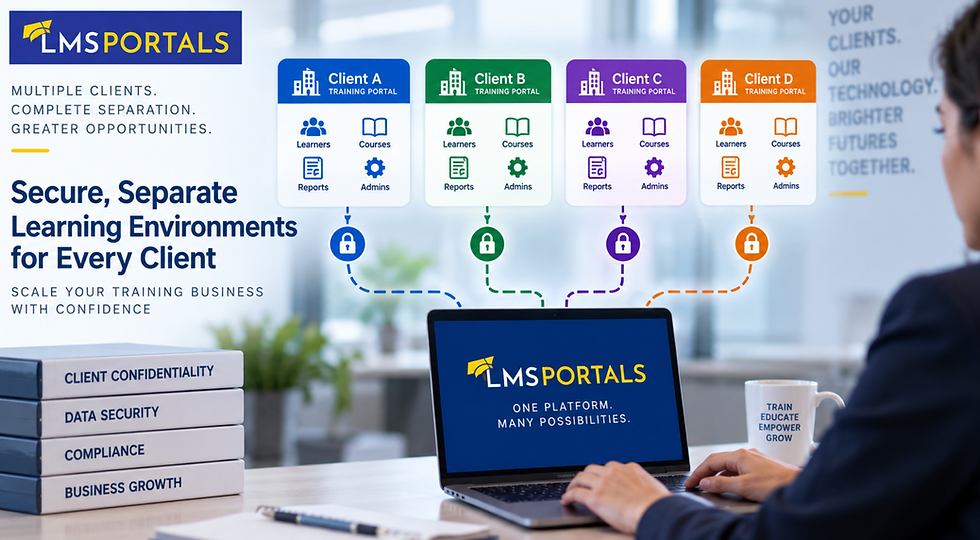
Because LMS Portals supports multiple branded learning environments from a single platform, organizations can customize governance training for different departments, business units, subsidiaries, or external clients while maintaining centralized administration.
This flexibility is especially valuable for consulting firms, compliance providers, and organizations serving multiple business audiences.
Keep Pace with Changing AI Regulations
AI governance is not static. Policies, regulations, and best practices continue to evolve as artificial intelligence becomes more deeply integrated into business operations.
LMS Portals makes it easy to update courses, distribute revised training materials, and ensure learners always have access to the most current guidance.
Key platform capabilities include:
Branded multi-tenant learning portals for different audiences
Learning paths, assessments, and certifications
Detailed reporting and compliance tracking
SCORM support for custom and third-party AI governance courses
Simple course updates as regulations and organizational policies evolve
Preparing Your Organization for the Future of AI
Governance as a Competitive Advantage
Organizations that invest in AI governance today are preparing for far more than regulatory compliance. They are creating an environment where employees can confidently embrace innovation while minimizing risk and protecting organizational integrity.
Strong governance improves decision-making, strengthens cybersecurity awareness, builds customer trust, and positions organizations to respond quickly as AI technologies continue to evolve.
Responsible Innovation Starts with Education
Artificial intelligence will continue reshaping every industry, but technology alone will never guarantee responsible outcomes. Success depends on employees understanding not only how to use AI, but how to use it wisely.
AI Governance Training equips organizations with the knowledge, policies, and practical skills needed to lead responsible innovation. By combining comprehensive governance education with a scalable learning platform like LMS Portals, organizations can build a workforce that is prepared to embrace AI confidently, ethically, and responsibly—turning governance into a lasting competitive advantage rather than simply another compliance requirement.
About LMS Portals
At LMS Portals, we provide our clients and partners with a mobile-responsive, SaaS-based, multi-tenant learning management system that allows you to launch a dedicated training environment (a portal) for each of your unique audiences.
The system includes built-in, SCORM-compliant rapid course development software that provides a drag and drop engine to enable most anyone to build engaging courses quickly and easily.
We also offer a complete library of ready-made courses, covering most every aspect of corporate training and employee development.
If you choose to, you can create Learning Paths to deliver courses in a logical progression and add structure to your training program. The system also supports Virtual Instructor-Led Training (VILT) and provides tools for social learning.
Together, these features make LMS Portals the ideal SaaS-based eLearning platform for our clients and our Reseller partners.
Contact us today to get started or visit our Partner Program pages

Comments