
Why Do Companies Outsource SCORM Course Development?

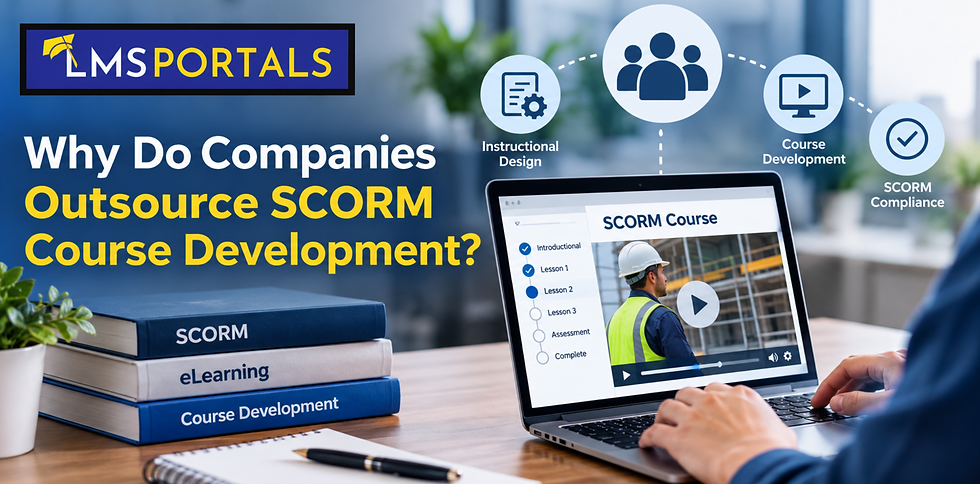
As organizations expand their employee, customer, partner, and compliance training programs, they often discover that creating effective online courses requires more time and specialized expertise than expected.
A company may already have the knowledge needed to train its workforce. Subject matter experts may have created PowerPoint presentations, policy documents, training manuals, videos, instructor-led materials, and other resources. The challenge is transforming that information into professional online courses that can be delivered and tracked through a learning management system (LMS).
This is one reason companies outsource SCORM course development.
Rather than building an internal eLearning development team, organizations can work with an experienced development partner to convert existing knowledge and training materials into structured, interactive, SCORM-compliant courses.
Outsourcing can accelerate course production, provide access to specialized skills, reduce the burden on internal teams, and make it easier to scale an organization's training library over time.
What Is SCORM Course Development?
SCORM stands for Sharable Content Object Reference Model. It is a widely used technical standard that enables eLearning content to communicate with compatible learning management systems.
A SCORM course is typically packaged so that it can be uploaded to an LMS and launched by learners within the training environment.
What Can a SCORM Course Track?
Depending on how the course and LMS are configured, SCORM can support the exchange of information such as:
Course completion status
Pass or fail status
Assessment scores
Learner progress
Time spent in training
Course interactions
This communication between the course and LMS is one of the primary reasons organizations use SCORM rather than simply uploading standalone presentations or videos.
SCORM transforms training content into a more trackable learning experience.
What Is Involved in Developing a SCORM Course?
SCORM development involves more than converting a document into another file format.
A development team may need to analyze the source material, organize the content into a logical structure, apply instructional design principles, create graphics and interactions, develop assessments, configure completion requirements, package the course, and test it within an LMS.
Depending on the project, development may also include narration, video, animation, scenarios, simulations, or other multimedia elements.
This combination of instructional, creative, and technical work is one of the reasons many companies choose to outsource the process.
Why Do Companies Outsource SCORM Development?
There is no single reason organizations outsource eLearning development. The decision usually involves some combination of expertise, resources, speed, scalability, and cost.
They Do Not Have an Internal eLearning Team
Many companies have extensive subject matter expertise but no dedicated eLearning development staff.
Human resources, compliance, safety, operations, and training teams may know exactly what employees need to learn. However, those teams may not have experience with instructional design, authoring tools, multimedia production, or SCORM packaging.
Hiring an entire internal development team may not make sense, particularly if course-development needs fluctuate throughout the year.
Outsourcing gives the organization access to these capabilities when they are needed.
Internal Teams Have Other Responsibilities
Even organizations with learning and development personnel may struggle with course-production capacity.
Internal teams often manage numerous responsibilities, including onboarding, instructor-led training, LMS administration, compliance programs, employee development, reporting, and communications.
Adding course design and production to that workload can create bottlenecks.
An outsourced development partner can provide additional production capacity without requiring the company to reorganize its internal team.
What Skills Are Needed to Develop SCORM Courses?
Professional eLearning development combines several disciplines.
That can make the work more resource-intensive than organizations initially expect.
Instructional Design
Instructional design focuses on turning information into an effective learning experience.
A lengthy policy document, for example, may contain all the necessary information but still be unsuitable as a training course.
An instructional designer can identify learning objectives, organize the material, eliminate unnecessary information, develop practical examples, and determine how learners should demonstrate understanding.
The objective is not simply to put information on screens. It is to help learners understand and retain what they need to know.
eLearning Development
Once the course has been designed, it must be built using appropriate development tools and technologies.
This may involve creating navigation, interactions, knowledge checks, assessments, branching scenarios, and other learning components.
The final course must also function properly when launched through the LMS.
Graphic and Multimedia Development
Visual design can have a significant impact on the learner experience.
Professional development may include custom graphics, diagrams, icons, photography, animation, audio, or video.
These elements should support the learning objectives rather than simply decorate the course.
Quality Assurance and SCORM Testing
Courses should be tested before they are released to learners.
Quality assurance may include reviewing navigation, interactions, assessment logic, spelling, visual consistency, responsive behavior, and SCORM communication.
Testing is particularly important when completion records and assessment results are being used for compliance or other business requirements.
What Training Materials Can Be Converted Into SCORM Courses?
Companies often already possess much of the content needed to create online training.
The source material simply exists in formats that were not originally designed for self-paced eLearning.
PowerPoint Presentations
PowerPoint presentations are among the most common sources for course development.
Slides used for classroom or virtual instructor-led training can provide a useful starting point.
However, effective conversion usually involves more than importing the slides into an authoring tool.
The content may need to be reorganized, expanded, simplified, or supplemented so that learners can complete the material without an instructor explaining each slide.
PDFs, Policies, and Training Manuals
Organizations frequently maintain valuable information in PDFs, policy documents, standard operating procedures, employee manuals, and technical documentation.
These resources can often be transformed into more engaging learning experiences.
Important concepts can be divided into manageable sections, supported with examples, and reinforced through knowledge checks and assessments.
Videos and Recorded Training
Existing videos, webinars, and recorded instructor-led sessions can also become part of a SCORM course.
Instead of requiring employees to watch a long recording from beginning to end, the content can be divided into shorter learning segments and combined with supporting materials and assessments.
Subject Matter Expert Knowledge
Not every training program begins with polished source materials.
Sometimes the organization's most valuable knowledge resides with experienced employees.
An outsourced development team can work with subject matter experts to organize that knowledge into a repeatable training program.
This can be particularly valuable for onboarding, operational procedures, product training, and specialized job skills.
How Does Outsourcing SCORM Development Save Time?
Course development can consume significant internal resources.
The work includes gathering source material, writing content, creating visuals, developing the course, reviewing drafts, making revisions, testing functionality, and preparing the final package.
Internal Experts Can Focus on Content
Outsourcing allows subject matter experts to focus on what they know best.
Rather than learning an authoring platform and building every screen themselves, they can provide the source knowledge and review the resulting course for accuracy.
The development partner handles much of the production process.
Multiple Courses Can Be Developed More Efficiently
The time savings become especially important when a company needs more than one course.
An organization may need to launch an onboarding curriculum, build a compliance library, convert instructor-led training, or develop courses for several departments simultaneously.
An external development resource can provide additional capacity and help move multiple projects forward.
Can Outsourcing Help Companies Scale eLearning Development?
Scalability is one of the strongest arguments for outsourcing.
Training demand does not always occur at a consistent rate.
A company might need only occasional course development during one period and then suddenly need ten, twenty, or more courses for a major initiative.
Development Capacity Can Expand With Demand
Maintaining enough full-time employees to handle peak course-production periods may be inefficient.
Outsourcing provides a more flexible model.
Organizations can increase development activity when needed without permanently expanding internal headcount.
Companies Can Build Larger Course Libraries
Once organizations begin delivering online training successfully, they often identify additional opportunities.
A company might start with compliance training and later add onboarding, cybersecurity, leadership development, product knowledge, sales training, and operational training.
Outsourced development can make it easier to continue expanding the library without overwhelming internal teams.
Does Outsourcing SCORM Development Reduce Costs?
Outsourcing does not automatically mean that every course will cost less than producing it internally.
The more important question is what capabilities an organization would need to develop and maintain internally.
An in-house operation may require instructional designers, eLearning developers, graphic designers, software licenses, multimedia resources, and technical expertise.
There are also less visible costs associated with employee time, training, management, and maintaining development capabilities.
For organizations without a steady volume of course-development work, outsourcing can provide access to these resources without the ongoing expense of maintaining a full production team.
How Does Outsourcing Improve Course Consistency?
Training libraries frequently grow over many years.
Without clear standards, courses can begin to look and function very differently from one another.
Consistent Branding
An outsourced development process can establish visual standards for elements such as colors, typography, imagery, navigation, and course layouts.
This creates a more cohesive experience across the training library.
Consistent Learning Structure
Consistency should extend beyond appearance.
Courses can follow common approaches to introductions, objectives, content organization, interactions, assessments, and completion requirements.
Learners then spend less time figuring out how each course works and more time focusing on the material.
What Should Companies Look for in a SCORM Development Partner?
Choosing the right partner requires more than reviewing graphic design samples.
Companies should consider the entire development process.
Experience With SCORM and LMS Platforms
A development provider should understand how courses interact with learning management systems.
The organization should be comfortable with SCORM packaging, completion criteria, assessment reporting, and testing.
Instructional Design Capabilities
Attractive slides do not necessarily create effective training.
A strong partner should be able to transform raw information into a structured learning experience rather than simply reproduce the source materials.
A Clear Review Process
Course development should include opportunities for stakeholders to review and approve the work.
Organizations should understand how drafts, feedback, revisions, and final approval will be managed.
Ability to Scale
Companies should also consider their future needs.
A provider that can develop one course may not necessarily have the processes or resources required to support a large training library.
If the organization expects its training program to grow, scalability should be part of the selection process.
Why Combine SCORM Development With an LMS?
Creating the courses solves only part of the training challenge.
Organizations also need a way to deliver those courses to learners, manage users, organize content, track activity, and report on results.
Combining course development with an LMS strategy can create a more complete approach.
Centralized Course Delivery
Once SCORM courses are uploaded to an LMS, employees can access training through a centralized learning environment.
Administrators can organize courses, assign learning activities, and manage access without distributing files manually.
Training Tracking and Reporting
The LMS can use information communicated by the SCORM course to maintain learner records.
This gives administrators greater visibility into course completions, assessment results, and other learning activity.
What Are the Benefits of Working With LMS Portals for SCORM Development?
LMS Portals helps organizations combine custom course development with the technology needed to deliver and manage online training.
This can be particularly valuable for companies that want to build an eLearning program without assembling multiple vendors and internal resources.
Custom SCORM Course Development
Organizations can work with LMS Portals to transform existing training materials and subject matter expertise into custom online courses.
Source materials might include PowerPoint presentations, PDFs, manuals, policies, videos, and other company resources.
This enables businesses to preserve their existing knowledge while making it easier to deliver through a structured online learning experience.
LMS and Course Development Together
One advantage of working with LMS Portals is the ability to address both sides of the training equation.
Companies need quality learning content, but they also need an environment for delivering, managing, and tracking that content.
Combining the LMS and course-development strategy can simplify implementation and reduce the need to coordinate across multiple providers.
Multi-Tenant Training Portals
LMS Portals uses a multi-tenant architecture that allows organizations to create multiple branded training portals while maintaining centralized administrative oversight.
This can be especially useful for companies that train different departments, business units, locations, customers, partners, contractors, or other audiences.
Courses can be developed centrally and then deployed to the appropriate learning environments.
Branded Learning Experiences
Organizations can create branded portals that reflect the company or audience being served.
This becomes particularly useful for extended enterprise training, where companies may want distinct learning experiences for customers, partners, or other external groups.
A Scalable Approach to Training
Organizations do not necessarily need to build their entire training library at once.
They can begin with priority courses and expand over time.
As additional training needs emerge, new SCORM courses can be developed and added to the learning environment.
This provides a practical path for organizations that want to build a professional eLearning program without making a large internal investment in course-production infrastructure.
When Does Outsourcing SCORM Development Make the Most Sense?
Outsourcing is particularly worth considering when a company has valuable training content but lacks the resources to convert it into eLearning.
It can also make sense when internal development teams are at capacity, a large number of courses must be produced, training needs fluctuate, or a project has a specific deadline.
Companies should also consider outsourcing when consistency and quality have become difficult to maintain across a growing course library.
The decision ultimately depends on whether developing and maintaining the necessary capabilities internally is the best use of the organization's resources.
Outsourcing Can Turn Existing Knowledge Into Scalable Online Training
Most organizations do not lack knowledge.
They lack the time, tools, and specialized resources required to transform that knowledge into effective online training.
That distinction is important.
A company may already have years of expertise contained in presentations, manuals, policies, videos, procedures, and the knowledge of experienced employees. Outsourced SCORM development provides a way to turn those resources into structured courses that can be delivered repeatedly and tracked through an LMS.
For organizations building or expanding an online training program, the result can be faster course production, more consistent learning experiences, and less pressure on internal teams.
LMS Portals brings course development and learning management together within a scalable platform. Organizations can develop custom SCORM courses, deploy them through branded learning portals, track learner activity, and expand their training programs as business requirements evolve.
Rather than building every capability internally, companies can focus on the knowledge they want to share—and use LMS Portals to help transform that knowledge into scalable online learning.
About LMS Portals
LMS Portals provides a flexible, SaaS-based multi-tenant learning management system for delivering training to employees, customers, partners, clients, and other learning audiences.
Our multi-portal architecture enables organizations to launch dedicated, branded learning environments while centrally managing users, courses, compliance, reporting, and administration.
The platform includes tools for creating and delivering SCORM-compliant courses, a library of ready-made training courses, and Learning Paths for building structured training programs. LMS Portals also supports virtual instructor-led training, certification programs, automation, reporting, and social learning.
Together, these capabilities make LMS Portals a scalable solution for organizations managing training across multiple audiences.
Contact us today to get started or visit our Partner Program pages


Comments