
What Is an API-First LMS?


Learning management systems are becoming increasingly connected to the broader technology environments organizations use to manage employees, customers, partners, compliance programs, and business operations.
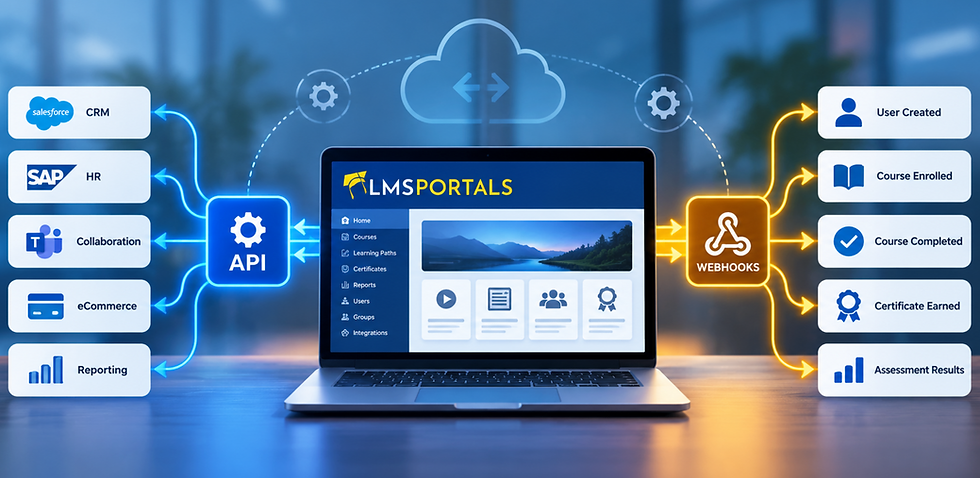
An LMS may need to exchange information with HR platforms, CRM systems, identity providers, eCommerce applications, collaboration tools, business intelligence platforms, customer portals, and other enterprise applications.
As these requirements become more sophisticated, organizations are beginning to evaluate not only what an LMS can do through its user interface, but also how easily its capabilities and data can be accessed by other software applications.
This has increased interest in the concept of an API-first LMS.
An API-first LMS is designed with application programming interfaces (APIs) as a fundamental part of the platform's architecture. Rather than treating integrations as an afterthought, an API-first approach makes interoperability, automation, and extensibility important considerations in how the LMS is designed.
For organizations building increasingly connected learning ecosystems, this approach can provide greater flexibility in determining where and how learning functionality is delivered.
What Does API-First Mean?
APIs Become Part of the Platform Architecture
An Application Programming Interface, or API, provides a structured method for one software application to communicate with another.
In a traditional software environment, functionality may primarily be designed around what administrators and users can accomplish through the application's graphical interface.
An API-first approach considers another question:
How will other applications interact with this functionality?
For an LMS, this might mean providing programmatic ways to perform tasks such as:
Creating and updating users
Enrolling learners in courses
Managing groups or organizations
Retrieving course information
Accessing completion records
Retrieving assessment results
Managing learning assignments
Accessing certificates
Synchronizing reporting data
Instead of requiring every process to begin within the LMS interface, APIs allow other applications and automated workflows to interact with LMS functionality.
What Is an API-First LMS?
The LMS Becomes Part of a Larger Technology Ecosystem
An API-first LMS is a learning platform designed to operate as part of a broader technology environment.
The LMS still provides the familiar functionality organizations expect, such as course delivery, learner management, assessments, certificates, reporting, and administration.
But its architecture also supports communication with external systems.
For example, an HR system could create a learner in the LMS when a new employee is hired.
A CRM could enroll a customer in onboarding training after a sale closes.
An eCommerce application could enroll someone in a course after a purchase.
A business intelligence platform could retrieve learning data for inclusion in company-wide dashboards.
In each case, the LMS becomes part of a larger automated workflow.
How Is an API-First LMS Different From a Traditional LMS?
Traditional LMS Platforms Can Operate as Standalone Systems
Many LMS platforms were originally designed primarily as self-contained applications.
Administrators logged into the LMS to create users, assign courses, manage training, and generate reports. Learners logged into the same application to access their training.
Integrations were sometimes added later as organizations requested connections with other systems.
That model can work well when most training activities remain within the LMS.
However, organizations increasingly want learning technology to interact with systems throughout the business.
API-First Design Anticipates Integration
An API-first strategy considers integration requirements much earlier in the platform architecture.
Instead of asking how an external application can be connected after functionality has already been developed, developers consider how software applications might interact with that functionality from the beginning.
This can create a more extensible environment for automation and integration.
It does not necessarily mean that every feature of an API-first LMS must be available through an API. API coverage varies considerably between platforms.
The important distinction is that programmatic access is treated as an architectural capability rather than simply an optional integration feature.
Why Are APIs Becoming More Important for LMS Platforms?
Learning Technology No Longer Operates in Isolation
Organizations now use specialized software platforms for nearly every major business function.
A typical technology environment might include:
Human resources systems
Customer relationship management platforms
Identity and access management
Collaboration applications
eCommerce systems
Customer portals
Business intelligence platforms
Compliance systems
Marketing automation platforms
Virtual meeting applications
Training frequently intersects with these systems.
An employee's role may determine required training.
A customer's purchase may determine which courses become available.
A partner's certification status may affect access to sales resources.
Completion of compliance training may determine whether an employee remains qualified to perform certain work.
APIs provide a mechanism for connecting these processes.
What Can LMS APIs Be Used For?
Automated User Provisioning
User provisioning is one of the most common LMS integration requirements.
Rather than manually creating learner accounts, another application can potentially send user information to the LMS through an API.
For example:
New employee created in HR system → API creates LMS user → learner receives required training.
The same approach can be applied to customers, partners, contractors, franchisees, members, and other audiences.
Automated Enrollment
APIs can also support automated training assignments.
A CRM might enroll a newly acquired customer in an onboarding program.
An HR system might assign compliance training based on job role.
A partner management system might enroll a reseller in certification training based on partnership level.
This connects training directly to the business process that creates the training requirement.
Learning Data Synchronization
Organizations often need LMS information outside the LMS.
APIs can make it possible for other applications to retrieve information such as:
Course completions
Enrollment status
Assessment results
Certificates
Learner activity
Training history
This information can then become part of HR records, customer profiles, compliance dashboards, or business intelligence systems.
API-First LMS vs. LMS Integrations
Prebuilt Integrations and APIs Solve Different Problems
Many LMS platforms offer integrations with popular applications.
These integrations can be extremely useful because much of the required connection has already been developed.
An organization might connect its LMS with a video conferencing platform, CRM, identity provider, or other application through an existing integration.
APIs provide a different level of flexibility.
They can enable organizations to develop workflows that are specific to their business requirements, including connections with proprietary applications or specialized systems for which a packaged integration may not exist.
The two approaches are complementary.
A strong LMS integration strategy may include prebuilt integrations for common applications and APIs for customized requirements.
How Do APIs and Webhooks Work Together?
APIs Request; Webhooks Notify
APIs are often discussed alongside webhooks because the two technologies can work together.
An API generally allows an application to request information or initiate an action.
A webhook generally enables an application to notify another system when a particular event occurs.
For example, an LMS might send a webhook when a learner completes a certification.
The receiving application could then use an API to retrieve additional information about the learner, course, or certification.
The workflow might look like this:
Learner completes certification → webhook announces completion → external application calls LMS API → detailed training record is retrieved → external system is updated.
Together, APIs and webhooks can support highly automated, event-driven learning environments.
What Is a Headless LMS?
API-First Architecture Can Support Headless Learning Experiences
API-first architecture is also closely related to the concept of a headless LMS.
In a traditional LMS, the platform typically provides both the underlying learning functionality and the interface learners use.
A headless approach separates these layers.
The LMS may continue to manage courses, enrollments, progress, assessments, and learning records while another application provides some or all of the learner-facing experience.
For example, an organization might deliver learning through its:
Customer portal
Partner portal
Employee application
SaaS product
Mobile application
Membership website
APIs can provide the connection between that experience and the underlying learning platform.
Not every API-first LMS is headless, but API accessibility can make headless or embedded learning models easier to implement.
Why API-First Architecture Matters for Multi-Tenant LMS Platforms
Multiple Audiences Create More Complex Integration Requirements
Integration requirements can become considerably more complex when an organization delivers training to multiple audiences.
A company might operate separate learning environments for:
Employees
Customers
Partners
Franchise locations
Dealers
Contractors
Business units
Each audience may require different branding, content, administrators, permissions, and workflows.
At the same time, these environments may need to connect with centralized enterprise systems.
This is where API capabilities become particularly valuable within a multi-tenant LMS architecture.
Centralized Systems Can Support Multiple Learning Portals
Consider an organization operating dozens of branded customer training portals.
A central CRM might contain customer records for all of those organizations.
An integration could use customer information to determine which learning portal a user belongs to, create the appropriate learner account, assign training, and synchronize completion information back to the CRM.
As the number of portals increases, manual administration becomes increasingly difficult.
APIs can help automate processes across a growing multi-portal environment.
How Can an API-First LMS Support SaaS Companies?
Learning Can Become Part of the Customer Experience
For SaaS companies, training is increasingly connected to customer onboarding, adoption, certification, and retention.
Instead of operating a separate training website disconnected from the product, an API-enabled LMS can potentially become part of the broader customer experience.
A customer could purchase a subscription, receive access to the appropriate training environment, complete onboarding courses, earn certifications, and have those accomplishments reflected in other customer systems.
This makes training part of the organization's technology and customer-success infrastructure rather than an isolated activity.
What Should Organizations Look for in an LMS API?
API Availability Alone Does Not Tell the Whole Story
Simply stating that an LMS "has an API" provides relatively little information.
Organizations evaluating LMS integration capabilities should determine what the API actually allows them to do.
Important questions include:
What LMS objects can be accessed?
Can users be created and updated?
Can enrollments be managed?
Can completion data be retrieved?
Are groups or organizations supported?
Can reporting information be accessed?
How is authentication handled?
Are there API usage limits?
How are errors communicated?
Is documentation available?
Does the platform also support webhooks or event notifications?
The answers can reveal much more about integration capabilities than the existence of an API alone.
Security and API-First LMS Architecture
Programmatic Access Requires Strong Controls
APIs create powerful integration opportunities, but they must be implemented securely.
Organizations should consider how API requests are authenticated and what permissions connected applications receive.
Depending on the platform and integration, security mechanisms might include API credentials, access tokens, OAuth, role-based permissions, encryption, or other controls.
Organizations should also apply the principle of least privilege.
An application that only needs to retrieve course completion information should not automatically receive unrestricted access to unrelated LMS data or administrative functions.
Security therefore needs to be considered alongside functionality when evaluating an LMS API strategy.
The Benefits of Working With LMS Portals
Multi-Tenant Architecture for Multiple Training Audiences
LMS Portals provides a multi-tenant SaaS learning management platform designed for organizations that need to create and manage multiple learning environments.
Organizations can establish branded portals for different customers, employees, partners, departments, or other audiences while maintaining centralized oversight.
This architecture can help organizations expand training programs without requiring a completely separate LMS implementation for every audience.
Integration Flexibility
LMS Portals supports an integration-oriented approach that can help organizations connect learning processes with other business applications and workflows.
API capabilities can support customized integration requirements, while available platform integrations can address common business use cases.
This flexibility can be particularly valuable for organizations whose training requirements extend beyond a single internal employee population.
A Foundation for Scalable Learning Ecosystems
As organizations grow, their LMS requirements often become more sophisticated.
A company might begin by delivering courses to employees and later add customer training, partner enablement, certification programs, compliance training, or training-as-a-service offerings.
Integration requirements may grow at the same time.
LMS Portals provides a multi-portal foundation that can support this evolution while helping organizations centralize the administration of multiple training environments.
For SaaS companies, training providers, associations, enterprises, and other organizations managing multiple learning audiences, this combination of multi-tenant architecture and integration flexibility can provide an important foundation for scale.
Is an API-First LMS Right for Your Organization?
Start With the Business Processes You Want to Connect
Organizations should not pursue API-first architecture simply because APIs are a popular technology.
The more useful question is whether training needs to interact with other business processes.
If learner administration is completely independent of other applications, extensive API capabilities may not be a major requirement.
But if training needs to interact with HR, CRM, customer onboarding, compliance, eCommerce, identity management, reporting, or proprietary applications, API capabilities become much more important.
Organizations should therefore evaluate their current integration requirements while also considering where their learning ecosystem may be heading.
The Future of the LMS Is Increasingly Connected
The LMS is evolving from a standalone destination for online courses into a connected component of the enterprise technology environment.
Training data can influence compliance processes, employee records, customer onboarding, partner certification, workforce qualification, and business reporting.
At the same time, information from other systems increasingly determines who should receive training, which learning experiences they should access, and when those experiences should begin.
An API-first approach helps create the technical foundation for these connections.
Rather than requiring every learning process to begin and end inside the LMS, APIs allow learning functionality and learning data to participate in broader business workflows.
For organizations building sophisticated employee, customer, partner, or commercial training programs, that flexibility can become increasingly important.
And for organizations managing multiple learning audiences, a platform such as LMS Portals can combine the advantages of multi-tenant learning management with the integration flexibility needed to build a more connected and scalable learning ecosystem.
About LMS Portals
LMS Portals provides a flexible, SaaS-based multi-tenant learning management system for delivering training to employees, customers, partners, clients, and other learning audiences.
Our multi-portal architecture enables organizations to launch dedicated, branded learning environments while centrally managing users, courses, compliance, reporting, and administration.
The platform includes tools for creating and delivering SCORM-compliant courses, a library of ready-made training courses, and Learning Paths for building structured training programs. LMS Portals also supports virtual instructor-led training, certification programs, automation, reporting, and social learning.
Together, these capabilities make LMS Portals a scalable solution for organizations managing training across multiple audiences.
Contact us today to get started or visit our Partner Program pages


Comments