
Webhooks vs. APIs: What Is the Difference for LMS Integrations?

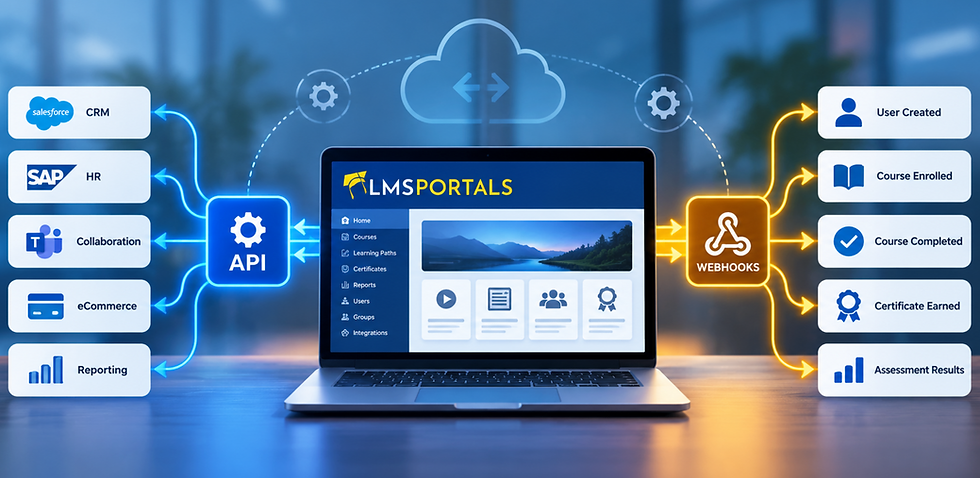
Modern learning management systems rarely operate in isolation. Organizations increasingly expect their LMS to exchange information with HR systems, CRM platforms, collaboration tools, eCommerce applications, identity providers, reporting systems, and other business applications.
Two technologies frequently make these integrations possible: APIs and webhooks.
Although APIs and webhooks are closely related, they serve different purposes. An API typically enables one application to request information or initiate an action in another system. A webhook enables an application to automatically notify another system when a particular event occurs.
Understanding this distinction can help organizations design LMS integrations that are faster, more automated, and easier to scale.
What Is an API?
APIs Allow Applications to Communicate
An Application Programming Interface (API) provides a structured way for software applications to communicate with one another.
An LMS API might allow another application to perform actions such as:
Create or update users
Enroll learners in courses
Retrieve course information
Access training records
Check completion status
Retrieve assessment results
Manage groups or organizations
Generate or retrieve reporting data
For example, an HR system might use an LMS API to create a learner account whenever a new employee is added.
The requesting application sends a request to an API endpoint. The LMS processes that request and returns a response.
This is often described as a request-response model.
A Simple LMS API Example
Imagine that an organization maintains employee records in an HR platform but delivers employee training through its LMS.
The HR application could send an API request to the LMS asking it to create a new learner.
The LMS might respond with information confirming that the account was successfully created.
Later, the HR platform could request that employee's training history through another API call.
In both cases, the external application initiates the communication.
That distinction becomes important when comparing APIs with webhooks.
What Is a Webhook?
Webhooks Are Triggered by Events
A webhook enables an application to automatically send information to another application when a specific event occurs.
Rather than repeatedly asking:
"Has something changed?"
the receiving application can effectively say:
"Tell me when something changes."
For an LMS, webhook events might include:
When one of these events occurs, the LMS can send a message—typically an HTTP request containing event data—to a configured endpoint in another application.
The receiving system can then process the information or trigger another workflow.
A Simple LMS Webhook Example
Suppose an organization wants its CRM to know whenever a customer completes a certification course.
Without webhooks, the CRM or an integration service might periodically call the LMS API to check whether the learner has completed the course.
With a webhook, the LMS can automatically send a notification as soon as the completion occurs.
The workflow becomes:
Learner completes course → LMS detects completion → webhook fires → CRM receives completion data → CRM updates customer record.
This event-driven model can make integrations significantly more responsive.
APIs vs. Webhooks: What Is the Main Difference?
APIs Usually Ask; Webhooks Usually Tell
The simplest distinction is:
An API is commonly used to request data or perform an action. A webhook is commonly used to announce that an event has occurred.
Consider an LMS and HR system.
Using an API, the HR system might ask:
"Has this employee completed cybersecurity training?"
Using a webhook, the LMS might automatically tell the HR system:
"This employee just completed cybersecurity training."
Both technologies enable system-to-system communication, but they initiate that communication differently.
Why APIs Are Important for LMS Integrations
APIs Provide Flexible Access to LMS Functions
APIs remain one of the most important integration technologies available to an LMS.
A well-designed API can expose LMS functionality to other applications and enable organizations to build customized workflows.
For example, an organization might integrate an LMS with its CRM so sales representatives can be automatically enrolled in training based on territory, role, product assignment, or another business rule.
A training provider might use an API to create customer accounts and enroll learners after a purchase.
A healthcare organization might connect an LMS with an HR platform to synchronize employee records and mandatory training assignments.
The API provides the building blocks needed to create these integrations.
APIs Are Useful When Data Must Be Requested on Demand
Sometimes an application needs information at a specific moment.
For example, a compliance dashboard might need the latest training status for 500 employees.
An API request can retrieve that information when the dashboard loads.
Similarly, an external application might need to retrieve:
A learner's current enrollments
Available courses
Certificate details
Assessment results
Training history
User profile information
These are natural API use cases because the requesting system determines when the information is needed.
Why Webhooks Are Important for LMS Integrations
Webhooks Support Real-Time Automation
Webhooks become especially valuable when organizations want workflows to happen automatically after LMS events.
Suppose a learner completes a safety certification.
That completion could trigger a webhook that initiates several downstream actions.
A connected system might update the employee's compliance record, notify a manager, update a CRM record, enable access to another system, or begin a recertification workflow.
Instead of waiting for another application to discover the completion, the LMS announces it immediately.
Webhooks Can Reduce Unnecessary API Requests
Without webhooks, integrations sometimes rely heavily on polling.
Polling means repeatedly asking an application whether something has changed.
An external application might call an LMS API every five minutes to check for new course completions.
Most of those API calls may return nothing new.
With a webhook, the LMS sends information only when the relevant event occurs.
This can reduce unnecessary requests and improve integration efficiency.
Polling vs. Event-Driven LMS Integrations
Why Polling Can Become Inefficient
Polling can work perfectly well for many integrations, particularly when immediate updates are unnecessary.
However, frequent polling becomes less attractive as an integration grows.
Imagine an application checking thousands of learner records every few minutes.
That creates additional API traffic, processing requirements, and integration complexity—even when very little information has changed.
There may also be delays between an event and the next polling interval.
If polling occurs every 30 minutes, a course completion could remain unknown to another system for almost half an hour.
Event-Driven Architecture Changes the Model
Webhooks enable a more event-driven architecture.
Instead of constantly checking for changes, connected systems react when something happens.
This approach can be particularly useful for LMS environments where events have business significance.
Course completion is not simply a database update. It may represent an employee becoming qualified to perform a task.
A failed assessment might require remedial training.
A certification expiration could create a compliance risk.
A completed customer training program might trigger the next step in an onboarding process.
Webhooks help transform these LMS activities into events that other business applications can act upon.
Should an LMS Use APIs or Webhooks?
Most Advanced Integrations Benefit From Both
APIs and webhooks should not necessarily be viewed as competing technologies.
They frequently work together.
A webhook might notify another application that an event occurred, while an API provides the detailed information or functionality needed to respond to that event.
For example:
A learner completes a course.
The LMS sends a completion webhook.
An integration service receives the webhook.
The integration service then calls the LMS API to retrieve the learner's complete training record.
The information is subsequently synchronized with an HR or compliance system.
The webhook initiates the workflow, while the API provides additional capabilities.
Common LMS API Integration Scenarios
User Provisioning and Enrollment
APIs are commonly used to automate learner administration.
An HR system, CRM, customer portal, or other application can send user information to the LMS and automatically create accounts.
Additional API calls can assign courses, groups, learning paths, or other training resources.
This reduces administrative work and helps ensure that training assignments follow business processes.
Training Data Synchronization
Organizations may also use APIs to retrieve training data from an LMS.
This could include course completions, assessment results, certifications, attendance information, and learner activity.
The information can then be displayed or analyzed in another business application.
Common LMS Webhook Scenarios
Course Completion Automation
Course completion is one of the clearest webhook use cases.
Once a learner completes a course, an LMS webhook can immediately inform another application.
That event could trigger a CRM update, manager notification, certificate workflow, compliance record, or additional training assignment.
Assessment and Certification Events
Assessment results can also trigger automated processes.
For example, passing an assessment could unlock the next stage of training.
Failing an assessment could initiate remedial coursework.
Earning a certification could update an employee qualification system.
The LMS event becomes the trigger for a broader workflow.
Security Considerations for APIs and Webhooks
Authentication and Authorization Matter
Any LMS integration must be designed with security in mind.
APIs typically use authentication methods such as API keys, access tokens, OAuth, or other authorization mechanisms.
Organizations should ensure that connected applications receive only the permissions required to perform their intended functions.
This principle of least privilege helps reduce unnecessary exposure.
Webhook Endpoints Must Also Be Protected
Webhook implementations require their own security controls.
Receiving applications should be able to verify that incoming webhook requests actually came from the expected system.
Depending on the implementation, this may involve signed requests, shared secrets, HTTPS, token validation, or other verification techniques.
Webhook processing should also account for duplicate messages, failed deliveries, retries, and unexpected payloads.
These considerations become increasingly important as integrations move from simple data synchronization toward mission-critical automation.
APIs, Webhooks, and Multi-Tenant LMS Architecture
Integration Requirements Become More Complex at Scale
Integration architecture becomes especially important when organizations operate multiple training environments.
A business may need separate LMS portals for customers, partners, departments, franchises, subsidiaries, or other audiences.
Each portal may have its own users, courses, branding, administrators, and business processes.
However, the organization may still need centralized integrations with CRM, HR, identity, reporting, or collaboration platforms.
A flexible integration architecture helps organizations maintain separation between training environments while connecting those environments with broader business systems.
This Is Where Multi-Tenant LMS Architecture Matters
A multi-tenant LMS can provide centralized administration while supporting multiple independently configured learning portals.
Combined with APIs and event-driven integration capabilities, this architecture can provide a foundation for sophisticated training ecosystems.
Organizations can manage multiple audiences without necessarily deploying and maintaining a completely separate LMS implementation for every group.
The Benefits of Working With LMS Portals
A Multi-Tenant Platform Designed for Complex Training Environments
LMS Portals provides a multi-tenant learning management platform that enables organizations to create and manage multiple branded training portals from a centralized environment.
This approach can be valuable for organizations delivering training to multiple audiences, including:
Employees
Customers
Channel partners
Franchisees
Members
Contractors
Dealers
Business units
Each portal can provide a dedicated learning experience while remaining part of a broader centralized LMS environment.
Integration Flexibility
LMS Portals is designed to support organizations that need their learning environment to connect with other business systems.
API-based integrations can help automate workflows involving users, training assignments, learning data, and other LMS functions.
Integration strategies can also be designed around the specific systems and business processes an organization uses rather than forcing every organization into the same rigid workflow.
This is particularly important for SaaS providers, training companies, associations, and enterprises that may have different integration requirements for different customers or audiences.
Support for Broader Learning Ecosystems
Modern LMS deployments increasingly extend beyond course delivery.
Organizations may need to connect training with virtual instructor-led learning, CRM processes, identity management, customer onboarding, compliance programs, reporting systems, and other enterprise applications.
LMS Portals provides organizations with a platform that can serve as the learning layer within this broader technology ecosystem.
Its multi-portal architecture can also help organizations scale these programs as additional customers, departments, partners, or business units are added.
A Platform That Can Evolve With Integration Requirements
Integration requirements rarely remain static.
An organization might initially need only user provisioning.
Later, it may want automated enrollment, training-data synchronization, CRM integration, webinar workflows, single sign-on, reporting automation, or event-driven processes.
Working with a flexible SaaS LMS platform gives organizations the ability to evolve their learning technology strategy as these requirements become more sophisticated.
Rather than viewing the LMS as an isolated application, organizations can treat it as an integrated component of their broader business infrastructure.
Questions to Ask When Planning an LMS Integration
Start With the Business Event
One of the best ways to design an integration is to begin with the business process rather than the technology.
Ask:
What event should start this workflow?
What information needs to move between systems?
Which application owns the authoritative data?
Does the information need to move immediately?
Does another application need to request information on demand?
What should happen if an integration attempt fails?
The answers help determine whether APIs, webhooks, scheduled synchronization, or a combination of approaches makes the most sense.
Consider Future Scale
Organizations should also think beyond their immediate integration requirement.
An integration designed for 100 learners may eventually need to support 100,000.
A company operating one learning portal today may eventually operate dozens or hundreds.
The number of systems, customers, events, and data transactions may also grow.
Designing the integration architecture with future scale in mind can reduce the need for expensive redesigns later.
The Future of LMS Integrations Is Increasingly Event-Driven
Learning Data Is Becoming Business Data
As corporate learning becomes more deeply connected with compliance, customer success, employee performance, partner enablement, and business operations, LMS data becomes increasingly valuable outside the LMS itself.
A course completion can represent a compliance milestone.
A certification can represent authorization to perform a job.
A customer-training completion can represent progress toward onboarding.
A partner certification can determine eligibility to sell a product.
APIs allow organizations to access and manipulate this information. Webhooks allow organizations to react to important learning events as they happen.
Together, they help transform the LMS from a standalone training application into an active part of the organization's technology ecosystem.
Conclusion
APIs and webhooks solve different but complementary integration challenges.
An API generally allows one application to request information or initiate an action in another application.
A webhook allows an application to automatically notify another system when an event occurs.
APIs are ideal when applications need flexible, on-demand access to LMS data and functionality. Webhooks are especially valuable when organizations want event-driven workflows that respond quickly to learner activity.
Many sophisticated LMS integrations use both.
As learning technology becomes increasingly connected with HR, CRM, compliance, collaboration, customer success, and other enterprise systems, understanding these integration models becomes an important part of selecting and implementing an LMS.
With its multi-tenant architecture and flexible approach to integrations, LMS Portals helps organizations build scalable learning environments that can connect training with the broader applications and workflows that drive their business.
About LMS Portals
LMS Portals provides a flexible, SaaS-based multi-tenant learning management system for delivering training to employees, customers, partners, clients, and other learning audiences.
Our multi-portal architecture enables organizations to launch dedicated, branded learning environments while centrally managing users, courses, compliance, reporting, and administration.
The platform includes tools for creating and delivering SCORM-compliant courses, a library of ready-made training courses, and Learning Paths for building structured training programs. LMS Portals also supports virtual instructor-led training, certification programs, automation, reporting, and social learning.
Together, these capabilities make LMS Portals a scalable solution for organizations managing training across multiple audiences.
Contact us today to get started or visit our Partner Program pages


Comments