
Managing California Sexual Harassment Prevention Training


California has some of the nation's most comprehensive workplace harassment prevention laws, making sexual harassment prevention training a legal obligation for many employers operating within the state. While the regulations are well established, managing compliance across an organization can quickly become a significant administrative challenge.
Human resources professionals must ensure that the right employees complete the appropriate training, new supervisors receive instruction within required timeframes, refresher courses are assigned every two years, and accurate records are maintained for every learner.
For organizations with multiple locations, hybrid employees, or a growing workforce, these responsibilities can become overwhelming when managed manually. Fortunately, today's learning management systems (LMS) make it possible to automate much of the compliance process while improving the overall learning experience.
Rather than simply helping organizations "check the compliance box," an LMS can create a repeatable, scalable training program that supports both regulatory requirements and a culture of respect throughout the workplace.
Understanding California's Training Requirements
Who Must Be Trained?
California law requires employers with five or more employees to provide sexual harassment prevention training to supervisory and nonsupervisory employees. The requirements extend beyond traditional full-time staff and often include part-time, temporary, and seasonal workers depending on their employment circumstances.
Because employee roles frequently change, organizations need an efficient way to determine who requires which training and when it must be completed.
Supervisor and Employee Requirements
Supervisory employees must complete at least two hours of interactive sexual harassment prevention training, while nonsupervisory employees must complete at least one hour of interactive instruction. Newly promoted supervisors must receive training within six months of assuming supervisory responsibilities, and all covered employees must complete refresher training every two years.
Meeting these deadlines consistently requires ongoing attention rather than a one-time training initiative.
Documentation Is Part of Compliance
Completing the training is only one part of the compliance process. Employers should also maintain accurate records demonstrating who completed training, when it was completed, and which course was assigned. Having reliable documentation readily available can prove invaluable during internal reviews, regulatory inquiries, or legal proceedings.
Compliance Is More Than a Legal Requirement
Reducing Organizational Risk
Many organizations initially view California sexual harassment prevention training as simply another regulatory obligation. While meeting legal requirements is essential, effective training also reduces organizational risk by helping employees recognize inappropriate behavior before problems escalate into formal complaints or litigation.
Employees who understand workplace expectations are more likely to make sound decisions, intervene appropriately when necessary, and report concerns through established channels.
Strengthening Workplace Culture
The most successful organizations recognize that compliance training also supports a healthier workplace culture. Employees gain a better understanding of professionalism, respectful communication, appropriate workplace conduct, and the organization's commitment to providing a safe and inclusive work environment.
When training is engaging and practical, employees are far more likely to retain the information and apply it in their daily interactions.
The Challenges of Managing Compliance Manually
Training Never Really Ends
California's recurring training requirements mean compliance is an ongoing process rather than a project that can be completed once and forgotten.
New employees are hired. Supervisors are promoted. Employees transfer between departments and locations. Others leave the organization while new staff members join throughout the year. Every personnel change can create new training obligations.
Without an organized system, it becomes increasingly difficult to ensure no one falls through the cracks.
Different Employees Need Different Training
Not every employee receives the same course.
Managers require different instruction than frontline employees. Newly promoted supervisors follow different deadlines than experienced managers. Some organizations also assign supplemental compliance training based on job function, department, or industry requirements.
Managing these differences manually often leads to duplicate assignments, missed deadlines, or inconsistent administration.
Administrative Tasks Consume Valuable Time
Many HR professionals continue managing compliance through spreadsheets, Outlook reminders, and manual email notifications. While these methods may work for small organizations, they become increasingly inefficient as employee counts grow.
Time spent chasing completion records, sending reminder emails, and compiling reports could be invested in higher-value employee development initiatives.
Why Interactive Training Makes a Difference
California Requires Interactive Learning
California regulations require sexual harassment prevention training to be interactive rather than passive.
Employees should actively participate through scenario-based exercises, knowledge checks, and practical workplace examples instead of simply watching videos or reading policy documents.
Interactive learning helps ensure employees understand not only what the law requires but how those requirements apply to real workplace situations.
Better Engagement Produces Better Results
Employees retain information more effectively when they actively participate throughout the learning experience.
Realistic workplace scenarios encourage learners to think critically about appropriate responses while reinforcing acceptable workplace behavior. As a result, employees are more likely to recognize inappropriate conduct and respond appropriately if situations arise.
Preparing Supervisors for Leadership Responsibilities
Managers Have Additional Obligations
Supervisors represent the organization and play a critical role in maintaining a respectful workplace.
Their responsibilities extend beyond their own conduct. They must understand how to respond appropriately when concerns are reported, document incidents properly, avoid retaliation, and escalate complaints according to organizational procedures.
Confidence Leads to Better Decisions
Effective supervisor training prepares managers for conversations they hope they never have to conduct.
By understanding both California law and company policies, supervisors can respond consistently, professionally, and confidently whenever workplace concerns arise.
Supporting Today's Distributed Workforce
Training Anywhere Employees Work
Today's workforce is increasingly mobile. Employees may work from corporate offices, satellite locations, customer sites, or home offices.
An online learning platform allows every employee to complete required training whenever it fits their schedule without sacrificing consistency or compliance.
Consistency Across Multiple Locations
Organizations with multiple California offices often struggle to deliver standardized training across every location.
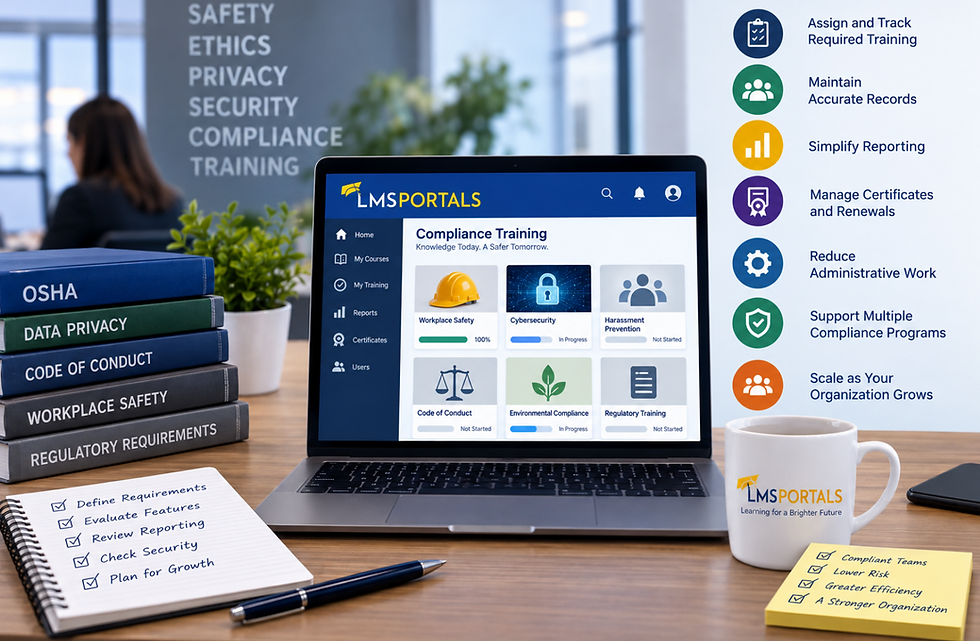
A centralized LMS ensures every employee receives the same approved course while allowing administrators to monitor compliance across the entire organization from a single dashboard.
Why Automation Changes Everything
Eliminate Repetitive Administrative Work
Automation transforms compliance management from a manual process into a streamlined workflow.
Courses can be assigned automatically based on employee role, department, location, or other business rules. Reminder emails can be scheduled automatically before deadlines, while recurring assignments help ensure retraining occurs on time every two years.
Instead of spending hours managing logistics, HR professionals can focus on supporting employees.
Real-Time Visibility
Managers and administrators always know where compliance stands.
Dashboards provide immediate insight into course completions, overdue assignments, learner progress, and upcoming deadlines without requiring manual reporting.
This visibility helps organizations identify potential compliance gaps before they become problems.
Accurate Recordkeeping Simplifies Audits
Good documentation is an essential part of every compliance program.
A modern learning management system automatically records enrollments, course progress, completion dates, assessment scores, and certificates while maintaining a historical record for each learner.
When documentation is requested during an audit or investigation, administrators can quickly generate reports instead of searching through paper files or disconnected spreadsheets.
Compliance Training Should Grow With Your Organization
As organizations expand, compliance requirements become more complex.
Additional offices, new departments, acquisitions, remote employees, and larger workforces all increase administrative responsibilities. A scalable LMS allows organizations to continue growing without creating a proportional increase in HR workload.
Whether supporting fifty employees or several thousand learners, the right platform makes compliance management predictable and efficient.
Why Organizations Choose LMS Portals
Built Specifically for Organizational Training
LMS Portals is a cloud-based learning management system designed to simplify compliance training while supporting every stage of the employee learning lifecycle. From onboarding through annual compliance training and professional development, organizations can manage all employee learning from a single platform.
Because LMS Portals is fully hosted, organizations can launch quickly without investing in additional infrastructure or IT resources.
Automate Mandatory Training
Recurring compliance requirements become significantly easier when much of the administrative work is automated.
LMS Portals allows administrators to assign courses automatically, enroll learners into learning paths, schedule recurring training, send automated reminder notifications, issue certificates upon successful completion, and monitor organizational compliance through real-time dashboards.
Automation reduces administrative effort while helping ensure important training deadlines are never overlooked.
Organize Learners Across Multiple Locations
Many organizations need to manage employees across multiple offices, departments, business units, or client organizations.
LMS Portals makes this easy through flexible organizational structures, learner groups, and Portal Groups that simplify administration across large deployments. Administrators can organize learners logically while maintaining centralized oversight of compliance throughout the organization.
For companies serving multiple business units or customers, LMS Portals also supports fully branded learning portals, allowing each organization to maintain its own identity while being managed from a common platform.
Deliver Any Type of Online Learning
California sexual harassment prevention training is only one part of a comprehensive employee development strategy.
LMS Portals supports SCORM-compliant eLearning courses, videos, documents, quizzes, assessments, learning paths, webinars, instructor-led training, and blended learning programs. Organizations can manage compliance training alongside onboarding, leadership development, product knowledge, continuing education, and customer training without requiring multiple systems.
Powerful Reporting and Compliance Tracking
One of the greatest advantages of LMS Portals is complete visibility into learner activity.
Administrators can generate reports showing enrollments, course completions, learner progress, certificates, assessment results, overdue assignments, and historical training records. Managers gain immediate insight into their team's compliance status, while HR professionals have the documentation needed to support audits and regulatory reviews.
Access a Comprehensive Compliance Training Library
Building mandatory training programs doesn't have to begin with creating courses from scratch.
LMS Portals offers an extensive online compliance training library that includes California Sexual Harassment Prevention courses for both supervisors and nonsupervisory employees, along with hundreds of additional titles covering workplace safety, HR compliance, ethics, cybersecurity awareness, diversity and inclusion, leadership development, customer service, communication skills, and professional development.
Organizations can quickly deploy high-quality training content while maintaining the flexibility to add their own custom courses whenever needed.
Simplify California Compliance With LMS Portals
Managing California sexual harassment prevention training doesn't have to be complicated.
With automated course delivery, recurring training schedules, comprehensive reporting, centralized recordkeeping, flexible learner management, multi-location support, and an extensive compliance course library, LMS Portals provides organizations with everything they need to build an efficient, scalable, and compliant workplace training program.
Whether you're training a single California office or managing thousands of employees across multiple locations, LMS Portals helps reduce administrative effort, strengthen compliance, and create a more informed, respectful workplace.
About LMS Portals
At LMS Portals, we provide our clients and partners with a mobile-responsive, SaaS-based, multi-tenant learning management system that allows you to launch a dedicated training environment (a portal) for each of your unique audiences.
The system includes built-in, SCORM-compliant rapid course development software that provides a drag and drop engine to enable most anyone to build engaging courses quickly and easily.
We also offer a complete library of ready-made courses, covering most every aspect of corporate training and employee development.
If you choose to, you can create Learning Paths to deliver courses in a logical progression and add structure to your training program. The system also supports Virtual Instructor-Led Training (VILT) and provides tools for social learning.
Together, these features make LMS Portals the ideal SaaS-based eLearning platform for our clients and our Reseller partners.
Contact us today to get started or visit our Partner Program pages


Comments