
How Is Blended Learning Evolving in the Modern LMS?

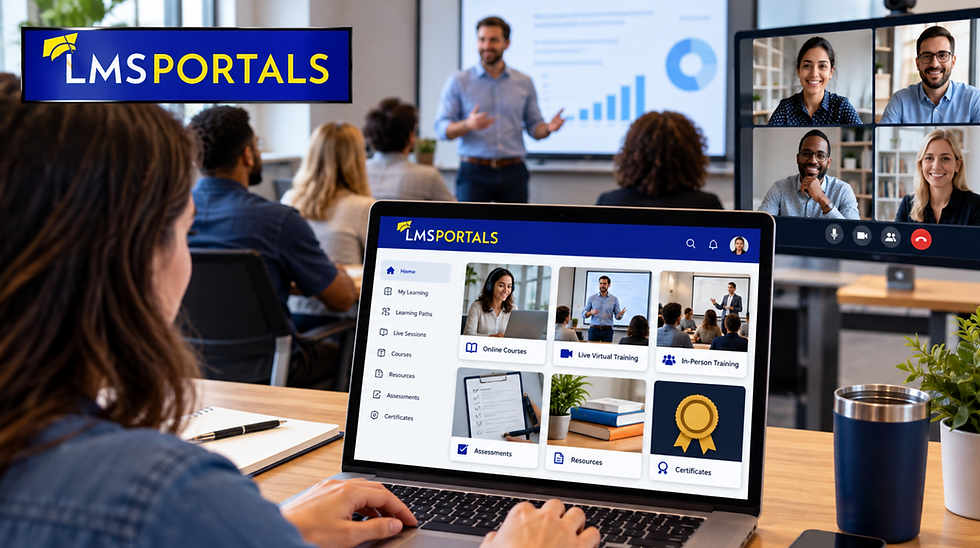
Blended learning has been part of corporate training and professional development for years, but the meaning of the term is changing.
Traditionally, blended learning described a relatively simple combination of classroom instruction and online courses. An organization might conduct an instructor-led workshop, assign several eLearning modules, and consider the two activities part of the same training program.
Today, organizations expect much more.
Modern blended learning can combine self-paced courses, virtual instructor-led training, live webinars, assessments, videos, documents, coaching, collaborative activities, certifications, and other learning experiences within a coordinated program.
The Learning Management System (LMS) is increasingly responsible for bringing these experiences together.
Rather than serving only as a repository for online courses, the modern LMS can become the central infrastructure for organizing, delivering, tracking, and reporting on learning that takes place across multiple formats.
For organizations, training companies, and learning providers, this evolution is creating opportunities to develop more flexible and engaging learning programs without sacrificing the structure and accountability required to manage training at scale.
What Is Blended Learning?
Combining Multiple Learning Methods
Blended learning is an instructional approach that combines two or more methods of learning within a coordinated training experience.
Those methods may include:
Self-paced online courses
Instructor-led classroom training
Virtual instructor-led training
Live webinars
Video instruction
Assessments and quizzes
Coaching or mentoring
Documents and reference materials
Hands-on exercises
Group discussions
On-the-job learning
The goal is not simply to offer learners multiple types of content. Effective blended learning connects those activities into a structured learning experience.
For example, an employee might complete an introductory online module before attending a live virtual session. Afterward, the learner could complete an assessment, review supplemental resources, and receive a certificate once all requirements have been satisfied.
The LMS provides the framework that can connect those activities.
Why Is Blended Learning Becoming More Important?
Workforces Are More Distributed
Many organizations now operate across multiple offices, regions, countries, and remote working environments.
Requiring every learner to attend training in the same physical location can be expensive and difficult to coordinate.
Blended learning allows organizations to reserve live instruction for activities where interaction with an instructor provides the greatest value while delivering other content online.
This can make training programs more accessible without eliminating human interaction.
Learners Expect Greater Flexibility
Modern learners often expect training to fit more naturally into their schedules.
Self-paced learning allows participants to complete certain activities when convenient, while scheduled virtual or classroom sessions can provide opportunities for discussion, demonstrations, and questions.
The combination provides flexibility without requiring organizations to move entirely to asynchronous learning.
Organizations Need Better Training Data
One challenge with traditional instructor-led training is that information about the learner experience may become fragmented.
Attendance might be stored in one system, online courses in another, assessment results in spreadsheets, and certification records somewhere else.
A modern LMS can help centralize these records.
That makes blended learning not only an instructional strategy but also a training management strategy.
How Is the Modern LMS Changing Blended Learning?
The LMS Is Becoming the Learning Hub
Historically, LMS platforms were often associated primarily with hosting SCORM courses and recording course completions.
Modern platforms can play a much broader role.
An LMS can provide learners with a central location where they can see their assigned courses, upcoming training events, learning resources, assessments, progress, and certifications.
Instead of asking learners to navigate disconnected systems, organizations can use the LMS as the primary gateway into the learning experience.
Learning Is Becoming More Modular
Blended learning is also moving away from large, isolated training events toward smaller learning components.
A program might contain:
A short introductory video
A self-paced course
A live webinar
Supporting documents
An assessment
A practical activity
A follow-up refresher course
Each component serves a different instructional purpose.
The LMS can organize these activities into learning paths or structured programs so learners understand what they need to complete and in what order.
What Role Does Virtual Instructor-Led Training Play?
Live Online Training Has Become a Core Learning Format
Virtual instructor-led training, often called VILT, has become an important component of blended learning.
Platforms such as Zoom make it possible for organizations to deliver live training to learners regardless of their physical location.
When live training and LMS functionality work together, organizations can combine the scalability of online learning with the interaction of instructor-led sessions.
Learners can ask questions, participate in discussions, respond to polls, and interact with instructors while still participating remotely.
Webinar Data Can Strengthen Training Records
The relationship between webinar platforms and LMS platforms is also becoming more sophisticated.
Organizations increasingly want more than a link that launches a virtual session. They may want information about registration, participation, attendance, and other webinar activity incorporated into the learning record.
This creates the potential for richer blended-learning reporting.
Instead of treating the live session as an activity outside the LMS, organizations can increasingly connect virtual training activity with the rest of the learner's training history.
How Are Learning Paths Supporting Blended Programs?
Training Can Be Organized Around Outcomes
A modern learning path can bring multiple learning activities together around a specific objective.
For example, a supervisor development program might include:
Leadership fundamentals
Workplace safety training
A live management workshop
Communication exercises
Policy documents
A final assessment
Certification
The individual components may use different delivery methods, but the learner experiences them as one structured program.
This approach is particularly valuable for onboarding, leadership development, compliance programs, professional certification, and customer or partner education.
Learning Paths Make Complex Training Easier to Manage
Without a structured platform, administrators may need to manually determine whether learners completed every required activity.
An LMS can simplify this process by organizing training requirements and maintaining completion records.
Administrators gain greater visibility into where learners are within the program, while learners gain a clearer understanding of what remains to be completed.
How Is Blended Learning Changing Compliance Training?
Compliance Programs Often Require Multiple Activities
Compliance training is a natural application for blended learning.
An organization might require employees to complete an online safety course, attend an instructor-led demonstration, review a policy document, pass an assessment, and renew the training annually.
The LMS can help connect these requirements into a repeatable process.
This is especially important when organizations must demonstrate that required training actually occurred.
Centralized Records Improve Audit Readiness
Blended learning creates a recordkeeping challenge when training occurs through multiple channels.
A centralized LMS can help organizations maintain records such as course completions, assessment results, certifications, and other learner activity.
Rather than reconstructing training history from several systems during an audit, administrators can maintain a more consolidated record of learner progress.
How Are Assessments Evolving Within Blended Learning?
Assessments Can Measure More Than Course Completion
Completing content does not necessarily demonstrate understanding.
Modern blended programs increasingly incorporate assessments throughout the learning process.
A learner might complete a knowledge check before a webinar, participate in questions during a live session, and complete a final assessment afterward.
This provides organizations with additional information about whether the training produced the intended learning outcome.
Assessment Data Can Inform Future Training
Assessment results can also identify knowledge gaps.
If a large percentage of learners struggle with the same topic, training administrators may decide to revise course content, schedule additional instruction, or provide supplemental resources.
The LMS therefore becomes part of a feedback loop that helps organizations continually improve training.
How Does Blended Learning Support Different Types of Learners?
Not Everyone Learns the Same Way
Some learners prefer reading. Others respond better to demonstrations, videos, discussion, or hands-on practice.
Blended learning allows organizations to incorporate multiple instructional formats rather than depending entirely on one method.
This does not mean every program needs every type of content.
Instead, organizations can select the format that best supports each learning objective.
Learners Can Reinforce Knowledge Over Time
Blended learning also supports reinforcement.
Instead of delivering training once and expecting learners to remember everything indefinitely, organizations can provide additional resources and refresher activities over time.
For example, learners might attend an initial workshop, complete an online follow-up course several weeks later, and receive refresher training before certification expires.
This creates a more continuous learning experience.
Why Is Blended Learning Valuable for Training Companies?
Training Providers Can Extend Their Services
Blended learning is particularly valuable for training companies and consultants that historically depended on classroom instruction.
An LMS allows these organizations to extend their expertise beyond the classroom.
A training company can package instructor-led services with:
Online courses
Learning paths
Assessments
Training resources
Webinar programs
Certificates
Recertification programs
Client reporting
This can transform a one-time training engagement into a broader learning service.
Blended Learning Can Support Recurring Revenue
Training providers can also use blended learning to develop recurring service models.
Instead of charging only for individual workshops, providers can offer clients ongoing access to an online training environment, course library, learning programs, reporting, and periodic instructor-led sessions.
This can create a stronger long-term relationship between the training provider and its clients.
How Can Multi-Tenant LMS Technology Support Blended Learning?
Different Audiences May Need Separate Learning Environments
Organizations that train multiple customers, departments, franchises, associations, or business units may need to deliver similar blended programs to different audiences.
Managing every audience within one undifferentiated environment can become difficult.
A multi-tenant LMS provides a different approach.
Separate learning portals can be created for different audiences while being managed through a centralized platform.
Each portal can potentially have its own branding, users, administrators, courses, and learning programs.
Training Providers Can Scale Their Model
This approach is especially useful for training companies.
Instead of building a separate LMS implementation for every client, a provider can create and manage client-specific learning environments from a common infrastructure.
That makes it easier to turn blended learning into a repeatable service offering.
How Does LMS Portals Support Modern Blended Learning?
A Centralized Platform for Multiple Learning Experiences
LMS Portals is designed to help organizations and training providers create and manage learning environments for employees, customers, partners, members, and other audiences.
The platform's multi-tenant architecture enables organizations to create separate, branded learning portals while managing them through a centralized administrative environment.
This model can be particularly useful for blended learning because different audiences can receive learning experiences designed around their specific requirements.
Organizations can combine online courses, learning resources, assessments, structured learning programs, and virtual instructor-led experiences within their broader training strategy.
Integrated Zoom Capabilities
LMS Portals supports integration with Zoom, helping organizations incorporate live virtual training into their learning environments.
This allows organizations to combine asynchronous course content with scheduled virtual learning experiences rather than treating the two approaches as completely separate training systems.
As blended learning continues to evolve, deeper connections between LMS and webinar data can provide organizations with greater visibility into participation and learner activity.
Support for Online Courses and Custom Content
Organizations adopting blended learning also need high-quality digital content.
LMS Portals can support organizations with access to online course content as well as custom course development services.
This can be valuable for organizations that have subject-matter expertise but do not have the internal resources required to convert that expertise into professional online training.
Existing presentations, documents, policies, videos, and other materials can become part of a broader digital learning strategy.
Branded Portals for Different Audiences
Blended learning does not always happen within a single organization.
Training companies may serve dozens of clients. Associations may educate members from different organizations. Enterprises may train employees, customers, distributors, and partners.
LMS Portals allows these audiences to be separated into dedicated portals.
This provides organizations with the flexibility to create targeted learning environments without managing completely independent LMS platforms.
Centralized Administration and Reporting
As blended programs grow, administration becomes increasingly important.
Training teams need visibility into users, enrollments, course activity, assessments, completions, and certifications.
Centralized LMS administration can reduce the operational complexity of managing these activities across multiple audiences.
For training companies in particular, this can make it easier to manage a growing client base without rebuilding the training infrastructure for every new customer.
What Are the Business Benefits of Using LMS Portals for Blended Learning?
Greater Training Flexibility
Organizations can combine self-paced and instructor-led approaches rather than committing entirely to one training format.
This allows each learning objective to be matched with an appropriate delivery method.
Improved Scalability
Digital learning can reduce the need to repeat the same instructor-led material for every audience.
Organizations can move foundational or repeatable content online while using instructors for higher-value activities such as discussion, coaching, demonstrations, and problem solving.
More Consistent Training
Online learning components can help ensure that every learner receives consistent foundational information.
Instructor-led sessions can then focus on applying that knowledge rather than repeatedly presenting basic material.
Better Visibility
Using an LMS as the central learning hub can provide administrators with greater visibility into learner participation, progress, assessments, and completion.
Stronger Client Services
For training providers, LMS Portals can help transform blended learning into a scalable service.
Providers can combine their expertise, instructor-led programs, online courses, client-specific portals, custom course development, and reporting into a more comprehensive offering.
Opportunities for Recurring Revenue
A portal-based model can also enable training providers to package LMS access and ongoing learning services into subscription or recurring service offerings.
Instead of ending the relationship when a workshop is complete, the training provider can remain part of the client's ongoing learning and compliance strategy.
What Will the Future of Blended Learning Look Like?
The Boundary Between Online and Instructor-Led Learning Will Continue to Blur
The future of blended learning is unlikely to be defined by a strict division between "online training" and "classroom training."
Instead, organizations will increasingly design learning programs around outcomes and choose the best delivery format for each activity.
A learner may move naturally between videos, courses, live virtual sessions, assessments, reference materials, coaching, and practical exercises without thinking of them as separate training systems.
LMS Platforms Will Become Learning Orchestration Platforms
As this evolution continues, the role of the LMS will expand.
The LMS will not simply deliver courses. It will help organizations orchestrate learning across different formats, audiences, instructors, content sources, and technologies.
Integrations, APIs, automation, webinar data, assessments, analytics, and multi-tenant architecture will become increasingly important as organizations attempt to create connected learning ecosystems.
Blended Learning Is Becoming a Connected Learning Strategy
Blended learning is evolving from a simple combination of classroom and online training into a much broader strategy for coordinating learning experiences.
Organizations want the flexibility of self-paced learning, the interaction of instructor-led training, the accessibility of virtual events, and the accountability of centralized tracking and reporting.
The modern LMS provides the infrastructure that can bring those elements together.
For organizations managing multiple learning audiences—and for training companies looking to expand beyond traditional instructor-led services—LMS Portals provides a flexible foundation for building and managing modern blended learning programs.
Through multi-tenant learning portals, Zoom integration, online course delivery, custom course development, assessments, learning management, centralized administration, and reporting, LMS Portals can help organizations turn individual training activities into connected learning experiences.
As blended learning continues to evolve, the organizations that benefit most will be those that stop viewing digital and instructor-led learning as competing approaches.
Instead, they can use the LMS to combine them into a single, scalable learning strategy.
About LMS Portals
LMS Portals provides a flexible, SaaS-based multi-tenant learning management system for delivering training to employees, customers, partners, clients, and other learning audiences.
Our multi-portal architecture enables organizations to launch dedicated, branded learning environments while centrally managing users, courses, compliance, reporting, and administration.
The platform includes tools for creating and delivering SCORM-compliant courses, a library of ready-made training courses, and Learning Paths for building structured training programs. LMS Portals also supports virtual instructor-led training, certification programs, automation, reporting, and social learning.
Together, these capabilities make LMS Portals a scalable solution for organizations managing training across multiple audiences.
Contact us today to get started or visit our Partner Program pages


Comments