
How Does an LMS Scale as User Volume Grows?


Organizations often select a learning management system based on what they need today. They may begin with a few hundred learners, a limited course catalog, and a relatively simple training program. But successful learning initiatives rarely remain static.
As training expands, an LMS may need to support thousands—or even tens of thousands—of users across multiple departments, customers, partners, geographic regions, or business units. Course libraries become larger, reporting requirements become more complex, integrations increase, and administrators need better ways to manage the growing environment.
This raises an important question: How does an LMS scale as user volume grows?
LMS scalability is about much more than allowing additional users to log in. A scalable
LMS must maintain performance while giving administrators the tools, architecture, automation, and organizational structure necessary to manage increasingly complex training operations.
Understanding these requirements can help organizations choose an LMS that supports both their immediate needs and their long-term growth.
What Does LMS Scalability Mean?
LMS scalability refers to the ability of a learning management system to support increasing demand without significant deterioration in performance, usability, security, or administrative efficiency.
Growth can occur across several dimensions.
An organization may add more learners, administrators, courses, training programs, portals, business units, integrations, reports, or customer accounts. Each type of growth places different demands on the LMS.
For example, increasing from 500 to 5,000 learners affects more than database capacity. Administrators may suddenly need better user segmentation, automated enrollment, portal-level reporting, delegated administration, and more sophisticated communication capabilities.
A truly scalable LMS therefore needs to scale both technically and operationally.
Technical Scalability
Technical scalability focuses on the underlying infrastructure supporting the LMS.
As user volume grows, the system must continue handling activities such as authentication, course launches, video access, assessments, reporting, notifications, and API requests.
Infrastructure must be capable of allocating sufficient computing, storage, database, and network resources as demand increases.
The objective is straightforward: adding users should not create an increasingly slow or unreliable learning experience.
Operational Scalability
Operational scalability is equally important.
An LMS that technically supports 50,000 users but requires administrators to manually manage every enrollment, course assignment, and report may not be practically scalable.
Operational scalability requires tools that reduce repetitive administrative work and allow organizations to organize increasingly complex learning environments efficiently.
Why Does User Growth Create LMS Challenges?
Adding users increases activity throughout an LMS.
Every learner creates additional data associated with course enrollments, completion records, assessment results, certificates, login activity, communications, and reporting.
As these records accumulate, the LMS must process and retrieve increasingly large volumes of information.
Concurrent Usage Can Matter More Than Total Users
The total number of registered users is only one scalability metric.
An LMS may have 50,000 registered learners but only a few hundred active simultaneously. Another organization might have 10,000 learners who are all expected to complete mandatory compliance training during the same week.
The second environment can generate much greater short-term demand.
For this reason, LMS scalability should consider both overall user volume and concurrent activity.
Training Complexity Often Grows With User Volume
Larger organizations typically do not simply add more people to the same training program.
Instead, growth often introduces different learner populations.
Employees may require compliance training
Managers may require leadership programs
Customers may need product education
Partners may require certification
Contractors may need safety training
Managing these audiences within one undifferentiated LMS environment can become increasingly difficult.
Scalable LMS architecture should make it possible to organize these populations without creating unnecessary administrative complexity.
How Does Cloud Infrastructure Help an LMS Scale?
Modern SaaS LMS platforms are typically built on cloud infrastructure designed to support changing levels of demand.
Cloud environments can provide access to computing, database, storage, networking, monitoring, and security resources without requiring customers to maintain their own physical infrastructure.
Elastic Resources Support Changing Demand
Training activity is rarely constant.
Organizations may experience large increases in usage during onboarding periods, annual compliance campaigns, certification deadlines, product launches, or major organizational initiatives.
A scalable architecture should be designed to accommodate these changes while maintaining reliable system performance.
This is particularly important for organizations whose training populations may increase significantly over time.
Storage Requirements Grow Too
User growth is only part of the scalability equation.
Organizations continuously generate and store learning records, certificates, assessment results, course assets, documents, multimedia content, and reporting data.
A scalable LMS needs an architecture capable of supporting this expanding volume of information without making historical learning records difficult to access.
Why Is Multi-Tenant Architecture Important for LMS Scalability?
For many organizations, scalability eventually becomes an organizational challenge rather than simply a user-volume challenge.
A company might begin by training employees and later expand training to customers, distributors, franchisees, resellers, contractors, or other external audiences.
Trying to manage every audience within a single learning environment can become cumbersome.
This is where multi-tenant LMS architecture can provide significant advantages.
Separate Learning Environments Can Simplify Growth
A multi-tenant LMS allows an organization to create separate learning environments, or portals, for different audiences while managing them through a centralized platform.
For example, an organization might create individual portals for:
Customers
Partners
Departments
Subsidiaries
Franchise locations
Geographic regions
Associations or member groups
Corporate clients
Each portal can provide its own users, branding, training programs, administrators, and reporting structure.
This allows growth to be distributed logically instead of forcing every learner and training program into one increasingly complex environment.
Centralized Management Prevents Administrative Fragmentation
Creating separate training environments should not require organizations to deploy completely separate LMS platforms.
A scalable multi-tenant model combines local independence with centralized control.
Central administrators can maintain visibility across the broader LMS ecosystem while portal administrators manage the learners and training activities relevant to their specific audience.
This model can become especially valuable as an organization expands from thousands to tens of thousands of learners.
How Does User Management Need to Scale?
Manual user administration becomes increasingly impractical as learner populations grow.
Uploading spreadsheets may work for a few hundred users, but large-scale learning programs typically require more efficient processes.
Groups Help Organize Large Learner Populations
Group management allows administrators to segment users based on characteristics such as:
Department
Job role
Location
Customer
Partner
Certification requirement
Business unit
Courses, learning paths, communications, and reporting can then be associated with groups instead of individual learners.
This significantly reduces administrative effort as user volume grows.
Self-Registration Can Reduce Administrative Work
Some training programs benefit from allowing users to create their own accounts.
Customer education, partner training, associations, and extended-enterprise learning programs may use controlled self-registration to reduce manual account creation.
Combined with appropriate rules and permissions, self-registration can help organizations onboard large populations more efficiently.
SSO and Integrations Can Automate User Provisioning
Larger LMS environments frequently connect with external systems such as identity providers, HR systems, CRM platforms, and other enterprise applications.
Single sign-on can simplify authentication, while APIs and other integration mechanisms can automate the exchange of user and training information.
These capabilities become increasingly important as manual administration becomes impractical.
How Does Course Management Scale?
Large learning environments may contain hundreds or thousands of courses.
Without an effective course-management strategy, administrators can end up maintaining duplicate versions of the same training content across different audiences.
Shared Course Libraries Reduce Duplication
A centralized course library allows administrators to maintain training content once and distribute it across multiple learning environments.
This can dramatically simplify course maintenance.
Instead of rebuilding the same compliance course for 30 customer portals, for example, administrators can maintain a central course and make it available wherever needed.
When content is updated, organizations can manage changes more efficiently.
Learning Paths Organize Increasingly Complex Training
As course catalogs grow, learners need clearer guidance about what training they should complete.
Learning paths can organize multiple courses into structured programs for onboarding, certification, professional development, compliance, or other purposes.
This allows organizations to expand their course libraries without overwhelming learners.
How Does Reporting Scale With User Growth?
Reporting becomes more important—and more complicated—as LMS usage expands.
A small organization may only need basic completion reports. Larger organizations may need reporting by department, portal, customer, region, course, certification, or other organizational dimension.
Administrators Need Different Levels of Visibility
Central administrators may need organization-wide reporting, while local administrators only need information about their assigned learners.
A scalable LMS should support these different reporting perspectives.
This becomes especially important in multi-tenant environments where organizations need both centralized oversight and appropriate separation between different learner populations.
Compliance Creates Additional Reporting Requirements
Organizations using an LMS for compliance training may need to quickly identify:
Learners with incomplete training
Expiring certifications
Overdue requirements
Training completion history
Assessment performance
Areas of organizational risk
As user volume grows, administrators need dashboards and reports that help them identify exceptions instead of manually reviewing thousands of learner records.
How Do APIs and Integrations Support LMS Scalability?
An LMS increasingly becomes part of a broader technology ecosystem as an organization grows.
Information may need to move between the LMS and HR platforms, CRM systems, identity providers, virtual meeting platforms, business applications, or custom software.
APIs Reduce Manual Data Movement
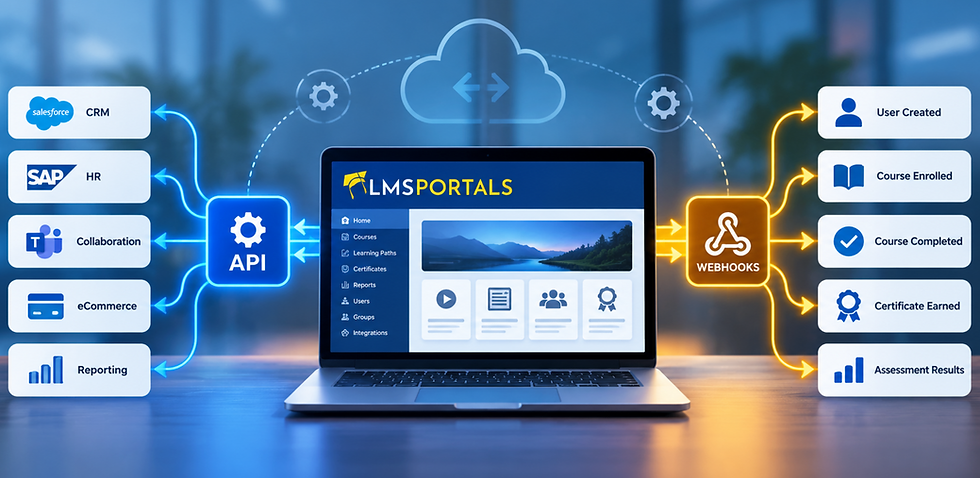
REST APIs can allow organizations to programmatically exchange information with an LMS.
Instead of manually updating the same information across several systems, organizations can build automated workflows that synchronize relevant data.
This becomes increasingly valuable as transaction volumes grow.
Webhooks Can Support Event-Driven Workflows
APIs are often used to request information from another system. Webhooks can complement APIs by notifying external systems when specific events occur.
For example, an organization could potentially use event-driven integrations to trigger downstream processes when a learner completes a course or reaches another defined training milestone.
Automation allows processes to scale without requiring administrative effort to increase at the same rate as user volume.
How Does LMS Performance Affect the Learner Experience?
Scalability ultimately matters because learners expect the LMS to work consistently.
They generally should not need to know whether the platform serves 500 users or 50,000.
Pages should load reliably. Courses should launch properly. Progress should be saved. Assessments should function correctly. Certificates should be generated when appropriate.
Performance problems can quickly reduce learner confidence and create additional support requirements.
For organizations delivering training to customers or partners, LMS performance can also affect perceptions of the organization's brand.
What Should Organizations Look for in a Scalable LMS?
Organizations evaluating LMS scalability should look beyond advertised user limits.
Important questions include how the platform handles infrastructure growth, concurrent usage, user segmentation, multiple learning audiences, course sharing, reporting, integrations, and delegated administration.
It is also important to consider what happens when the organization's training model changes.
Can additional portals be created?
Can courses be shared across them?
Can administrators be assigned to specific environments?
Can integrations automate repetitive processes?
Can reporting provide both centralized and localized visibility?
These architectural questions often become more important than individual features as LMS adoption expands.
How LMS Portals Supports Scalable Training Environments
LMS Portals is designed around a multi-tenant architecture that helps organizations expand training across multiple audiences while maintaining centralized management.
Rather than forcing every learner into one large environment, organizations can deploy branded portals for different customers, departments, partners, business units, or other audiences.
Multi-Tenant Architecture
LMS Portals enables organizations to create and manage multiple training portals from a centralized platform.
Each portal can serve a distinct audience while maintaining separation of users and training activities. This model can be particularly valuable for training providers, extended-enterprise programs, associations, franchises, and organizations serving multiple internal or external populations.
Centralized Course Library
Organizations can maintain courses centrally and make them available across multiple portals.
This reduces unnecessary course duplication and makes it easier to maintain consistent training programs as the number of learning environments grows.
LMS Portals supports standards such as SCORM and xAPI while also providing capabilities for building and managing non-SCORM learning experiences.
Portal and Group Management
Portal-level and group-level organization gives administrators multiple ways to structure growing learner populations.
Organizations can create separate environments for major audiences and then use groups within those environments to further organize users.
This layered structure helps administrative processes remain manageable as training programs expand.
Integration Capabilities
LMS Portals provides REST API capabilities that can support integration with external business systems and automated workflows.
Integration becomes increasingly important as organizations scale because it reduces duplicate data entry and allows the LMS to participate in broader business processes.
Compliance Management and Reporting
For organizations delivering mandatory training, LMS Portals provides compliance-management capabilities that help administrators monitor training requirements and identify potential areas of risk.
This can be especially useful when administrators are responsible for large learner populations distributed across multiple portals.
Branded Training Environments
Scaling does not necessarily mean sacrificing customization.
LMS Portals allows organizations to create branded learning environments for different audiences. Training providers and extended-enterprise organizations can therefore expand to new clients or partners while delivering learning experiences tailored to each audience.
Support for B2B and B2C Training Models
Scalable LMS strategies increasingly extend beyond internal employee training.
Organizations may want to deliver customer education, partner enablement, certification programs, professional development, or commercial training.
LMS Portals supports both B2B and B2C training models, giving organizations flexibility to expand how their learning programs are delivered and monetized.
Building an LMS Strategy for Long-Term Growth
Organizations should not evaluate LMS scalability solely by asking, “How many users can the system support?”
The more important question is:
“How efficiently can we manage our learning environment as the number of users, audiences, courses, administrators, and business requirements grows?”
A technically scalable platform provides the infrastructure necessary to support increasing activity. An operationally scalable platform provides the architecture and administrative tools necessary to manage that growth efficiently.
Features such as multi-tenant architecture, centralized course management, groups, delegated administration, APIs, integrations, automated workflows, and scalable reporting can help prevent training operations from becoming increasingly difficult as adoption expands.
For organizations expecting significant growth—or those already managing training across multiple customers, partners, departments, or business units—these capabilities should be considered early in the LMS selection process.
LMS Portals provides a multi-tenant SaaS LMS designed to help organizations build, manage, and expand training programs across multiple audiences from a centralized platform.
By combining independent branded portals with centralized course management, user administration, integrations, compliance capabilities, and reporting, LMS Portals gives organizations an architecture designed to support training growth without requiring a separate LMS deployment for every new audience.
About LMS Portals
LMS Portals provides a flexible, SaaS-based multi-tenant learning management system for delivering training to employees, customers, partners, clients, and other learning audiences.
Our multi-portal architecture enables organizations to launch dedicated, branded learning environments while centrally managing users, courses, compliance, reporting, and administration.
The platform includes tools for creating and delivering SCORM-compliant courses, a library of ready-made training courses, and Learning Paths for building structured training programs. LMS Portals also supports virtual instructor-led training, certification programs, automation, reporting, and social learning.
Together, these capabilities make LMS Portals a scalable solution for organizations managing training across multiple audiences.
Contact us today to get started or visit our Partner Program pages


Comments