
How Can an LMS Manage Annual Compliance Training?


Annual compliance training is a recurring responsibility for organizations across many industries. Employees may need to complete training on workplace safety, cybersecurity, data privacy, harassment prevention, ethics, regulatory requirements, or organization-specific policies every year.
The challenge is rarely just delivering the course.
Organizations also need to determine who must complete the training, assign it at the appropriate time, communicate deadlines, monitor progress, document completion, identify overdue learners, and maintain historical records that may be needed months or years later.
When these processes are managed manually, annual compliance training can create a significant administrative burden.
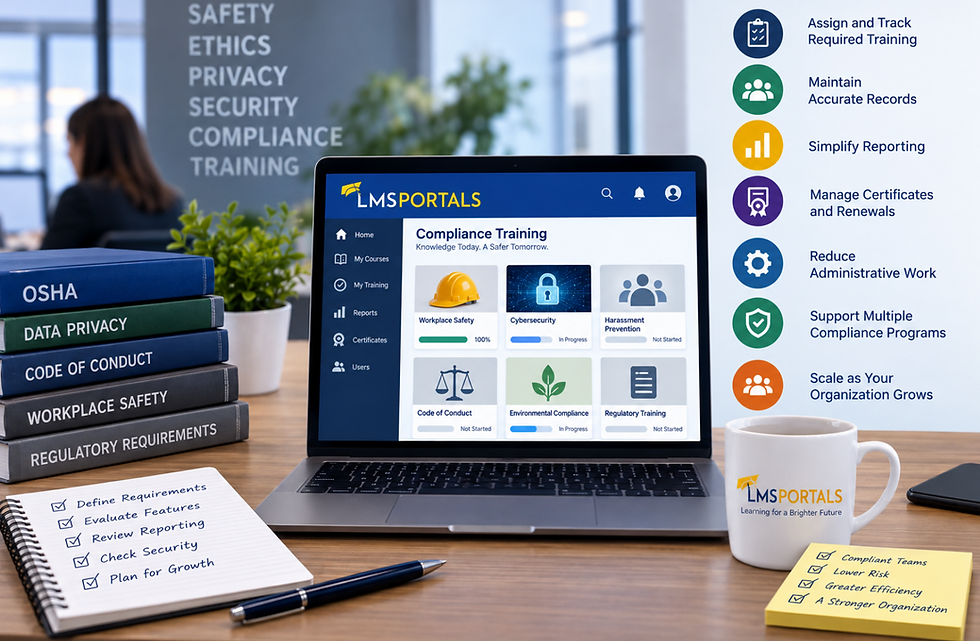
A learning management system (LMS) provides a centralized environment for managing the entire compliance training cycle. Instead of rebuilding the process every year, organizations can establish repeatable workflows for assigning, tracking, documenting, and reporting on recurring training.
For organizations managing multiple departments, locations, clients, or other training audiences, a multi-portal LMS can extend this approach by providing separate learning environments while maintaining centralized oversight.
Why Is Annual Compliance Training Difficult to Manage?
Annual training sounds straightforward: assign a course once a year and make sure everyone completes it.
In practice, compliance programs often involve considerably more complexity.
Training Requirements Can Apply to Different Groups
Not every employee necessarily requires the same training.
Requirements might depend on job role, department, location, seniority, regulatory jurisdiction, access to particular systems, or other factors.
A healthcare organization, for example, may have training that applies to all employees alongside specialized requirements for clinical staff. A manufacturer might require different safety courses for employees working with particular equipment.
The organization therefore needs a reliable way to determine who needs which training and when.
The Learner Population Is Constantly Changing
Annual compliance programs are not static.
Employees join the organization throughout the year. Others leave. People change departments, locations, or job responsibilities.
An effective compliance training process must account for these changes rather than relying on a learner list created once per year.
Administrators Need Reliable Training Records
Knowing that a course was made available is not the same as knowing that it was completed.
Organizations may need records showing which learner completed which course, when the training was completed, whether an assessment was passed, and whether a certificate or other documentation was issued.
These records can become especially important when organizations face internal reviews, customer requirements, regulatory inquiries, or audits.
What Role Does an LMS Play in Compliance Training?
An LMS creates a structured environment for managing training rather than treating individual courses as isolated events.
The platform can bring learners, courses, assignments, communications, completion records, and reporting together within one system.
Centralize Compliance Courses
An LMS provides a central repository for the training programs an organization needs to deliver.
These might include courses addressing:
Workplace safety
Information security
Data privacy
Code of conduct
Ethics
Anti-harassment policies
Industry regulations
Organizational policies
Health and safety procedures
Role-specific compliance requirements
Centralization can make it easier for administrators to maintain the current version of required training and determine which learners should receive it.
Maintain Individual Learner Records
Each learner can have a training history showing assigned and completed learning activities.
Instead of maintaining separate spreadsheets, email confirmations, and departmental records, organizations can use the LMS as a central location for training information.
That becomes increasingly valuable when compliance training repeats year after year.
How Can an LMS Automate Annual Training Assignments?
One of the most useful capabilities of an LMS for recurring compliance training is automation.
Without automation, administrators may need to recreate assignments and manually enroll hundreds or thousands of learners every year.
Assign Training Based on Learner Criteria
Organizations can structure learners according to factors such as departments, roles, locations, groups, or other organizational categories.
Training can then be directed to the appropriate audiences.
For example, all employees might receive an annual cybersecurity course, while managers receive an additional leadership compliance program and employees in a particular facility receive location-specific safety training.
This makes the training process more targeted and reduces unnecessary assignments.
Create Repeatable Training Cycles
Annual training is inherently recurring.
Rather than treating each year's program as an entirely new initiative, organizations can establish a repeatable process.
The LMS can provide the infrastructure for managing recurring assignments, due dates, completion requirements, and subsequent training cycles.
The specific automation available depends on the LMS and its configuration, but the objective is the same: reduce the amount of repetitive administrative work required each year.
How Can an LMS Track Compliance Training Completion?
Tracking is one of the primary reasons organizations use an LMS for compliance programs.
Administrators need more than a list of people who were assigned training. They need visibility into what happened afterward.
Monitor Training Status
An LMS can provide information about learner progress.
Depending on the training activity, administrators may be able to distinguish between learners who have not started, are in progress, or have completed their assigned training.
This gives administrators a clearer picture of the compliance program while it is underway.
Instead of waiting until the deadline to discover that large numbers of employees have not completed training, administrators can monitor progress throughout the training period.
Capture Course Completion
When a learner satisfies the requirements of a course, the LMS can record the completion.
For eLearning content, completion might be determined by viewing required material, reaching a defined point in a course, completing an assessment, or satisfying another configured requirement.
The completion record can then become part of the learner's training history.
Record Assessment Results
Many compliance courses include assessments designed to verify understanding.
When supported by the course and LMS, assessment scores can be associated with learner records.
Organizations can establish passing requirements and use those results as another component of compliance documentation.
How Can an LMS Help Manage Compliance Training Deadlines?
A major challenge with annual training is getting everyone to complete it on time.
Employees have competing responsibilities, and compliance training may not remain at the top of their priorities without communication and follow-up.
Establish Due Dates
Administrators can associate training requirements with specific deadlines.
This gives learners a defined completion window and allows administrators to evaluate progress relative to the required date.
Communicate With Learners
An LMS can support communication surrounding training assignments.
Learners can be informed about required courses and deadlines, while reminder processes can encourage completion as deadlines approach.
This reduces the need for administrators to manually contact individual learners repeatedly.
Identify Overdue Training
Once a deadline has passed, administrators need to know who remains incomplete.
Centralized LMS reporting can make it easier to identify outstanding training and determine where follow-up is required.
For organizations with large learner populations, this can save considerable administrative time compared with manually reconciling spreadsheets and email records.
Why Are Historical Training Records Important?
Annual compliance training does not end when the year's course is completed.
Organizations frequently need to retain records demonstrating what occurred in previous years.
Training Histories Provide Continuity
Suppose an employee has worked for an organization for six years and completed cybersecurity training every year.
A training history can provide a chronological record of those activities rather than showing only the employee's most recent course.
This can help organizations demonstrate that training requirements were consistently addressed over time.
Records Can Support Audit Readiness
Training records are often an important component of audit readiness.
An auditor, customer, regulator, or internal compliance team may ask questions such as:
Who was required to complete the training?
Which version of the training was delivered?
When did each employee complete it?
Were required assessments passed?
Who was overdue?
An LMS can help organizations maintain structured records that make these questions easier to answer.
An LMS does not itself guarantee regulatory compliance, but it can provide the training documentation and administrative controls that support an organization's broader compliance processes.
How Can Certificates Support Annual Compliance Training?
Some organizations use certificates to provide additional documentation of course completion.
A certificate can identify the learner, training program, completion date, and other relevant information.
Certificates Provide Learners With Completion Documentation
Employees may need evidence that they completed a particular training requirement.
This can be especially valuable for professional development, safety programs, certifications, and training that may need to be documented outside the immediate LMS environment.
Expiration Can Help Support Recertification
Certain training requirements expire after a defined period.
Rather than thinking about training as permanently complete, organizations can treat it as a recurring qualification.
A learner completes the training, remains current for the required period, and then must complete the appropriate training again.
This model can be useful for annual compliance requirements as well as other certification and recertification programs.
Can an LMS Manage Different Compliance Requirements Across Locations?
Organizations operating across multiple locations may have additional complexity.
Some training requirements apply company-wide, while others vary by state, country, facility, business unit, or job function.
Combine Organization-Wide and Local Training
An organization might establish a core compliance curriculum for everyone.
Individual locations could then receive additional training appropriate to their regulatory or operational requirements.
For example, employees throughout an organization might receive common information-security training while workers at individual facilities receive safety training specific to their environment.
The LMS can provide a structure for combining these requirements without creating an entirely separate training system for each audience.
How Can a Multi-Portal LMS Support Compliance Training?
For organizations managing several distinct training populations, a conventional single-audience LMS may eventually become difficult to administer.
A multi-portal LMS provides another approach.
Create Separate Training Environments
Individual portals can be created for different business units, locations, customers, partners, franchises, departments, or other audiences.
Each portal can provide a defined learning environment for its users.
This can be especially useful when organizations need separation between learner populations while still managing the overall compliance program centrally.
Delegate Compliance Administration
Not every training activity needs to be managed by the central learning team.
Local administrators can potentially manage learners, assignments, communications, and reporting within their own portal.
This allows responsibility to be distributed without necessarily giving every administrator access to the entire training environment.
Maintain Central Oversight
Distributed administration does not have to mean fragmented management.
The organization can maintain centralized control over the broader training strategy while allowing individual portals to handle appropriate local responsibilities.
This balance can be valuable for organizations that need both consistency and flexibility.
How Does LMS Portals Support Annual Compliance Training?
LMS Portals provides a centralized learning management platform designed to support organizations managing training across one or many audiences.
Its combination of LMS functionality and multi-portal architecture makes it well suited to organizations that need to organize, deliver, and document recurring training programs.
Centralize Compliance Training Management
Organizations can use LMS Portals to bring courses, learners, training activities, and records into a centralized learning environment.
This reduces dependence on disconnected spreadsheets, email processes, and manually maintained training documentation.
Administrators gain a more structured approach to managing recurring training requirements.
Deliver Online Compliance Courses
LMS Portals supports online course delivery, including SCORM-based eLearning.
Organizations can use interactive courses for subjects such as safety, cybersecurity, privacy, ethics, workplace policies, and other compliance-related topics.
Combining course delivery with learner management allows the organization to connect training activity with individual records.
Organize Learners and Training Requirements
Compliance programs often involve different requirements for different audiences.
LMS Portals provides tools for organizing learners and structuring training so administrators can manage programs more efficiently.
Rather than treating every learner identically, organizations can create training experiences appropriate to their organizational structure.
Maintain Training Records and Reporting
LMS Portals helps organizations maintain visibility into training activity and completion.
Centralized reporting can help administrators monitor participation, identify outstanding requirements, and maintain records of completed training.
This provides an important foundation for compliance reporting and audit preparation.
Support Certificates and Structured Learning Programs
Compliance training may involve more than a single course.
Organizations can build structured learning programs that combine courses and other learning activities, while certificates can provide additional documentation of successful completion where appropriate.
These capabilities allow organizations to build more comprehensive compliance programs rather than managing each training activity independently.
Create Separate Compliance Training Portals
The multi-portal architecture of LMS Portals provides an additional advantage for organizations managing multiple training populations.
Separate portals can be created for locations, departments, clients, customers, partners, franchises, or other groups.
This can provide clearer separation of learners and training activity while allowing the organization to manage the overall learning ecosystem through a centralized platform.
Support Training Providers Managing Multiple Clients
The same architecture can benefit companies that provide compliance training as a service.
A training provider might need to deliver similar compliance courses to dozens or hundreds of client organizations.
Instead of operating an entirely separate LMS for each customer, the provider can create individual client portals while managing courses and the broader training operation centrally.
This creates opportunities to scale compliance training services without scaling administration at the same rate.
What Should Organizations Look for in a Compliance Training LMS?
Choosing an LMS for annual compliance training should involve more than determining whether the platform can host courses.
Organizations should evaluate how effectively the platform supports the complete recurring training cycle.
Look Beyond Course Delivery
Important capabilities can include learner management, course assignments, due dates, communications, completion tracking, assessments, certificates, training histories, reporting, and administrative permissions.
Organizations should also consider whether the platform can accommodate changes in their learner population throughout the year.
Consider Reporting and Audit Requirements
Before selecting an LMS, organizations should determine what information they may need to retrieve later.
The reporting requirements of the compliance, HR, safety, or regulatory teams can help define what the LMS needs to capture.
It is much easier to establish appropriate data and reporting processes before an audit than to reconstruct historical information afterward.
Plan for Multiple Training Audiences
Organizations should also consider how their compliance programs might evolve.
Training that initially applies only to employees could eventually expand to contractors, suppliers, partners, franchisees, customers, or other external audiences.
An LMS architecture capable of supporting multiple training populations can provide greater flexibility as those requirements grow.
Building a Repeatable Annual Compliance Training Process
The greatest advantage of using an LMS for annual compliance training may be its ability to transform a recurring administrative burden into a structured, repeatable process.
Rather than rebuilding learner lists, assignments, communications, tracking spreadsheets, and completion records every year, organizations can establish a centralized framework for managing the training lifecycle.
Learners receive the appropriate training. Administrators can monitor progress.
Completion information becomes part of the training record. Reports provide visibility into outstanding requirements. Historical information remains available when documentation is needed.
For organizations managing training across multiple locations, departments, customers, or other audiences, LMS Portals extends this model through its multi-portal architecture.
Organizations can centralize compliance training management while providing separate learning environments for different groups, distributing administrative responsibility, maintaining training records, and supporting the reporting needed for ongoing compliance and audit readiness.
The result is not simply a better way to deliver an annual course. It is a more scalable way to manage the entire recurring compliance training process.
About LMS Portals
LMS Portals provides a flexible, SaaS-based multi-tenant learning management system for delivering training to employees, customers, partners, clients, and other learning audiences.
Our multi-portal architecture enables organizations to launch dedicated, branded learning environments while centrally managing users, courses, compliance, reporting, and administration.
The platform includes tools for creating and delivering SCORM-compliant courses, a library of ready-made training courses, and Learning Paths for building structured training programs. LMS Portals also supports virtual instructor-led training, certification programs, automation, reporting, and social learning.
Together, these capabilities make LMS Portals a scalable solution for organizations managing training across multiple audiences.
Contact us today to get started or visit our Partner Program pages


Comments