
Compliance Training for Public Sector Organizations


Public sector organizations operate under some of the highest standards of accountability. Every day, government agencies, municipalities, school districts, public healthcare organizations, transportation authorities, and other public institutions make decisions that directly affect the communities they serve. Ensuring employees understand their legal responsibilities, organizational policies, and ethical obligations is essential to maintaining public trust.
Compliance training is one of the most effective ways to reduce organizational risk while building a knowledgeable and accountable workforce. But delivering consistent training across multiple departments, locations, and employee groups can be challenging without the right technology.
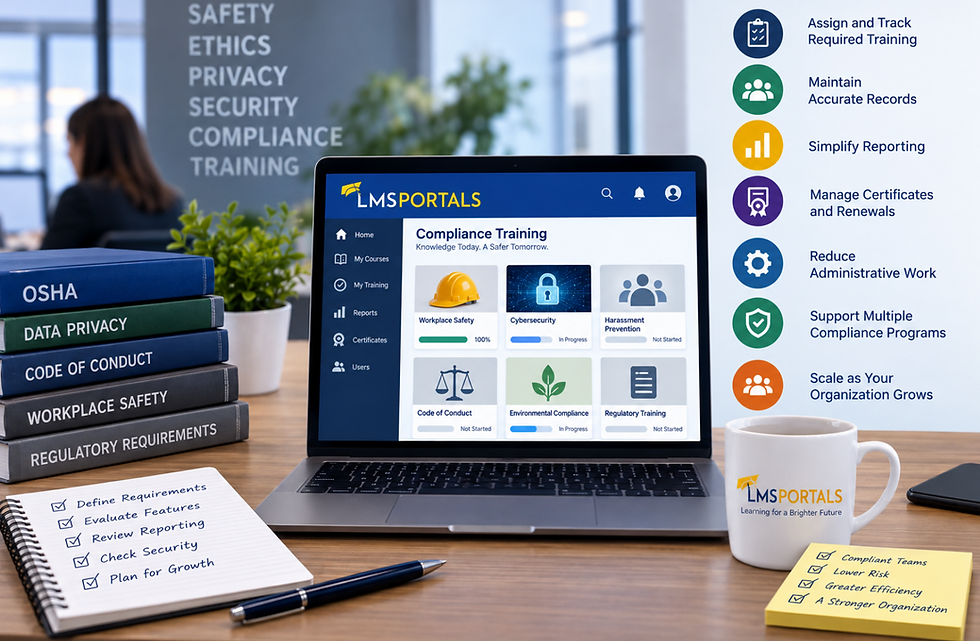
A modern Learning Management System (LMS) helps public organizations streamline compliance training, automate recordkeeping, and ensure employees remain current on evolving regulations.
Why Compliance Training Matters
Compliance training is about much more than satisfying regulatory requirements. It helps organizations create consistent standards, reduce workplace incidents, and ensure employees understand how to perform their jobs responsibly.
When employees receive timely and relevant compliance training, organizations are better positioned to avoid legal disputes, improve workplace safety, protect sensitive information, and demonstrate due diligence during audits or investigations.
Just as importantly, ongoing training reinforces a culture of professionalism and accountability that benefits both employees and the public.
Public Trust Depends on Well-Trained Employees
Every interaction between a public employee and a citizen reflects on the organization as a whole. Whether processing permits, responding to emergencies, managing financial records, or providing healthcare services, employees must understand both organizational policies and applicable laws.
Even small compliance failures can have significant consequences. A missed cybersecurity procedure, an improperly handled public record, or a workplace safety violation can create legal exposure, financial costs, and damage public confidence.
Regular training helps employees make better decisions while reducing preventable mistakes.
Common Compliance Training Topics
Although every organization has unique requirements, most public sector compliance programs cover several core subject areas.
Ethics and Code of Conduct
Government employees are expected to uphold high ethical standards in every aspect of their work. Ethics training helps employees understand conflicts of interest, responsible use of public resources, transparency requirements, and professional conduct expectations.
These programs reinforce integrity while helping organizations maintain public confidence.
Cybersecurity Awareness
Cybersecurity has become one of the fastest-growing compliance priorities for government organizations.
Employees need to recognize phishing attacks, protect passwords, safeguard confidential information, and understand their role in preventing data breaches. Because human error remains one of the leading causes of cybersecurity incidents, regular awareness training has become essential.
Privacy and Data Protection
Public organizations routinely manage sensitive information involving citizens, students, patients, employees, and financial records.
Compliance training helps employees understand how information should be collected, stored, shared, and protected while meeting applicable privacy regulations.
Workplace Harassment Prevention
Creating respectful workplaces is critical throughout the public sector.
Harassment prevention training helps employees recognize inappropriate behavior, understand reporting procedures, and support inclusive workplace cultures. Managers often require additional training to understand their responsibilities for addressing complaints and maintaining safe work environments.
Workplace Safety
Many public organizations also require recurring safety training covering emergency procedures, hazard awareness, incident reporting, and job-specific safety practices.
Keeping safety knowledge current helps reduce injuries while improving organizational preparedness.
The Challenges of Managing Compliance Training
Compliance training becomes increasingly difficult as organizations grow.
Multiple Departments Mean Multiple Requirements
A single municipality may include Public Works, Police, Fire, Human Resources, Utilities, Finance, Parks and Recreation, and Information Technology.
While many compliance requirements apply across the organization, each department also requires specialized training. Managing these unique learning paths manually quickly becomes complicated.
Employees Work Everywhere
Unlike traditional office environments, many public employees spend much of their day in the field.
Maintenance crews, inspectors, transportation personnel, utility workers, emergency responders, and remote employees all require convenient access to training regardless of location or work schedule.
An LMS allows employees to complete required learning whenever and wherever it is most convenient.
Regulations Continue to Change
Compliance requirements rarely remain static.
Organizations must continually update policies, revise training materials, and ensure employees receive the latest information. Without centralized course management, keeping content current becomes both expensive and time consuming.
Reporting Cannot Be an Afterthought
Public organizations are frequently asked to demonstrate compliance during audits, grant reviews, accreditation processes, or legal proceedings.
Finding completion records should take minutes—not days.
Automated reporting provides immediate access to training histories, certificates, assessment results, and learner progress whenever documentation is required.
Moving Beyond Annual Training
The most effective compliance programs no longer rely solely on annual training events.
Continuous Learning Improves Retention
Employees retain information more effectively when training is delivered in shorter, more frequent learning experiences.
Rather than completing several hours of training once each year, organizations are increasingly providing ongoing education that reinforces important concepts throughout the year.
This approach also allows organizations to respond more quickly when regulations change.
Learning Paths Keep Employees Organized
Many compliance programs require employees to complete multiple related courses.
Learning paths organize those courses into logical sequences, making it easier for employees to understand what training is required while helping administrators monitor progress.
This structure is particularly valuable for onboarding, annual compliance requirements, and leadership development programs.
Why Multi-Portal Learning Makes Sense
Large public organizations often consist of multiple departments, agencies, or regional offices.
Although each group shares organization-wide policies, they frequently require different training catalogs, administrators, and reporting.
A multi-portal learning environment allows each department to have its own branded learning portal while maintaining centralized oversight.
Employees see only the training that applies to their responsibilities, creating a cleaner and more focused learning experience.
Meanwhile, administrators retain visibility across the entire organization from a single management interface.
How LMS Portals Simplifies Compliance Training
LMS Portals was built specifically for organizations that need to manage multiple learning environments from one centralized platform.
Independent Branded Learning Portals
Each department, agency, or regional office can have its own branded portal with customized courses, administrators, branding, and reporting.
This creates a more personalized experience while maintaining consistent organizational standards.
Unlimited Learners
Unlike platforms that charge per user, LMS Portals includes unlimited learners.
This allows organizations to add employees, contractors, seasonal workers, volunteers, and new hires without worrying about increasing licensing costs or unpredictable budgets.
Flexible Course Delivery
Compliance training comes in many formats.
LMS Portals supports interactive eLearning, SCORM courses, videos, quizzes, assessments, documents, instructor-led training, and structured learning paths, allowing organizations to build comprehensive learning programs within one platform.
Centralized Administration
Managing compliance should not require multiple disconnected systems.
Administrators can assign training, enroll users, monitor progress, generate reports, and manage multiple portals through one centralized dashboard, significantly reducing administrative effort.
Automated Reporting
Every course completion, assessment score, certificate, and learner activity is automatically tracked.
When audits occur, organizations can quickly produce accurate documentation without manually compiling records from multiple sources.
Preparing for the Future
Compliance training continues to evolve alongside technology.
Artificial intelligence, interactive learning experiences, personalized recommendations, and mobile learning are making compliance education more engaging while improving knowledge retention.
Organizations that invest in scalable learning platforms today will be better equipped to respond to future regulatory changes while expanding beyond compliance into onboarding, leadership development, continuing education, and workforce development.
Summary
Effective compliance training protects both public organizations and the communities they serve. It helps employees make informed decisions, reduces organizational risk, strengthens accountability, and demonstrates a commitment to excellence.
As compliance requirements become more complex, organizations need learning technology that simplifies administration while providing the flexibility to support multiple departments and evolving training needs.
LMS Portals delivers that flexibility through branded learning portals, unlimited learners, centralized administration, automated reporting, and support for virtually every type of training content. The result is a modern compliance training solution that helps public sector organizations spend less time managing training and more time serving the public.
About LMS Portals
At LMS Portals, we provide our clients and partners with a mobile-responsive, SaaS-based, multi-tenant learning management system that allows you to launch a dedicated training environment (a portal) for each of your unique audiences.
The system includes built-in, SCORM-compliant rapid course development software that provides a drag and drop engine to enable most anyone to build engaging courses quickly and easily.
We also offer a complete library of ready-made courses, covering most every aspect of corporate training and employee development.
If you choose to, you can create Learning Paths to deliver courses in a logical progression and add structure to your training program. The system also supports Virtual Instructor-Led Training (VILT) and provides tools for social learning.
Together, these features make LMS Portals the ideal SaaS-based eLearning platform for our clients and our Reseller partners.
Contact us today to get started or visit our Partner Program pages


Comments